PDF(5665 KB)

The exploration direction of the Cretaceous pre-salt lacustrine carbonate rocks in the Kwanza Basin, Western Africa
LIU Jingjing, GUO Rongtao, HUO Hong, GONG Yue, JI Shengzhen
Marine Origin Petroleum Geology ›› 2025, Vol. 30 ›› Issue (5) : 425-434.
PDF(5665 KB)
PDF(5665 KB)
The exploration direction of the Cretaceous pre-salt lacustrine carbonate rocks in the Kwanza Basin, Western Africa
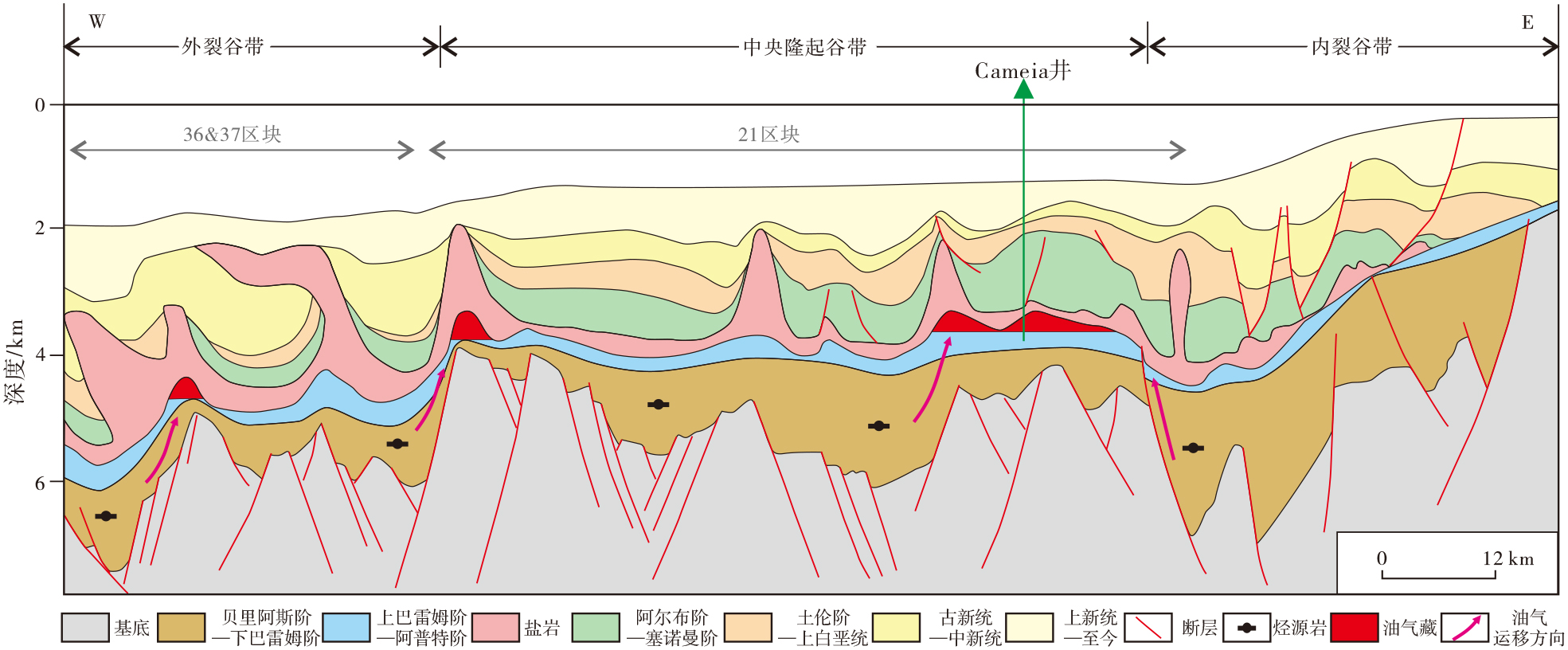
Kwanza Basin, located in Angola and its adjacent offshore area along the West African coast, is a typical passive continental margin salt-bearing basin. It comprises three major structural layers: pre-salt structural layer, salt structural layer, and suprasalt structural layer. The pre-salt Cretaceous lacustrine carbonate rocks represent the primary target for hydrocarbon exploration in the basin. The pre-salt structural layer exhibits a tectonic pattern of alternating depressions and uplifts, which can be divided into the Inner Rift Zone, Central Uplift Zone, and Outer Rift Zone from east to west. The hydrocarbon accumulation mechanism in pre-salt lacustrine carbonate rocks is characterized by "rift-controlled source rocks, uplift-controlled reservoirs, salt-controlled seals, and high-quality reservoirs controlling accumulation". The Central Uplift Zone, with well-developed basement uplifts, not only facilitates trap formation and carbonate reservoir development but also serves as the migration pathway for hydrocarbons, making it the most favorable area for pre-salt Cretaceous carbonate reservoir accumulation. The presence of high-quality reservoirs is critical for successful exploration. Based on newly acquired seismic and drilling data, this study investigates the factors influencing the differential distribution of pre-salt lacustrine carbonate reservoirs. The analysis further narrows down the prospective exploration areas for subsalt hydrocarbon plays in the Kwanza Basin to the northern part of the Central Uplift Zone, providing guidance for regional evaluation and exploration target selection.
lacustrine carbonate rocks / pre-salt / hydrocarbon accumulation model / Central Uplift Zone / Kwanza Basin
| [1] |
霍红, 熊利平, 张克鑫. 宽扎盆地油气地质特征及成藏主控因素[J]. 内蒙古石油化工, 2008, 34(24): 175-179.
|
| [2] |
赫鹏飞. 宽扎盆地油气地质特征[J]. 海洋地质前沿, 2014, 30(5): 27-31.
|
| [3] |
窦立荣, 温志新, 王兆明, 等. 桑托斯盆地盐下孤立碳酸盐台地沉积建造与深水大油田[J]. 石油勘探与开发, 2024, 51(4): 829-840.
针对桑托斯被动陆缘盆地深水盐下碳酸盐岩储层分布特征及大油田成藏规律不清的难题,综合利用地质、地震及岩心等数据资料,通过早白垩世原型盆地与岩相古地理恢复重建,提出盐下碳酸盐岩沉积建造受控于坳间断隆型和坳中断凸型两类孤立台地。坳间断隆型孤立台地分布于现今盐下坳间隆起带上,建造于早期陆内和陆间裂谷两个原型阶段继承性发育的单断式和双断式垒式断块上,早白垩世陆内裂谷晚期沉积的ITP组介壳灰岩和陆间裂谷早期沉积的BVE组微生物灰岩为连续建造;坳中断凸型孤立台地分布于现今盐下坳陷带中,建造于早期陆内裂谷原型阶段火山岩建隆所形成的凸起带上,发育BVE组微生物灰岩。两类孤立台地灰岩所形成礁滩体均具有储层厚度大、物性好的特点。结合盐下已发现大油田解剖,发现两类台地均可形成大型构造-岩性复合圈闭,周缘为优质湖相和潟湖相烃源岩环绕,上覆为巨厚的优质蒸发盐岩盖层高效封堵,形成了“下生中储上盖”式最佳生储盖组合关系,油气富集程度高。已发现大油田均为具有统一压力系统的底水块状油田,且均处于充满状态。未来勘探重点目标是西部隆起带和东部隆起带南段上的坳间断隆型孤立台地及中央坳陷带中的坳中断凸型孤立台地。该项研究成果为在桑托斯被动陆缘盆地超前选区选带、新项目评价及中标区块探区勘探部署提供了重要依据,也为今后在全球被动大陆边缘盆地深水勘探战略选区提供借鉴。
|
| [4] |
何文渊, 史卜庆, 范国章, 等. 巴西桑托斯盆地深水大油田勘探实践与理论技术进展[J]. 石油勘探与开发, 2023, 50(2): 227-237.
分析研究巴西桑托斯盆地油气勘探历程及勘探实践成果,利用地震、重磁、钻井等资料,系统研究总结了巴西桑托斯盆地油气富集规律理论认识和勘探关键技术进展。提出盆地“两隆三坳”构造格局及阿—乌隆起带控藏的认识,认为裂谷期主烃源灶控制油气富集区带、古构造控制湖相碳酸盐岩储集层规模和质量、连续厚层盐岩控制油气聚集与保存,揭示了CO<sub>2</sub>充注改造油气藏过程和机理。研发了层控、相控盐下构造变速成图、湖相碳酸盐岩储集层预测、侵入岩和喷发岩分布预测、湖相碳酸盐岩烃类检测以及超临界状态CO<sub>2</sub>流体测井识别等5项勘探关键技术。上述理论认识与技术方法为中国石油巴西深水项目超大型油田的发现和探明提供重要支撑,对桑托斯盆地及相似领域的深水大型油田勘探具有启示意义。
|
| [5] |
杨永才, 张树林, 孙玉梅, 等. 西非宽扎盆地烃源岩分布及油气成藏[J]. 海洋地质前沿, 2013, 29(3): 29-36.
|
| [6] |
S&P Global Commodity Insight. EDIN[DB/OL]. [2024-5-30]. https://energyportal.ci.spglobal.com/userHome-https://edin.ci.ihsenergy.com/portal/search.
|
| [7] |
刘亚雷, 柳永杰, 李梅, 等. 西非宽扎盆地盐下构造特征及成藏条件分析[J]. 断块油气田, 2017, 24(1): 1-4.
|
| [8] |
|
| [9] |
|
| [10] |
|
| [11] |
By applying an integrated basin modelling approach that combines quantitative kinematic and isostatic basin modelling with the principles of sequence stratigraphy the tectonic significance of the major syn- and post-rift stratigraphic packages that comprise the West African and eastern Brazilian Margins have been determined. Rifting occurred in three phases: Berriasian-Hauterivian, Hauterivian-late Barremian and late Barremian-early Aptian, with each phase being recorded by an onlap surface followed by an overall regressive package representing the subsequent infilling of the basin. Each rift phase resulted in the formation of deep, anoxic, lacustrine systems. The spatial partitioning of extension was responsible for the development of two major tectonic hinge zones, an inner-onshore and outer-offshore hinge zone subparallel to the margin. Seaward of the offshore hinge, individual rift basins tend to show an en-echelon arrangement. Deposition in these basins resulted in the production of thick sediment wedges. Using the modelling results from the West African Margin, together with palaeontological and stratigraphic correlations, the tectonic history of the rift basins comprising the eastern Brazilian Margin (i.e. Jequitinhonha to Sergipe-Alagoas) can be inferred. For example, the unconformities bounding the rift packages within the Camamu-Almada Basins (late Berriasian, Valanginian-Hauterivian and late Barremian-early Aptian) are identical to those on the West African Margin. Further, the rift architecture of the eastern Brazilian Margin is controlled by an onshore and an offshore hinge zone, similar to that observed on the West African Margin.
|
| [12] |
New ostracode data from the West African margin indicate that the Outer Basin Sediment Wedge (also termed the ‘pre-salt wedge’ and the ‘pre-salt sag basin’) is Neocomian to Aptian in age and is contemporaneous with syn-rift deposits developed inboard of the Atlantic hinge zone. Despite the fact that the Outer Basin Sediment Wedge is clearly a syn-rift deposit, it does not exhibit any of the diagnostic characteristics of brittle deformation, such as the existence of normal faults and the faulting and rotation of crustal blocks. Such features are common between the Atlantic and Eastern hinges for the early stages of rifting between West Africa and Brazil, which occurred as a series of extensional phases commencing in the Berriasian and culminating in the Late Aptian. To reconcile the concomitant development of fault-controlled subsidence between the hinges and across the Atlantic hinge zone and sag-basin development seaward of the Atlantic hinge zone requires that: (1) extension seaward of the Atlantic hinge is the result of strain-partitioning between a relatively non-deforming upper crust (i.e. the upper plate) and a ductile-deforming lower crust and lithospheric mantle (i.e. the lower plate) during the second and third rift phases, while (2) between the hinges, early brittle deformation (normal faulting) progresses to ductile deformation in the third rift phase. During the third rift phase, lower plate ductile deformation across the entire region generated regional subsidence both seaward of the Atlantic hinge and between the hinges with little attendant brittle deformation. This extension style produced, directly or indirectly, a sequence of crucial events across the West African margin: (1) the development of the pre-Chela unconformity as lake level dropped in the Early Aptian, exposing the prograding deltas of the Argilles Vertes Formation; (2) the regional development of the Chela unconformity and transgressive lag deposits of the Chela Formation in the Mid-Aptian; (3) the development of regionally extensive, shallow-water, restricted marine conditions across the entire margin (between West Africa and Brazil) immediately prior to evaporite precipitation; and (4) the development of significant post-rift accommodation (deposition of the Late Cretaceous, Paleogene and Neogene formations) in the same region previously characterized by minor syn-rift faulting, repeated dessication cycles (allowing the precipitation of thick evaporites) and negligible erosional truncation of earlier syn-rift units.
|
| [13] |
|
| [14] |
|
| [15] |
|
| [16] |
|
| [17] |
|
| [18] |
|
| [19] |
|
| [20] |
|
| [21] |
|
| [22] |
|
| [23] |
\n The purpose of this paper is to provide an overview of petroleum occurrence and provenance for the 1000 km West African Atlantic Margin from Cabinda to mid-Angola. Over this margin the Lower Congo Coastal and Kwanza provinces cumulatively account for reserves of\n c.\n 6 gigabarrels oil recoverable (GBOR). These are dominantly reservoired in Pinda carbonate traps of the former basin. However, with production from a range of aggradational wedge, carbonate platform and pre-salt reservoirs, a diversity in oil character presupposes complex hydrocarbon habitats charged by multiple sourcing.\n
|
| [24] |
|

/
| 〈 |
|
〉 |