PDF(7671 KB)

Controlling mechanisms of complex lithology development in a gentle slope marine-continental transitional setting: a case study of the Asmari Formation in Iraq B Oilfield
TONG Kaijun, LI Zongze, CAO Shuchun, TANG Jiawei, LIU Yilong, LIU Sibing, FAN Yunjie, FU Meiyan
Marine Origin Petroleum Geology ›› 2025, Vol. 30 ›› Issue (5) : 471-480.
PDF(7671 KB)
PDF(7671 KB)
Controlling mechanisms of complex lithology development in a gentle slope marine-continental transitional setting: a case study of the Asmari Formation in Iraq B Oilfield
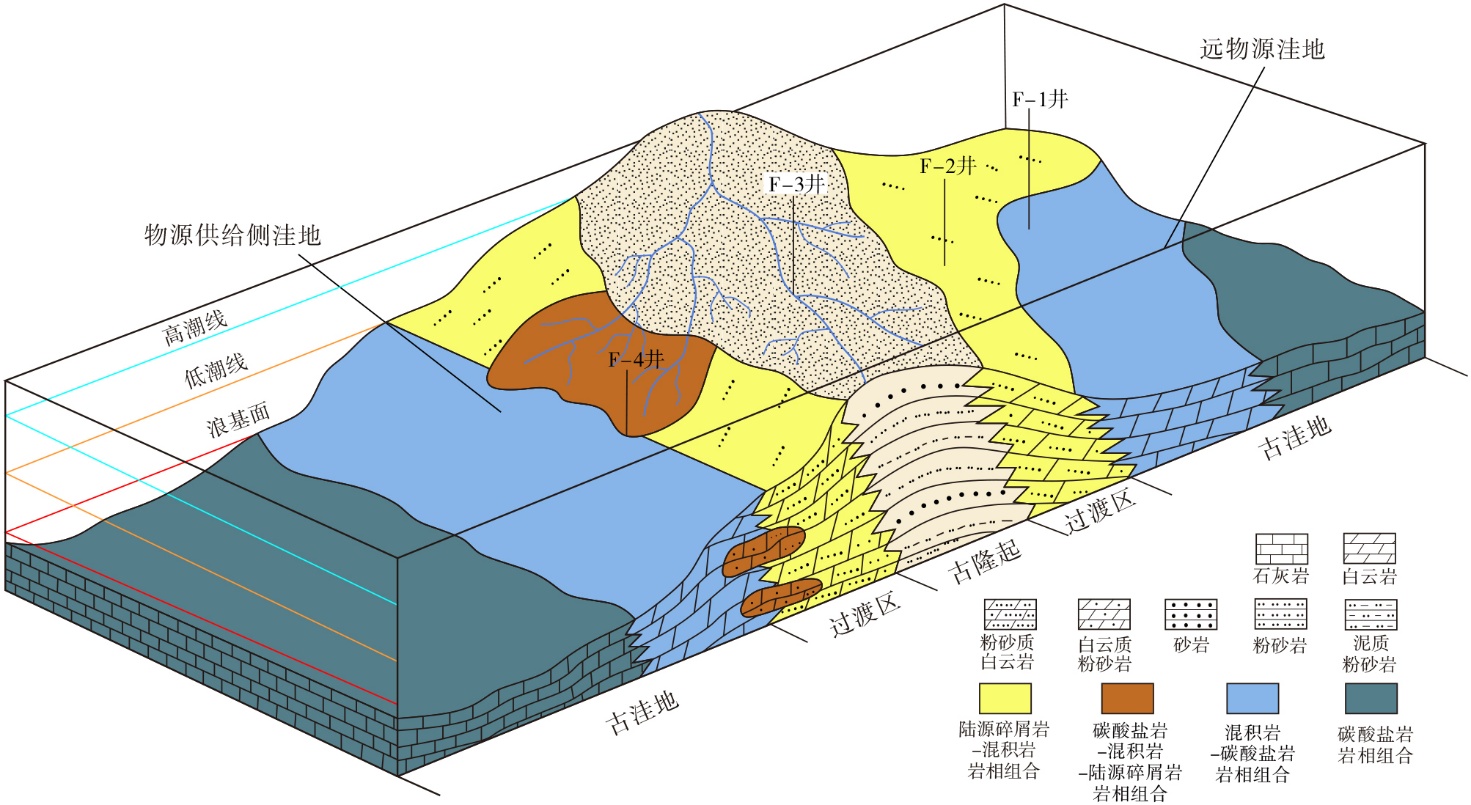
The Asmari Formation in Iraq B Oilfield was deposited in a remnant ocean basin environment formed during the closure process of the Neo-Tethys Ocean. Influenced by the intermittent uplift of the Arabian Shield from the Oligocene to Miocene, the study area developed a multi-stage terrigenous clastic supply system. Under the depositional background of a gentle slope, frequent sea-level fluctuations have led to complex mixed sedimentary characteristics of sandstone, dolomite, limestone, and mixed rocks in vertical and planar distributions, whose lithological distribution laws remain to be further clarified. This study takes Iraq B Oilfield as the research object, and systematically reveals the main controlling factors of complex lithology development under the gentle slope background through detailed core observation, thin-section microscopic analysis, and comprehensive interpretation of drilling and logging data. The research has achieved the following understandings: (1) The lithologies of the Asmari Formation can be scientifically classified into three major categories: carbonate rocks, mixed rocks, and terrigenous clastic rocks. Among them, mixed rocks are further subdivided into 8 types based on the 50% ternary classification nomenclature; seven typical lithofacies combination sequences are identified through the coupling analysis of petrological characteristics and logging responses. (2) The spatial distribution of lithofacies shows significant zonation: the northwestern and southeastern regions of the study area are dominated by carbonate facies, the proportion of clastic facies in the central part increases significantly, and the mixed rock facies account for a large proportion in the remaining transition zones. (3) The paleogeomorphology of the study area presents a gentle slope pattern of "low in the northwest and southeast parts and high in the central part". The comprehensive tectonic-sedimentary analysis shows that terrigenous clastic sediments are mainly developed in the paleo-uplift area, carbonate sediments are developed in the paleo-depression area, and mixed sediments are dominant in the transitional slope zone. Finally, a development model of complex lithology controlled by three factors of "paleogeomorphic form—sea-level fluctuation—material source supply" under the gentle slope background is established.
complex lithology / lithological development pattern / gentle slope / marine-continental transition / Asmari Formation / Iraq
| [1] |
汪洪强, 齐明明, 孙福亭. 伊拉克A油田Asmari组混积型碳酸盐岩储层隔夹层研究[J]. 石油化工应用, 2021, 40(3): 80-85.
|
| [2] |
|
| [3] |
The distribution of good reservoir quality and its causes is the main challenges in carbonate reservoir characterization. This study investigates the effects of diagenetic processes on the reservoir quality of the carbonate successions of the Asmari Formation, in the Marun oil field, southwest Iran. The study applies an integrated approach including core petrography, petrophysical rock typing, stable carbon and oxygen isotopes as well as major and trace elements analyses. Petrographic studies and geochemical analyses express that the Asmari limestones have been affected mainly by compaction, dissolution, recrystallization, calcite and anhydrite cementation and dolomitization. Among those diagenetic overprints, dolomitization and dissolution played an important role to enhance the reservoir quality of the formation. Moreover, four types of dolomites were recognized and the rate of dolomitization increases toward the top of the Asmari carbonate successions. Possible models for dolomitization include mixing zone, brine reflux, seepage reflux and tidal pumping of seawater. Employing Flow Zone Index and Discrete Rock Type concepts led to classification of the Asmari reservoir into seven reservoir rock types. Integrating reservoir rock typing with petrographic studies and geochemical analyses also confirms that reservoir quality of the Asmari Fm. would have been mainly controlled by diagenetic processes. Moreover, stable isotopes, trace elements and facies analyses support the idea that carbonate intervals of the Asmari Formation were deposited in a warm, shallow-water environment under a saline condition.
|
| [4] |
|
| [5] |
何娟, 倪军娥, 伊硕, 等. 伊拉克M油田Asmari组储层特征[J]. 石油化工应用, 2021, 40(8): 65-71, 76.
|
| [6] |
孙福亭, 何娟, 王龙, 等. 伊拉克A油田Asmari组碳酸盐岩储层裂缝特征及其对油藏开发的影响[J]. 东北石油大学学报, 2020, 44(6): 12-20.
|
| [7] |
区舫, 杨辉廷, 陈敏. 基于主成分分析的BP神经网络在Fauqi油田Asmari组地层识别岩性中的应用[J]. 中外能源, 2021, 26(7): 26-32.
|
| [8] |
陈培元. 古地貌对伊拉克米桑油田群Mishrif组储层质量的影响[J]. 中国海上油气, 2021, 33(6): 119-129.
|
| [9] |
汪洪强, 张义楷, 李志明, 等. 伊拉克A油田Asmari组碳酸盐岩相控型岩溶特征研究[J]. 中外能源, 2023, 28(11): 38-44.
|
| [10] |
伊硕, 王龙, 倪军娥, 等. 伊拉克M油田Asmari组混积储层隔夹层特征及地质意义[J]. 西安科技大学学报, 2021, 41(6): 1014-1024.
|
| [11] |
孙福亭. 伊拉克东南部A油田白云岩储层特征及控制因素[J]. 石油化工应用, 2020, 39(12): 101-107.
|
| [12] |
曹树春, 李春鹏, 饶溯. 伊拉克M油田群碳酸盐岩中混积砂体预测研究[J]. 能源与环保, 2023, 45(2): 114-120.
|
| [13] |
李晨, 陈培元, 王龙, 等. 中期旋回格架沉积演化规律及其对渗透率差异的影响: 以伊拉克M油田Asmari组A段为例[J]. 东北石油大学学报, 2019, 43(5): 11-24.
|
| [14] |
何娟, 孙立春, 倪军娥, 等. 伊拉克M油田Asmari组B段混积岩储层特征及储层非均质性对开发的影响[J]. 中国海上油气, 2018, 30(4): 127-134.
|
| [15] |
余义常, 沈博珩, 李知为, 等. 古地貌对生物碎屑灰岩沉积成岩的控制作用[J]. 地质论评, 2023, 69(增刊1): 5-8.
|
| [16] |
张雄华. 混积岩的分类和成因[J]. 地质科技情报, 2000, 19(4): 31-34.
|

/
| 〈 |
|
〉 |