PDF(8054 KB)

History of oil and gas exploration and implications from the discovery of large oil and gas fields in the Santos Basin, Brazil
FAN Guozhang, YANG Liu, WANG Hongping, WANG Chaofeng, SHAO Dali, ZUO Guoping, SONG Xu, PANG Xu, DING Liangbo, LI Lisheng, WANG Siwen
Marine Origin Petroleum Geology ›› 2025, Vol. 30 ›› Issue (6) : 537-549.
PDF(8054 KB)
PDF(8054 KB)
History of oil and gas exploration and implications from the discovery of large oil and gas fields in the Santos Basin, Brazil
After more than 50 years of exploration, the Santos Basin in Brazil has become the continental margin basin with the most deep-water oil and gas discoveries in the world to date. Based on the primary exploration objectives and the process of oil and gas discoveries, the exploration history of the Santos Basin can be divided into three stages: shallow-water clastic reservoir exploration, deep-water gravity flow sandstone exploration, and pre-salt carbonate reservoir exploration. During the deep-water pre-salt carbonate reservoir exploration phase, some large and giant oil and gas discoveries were discovered, establishing the Santos Basin as a global leader in deep-water hydrocarbon exploration. The exploration in the Santos Basin has always been accompanied by innovation in geological understanding and advances in exploration technology. Particularly in the phase of deep-water pre-salt carbonate reservoir exploration, there was a transition from focusing on giant structural traps in the core exploration areas to the peripheral and outer regions. The innovations in oil and gas geological understanding played a key role in determining the direction of exploration into ultra-deepwater frontiers. These innovations primarily include four aspects: the differential distribution of hydrocarbon source kitchens determined by the tectonic framework during the rift phase, the genesis and distribution characteristics of large-scale reservoirs, the distribution patterns of medium and large scale oil and gas fields, and the distribution characteristics of mantle-derived carbon dioxide. During the exploration of the Santos Basin, major international oil companies were actively involved in the oil and gas exploration bidding. However, they exhibited different exploration strategies, and the drilling results were, on the whole, far below expectations. This not only confirmed the basin´s rich oil and gas potential but also revealed the significant variability in hydrocarbon accumulation and reservoir formation within continental margin basins. As a typical passive continental margin basin, understanding the oil and gas accumulation patterns and key factors in the deep-water regions of the Santos Basin has significant reference value for comprehensively understanding and systematically mastering the petroleum geological characteristics of global continental marginal deep-water basins. It also provides guidance for the expansion of new frontiers in deep-water exploration and optimizing exploration planning.
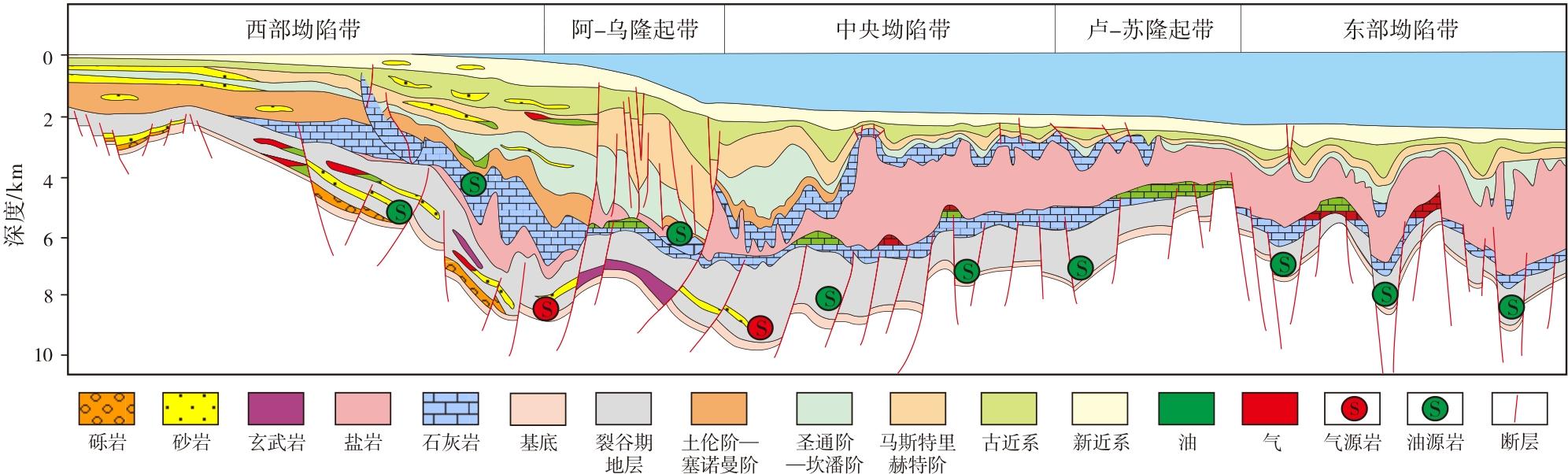
deep-water plays / history of petroleum exploration / reservoir distribution / Santos Basin / continental margin basin
| [1] |
史卜庆, 范国章, 邵大力, 等. 巴西桑托斯盆地盐下构造单元划分原则与方案刍议[J]. 海相油气地质, 2021, 26(3): 263-271.
|
| [2] |
范国章, 史卜庆, 杨柳, 等. 巴西桑托斯盆地盐下油气分布特征与富集规律[J]. 海相油气地质, 2022, 27(4): 337-347.
The Santos Basin is the richest hydrocarbon continental marginal basins in the world so far. This paper studied the discovery history and discussed the characteristics and distribution of the pre-salt oil-gas fields in the basin. According to the exploration strategy, the discovery history could be divided into three stages. The first stage is concerned with the exploration at the core of outer high (2005-2009) while the second stage at the surrounding of outer high (2009-2013). The third stage is characterized by the commercial mode of PSC given its increasing exploration risks. The hydrocarbon mainly lies under the thick salt in the deep water ocean. The discoveries are primarily oil reservoir with few gas reservoir and condensate oil reservoir. The oil reservoirs are characterized by medium-high density, high gas/oil ratio, existence of CO2 and normal / super-high pressure. The reservoir type is mainly structural reservoir whose source (lacustrine shale) - reservoir (lacustrine carbonate) - cap (continuous salt rock) developed in the rift and sag stage. The super-giant oilfields are located in the structural traps of Lula-Sugar Loaf uplift and Aram-Uirapuru uplift. The large and medium-small oilfields are located in the structural traps of secondary uplifts in western depression and central depression. From the viewpoint of basin evolution and hydrocarbon accumulation, the formation and distribution of hydrocarbon reservoirs are decided by the tectonic framework of rift stage. The hydrocarbon accumulation directions and favorable enrichment belts are decided by the tectonic activity of passive continental margin stage. There are five geological factors controlling the pre-salt hydrocarbon enrichment. The paleo-structure controls the reservoir type and quality. The current structure controls the accumulation direction. The salt rock controls the accumulation efficiency. The source kitchen controls the oil enrichment belt. The CO2 charging influences the fluid property. The study shared a comprehensive understanding about the exploration of Santos Basin and may provide some references of the exploration for other deep-water passive margin basins.
|
| [3] |
|
| [4] |
21世纪以来,随着桑托斯盆地深水盐下获得一系列重大油气发现,巴西东部海域成为全球深水油气勘探与生产的热点区域。通过全面回顾巴西油气勘探开发历程,系统阐述了从陆上到海域、从浅水到深水—超深水直至盐下勘探的探索实践、战略转变、重大突破和关键理论技术。巴西国家石油公司(简称巴西国油)自1953年成立以后的15年间,在陆上古生界克拉通盆地和断陷盆地进行了勘探,并于断块和三角洲砂体圈闭获得了一些中小型油气发现。20世纪70年代,应用重力流沉积模式和高质量三维地震等勘探新技术,在坎波斯盆地浅水中发现Namorado和Enchova等油田,随后深水盐上勘探获得突破,成功发现Marlim、Roncador等大型油田。21世纪初,通过盐下含油气系统、碳酸盐岩成储成藏模式和核磁共振测井等理论技术攻关,推动桑托斯盆地下白垩统湖相碳酸盐岩陆续获得Tupi(Lula)、Buzios、Mero等世界级超深水盐下大油田的系列重大发现。在复杂的深水作业环境下,油气开发工程面临巨大挑战,巴西国油通过启动深水研发计划(PROCAP),开发并实施窄压力窗口控压钻井、加压钻井液帽钻井、多段智能完井、水下采油及浮式生产平台开发和流动保障等关键技术,显著提升了钻完井、油气田开发和输运的效率及安全性。此外,在浮式采储卸油系统建产规模受限的情况下,推进全球最大规模的CO<sub>2</sub>捕集、驱油利用与埋存工程(CCUS-EOR),有效减少温室气体排放并提高了原油采收率。上述理论技术的发展和应用,也为全球深水油气勘探开发提供了宝贵经验。未来巴西油气勘探将继续聚焦深水盐下碳酸盐岩和盐上浊积岩,并在古生界天然气等勘探领域持续寻求新的发现,同时通过技术创新和战略合作,促进巴西石油天然气行业的可持续发展。
|
| [5] |
窦立荣, 温志新, 王兆明, 等. 桑托斯盆地盐下孤立碳酸盐台地沉积建造与深水大油田[J]. 石油勘探与开发, 2024, 51(4): 829-840.
针对桑托斯被动陆缘盆地深水盐下碳酸盐岩储层分布特征及大油田成藏规律不清的难题,综合利用地质、地震及岩心等数据资料,通过早白垩世原型盆地与岩相古地理恢复重建,提出盐下碳酸盐岩沉积建造受控于坳间断隆型和坳中断凸型两类孤立台地。坳间断隆型孤立台地分布于现今盐下坳间隆起带上,建造于早期陆内和陆间裂谷两个原型阶段继承性发育的单断式和双断式垒式断块上,早白垩世陆内裂谷晚期沉积的ITP组介壳灰岩和陆间裂谷早期沉积的BVE组微生物灰岩为连续建造;坳中断凸型孤立台地分布于现今盐下坳陷带中,建造于早期陆内裂谷原型阶段火山岩建隆所形成的凸起带上,发育BVE组微生物灰岩。两类孤立台地灰岩所形成礁滩体均具有储层厚度大、物性好的特点。结合盐下已发现大油田解剖,发现两类台地均可形成大型构造-岩性复合圈闭,周缘为优质湖相和潟湖相烃源岩环绕,上覆为巨厚的优质蒸发盐岩盖层高效封堵,形成了“下生中储上盖”式最佳生储盖组合关系,油气富集程度高。已发现大油田均为具有统一压力系统的底水块状油田,且均处于充满状态。未来勘探重点目标是西部隆起带和东部隆起带南段上的坳间断隆型孤立台地及中央坳陷带中的坳中断凸型孤立台地。该项研究成果为在桑托斯被动陆缘盆地超前选区选带、新项目评价及中标区块探区勘探部署提供了重要依据,也为今后在全球被动大陆边缘盆地深水勘探战略选区提供借鉴。
|
| [6] |
黄继新, 王红军, 徐芳, 等. 裂谷湖盆孤立台地层序分析与岩相古地理重建: 对巴西桑托斯盆地深水盐下油气勘探的启示[J]. 石油勘探与开发, 2025, 52(4): 870-884.
以巴西桑托斯盆地M区块白垩系巨厚碳酸盐岩为例,综合岩心、测井及地震资料,建立裂谷湖盆断控孤立台地层序充填模式并揭示其控滩控储机制,重建岩相古地理演化。结果表明:①M区块下白垩统Itapema(ITP)组—Barra Velha(BVE)组发育3个三级层序(SQ1—SQ3),SQ1层序沉积期裂谷基底断裂控制了两侧厚、中间薄的地层展布特征,早期地层具有向凸起超覆充填特征;SQ2—SQ3层序沉积期同沉积断层控制了“西北沉降、东北抬升”的古地貌调整,伴随相对湖平面下降。②M区块下白垩统主要为滨浅湖沉积环境,岩相古地理格局由SQ1层序“内介屑滩、外介壳滩”向SQ2—SQ3层序丘滩相间展布转变。③受相对湖平面升降、同沉积断层及火山活动的共同控制,SQ1层序介壳滩趋于在凸起区垂向加积建隆,SQ2—SQ3层序丘滩复合体因可容纳空间减小趋于向坡折带侧向迁移。④高能丘滩体早期垂向加积、后期侧向迁移的演化模式控制了优质储层展布由“中心式”向“环带式”转变。上述研究揭示了湖相断控孤立台地丘滩体发育模式及有利储集相带展布,可为桑托斯盆地深水盐下碳酸盐岩油气勘探提供支撑。
|
| [7] |
何文渊, 史卜庆, 范国章, 等. 巴西桑托斯盆地深水大油田勘探实践与理论技术进展[J]. 石油勘探与开发, 2023, 50(2): 227-237.
分析研究巴西桑托斯盆地油气勘探历程及勘探实践成果,利用地震、重磁、钻井等资料,系统研究总结了巴西桑托斯盆地油气富集规律理论认识和勘探关键技术进展。提出盆地“两隆三坳”构造格局及阿—乌隆起带控藏的认识,认为裂谷期主烃源灶控制油气富集区带、古构造控制湖相碳酸盐岩储集层规模和质量、连续厚层盐岩控制油气聚集与保存,揭示了CO<sub>2</sub>充注改造油气藏过程和机理。研发了层控、相控盐下构造变速成图、湖相碳酸盐岩储集层预测、侵入岩和喷发岩分布预测、湖相碳酸盐岩烃类检测以及超临界状态CO<sub>2</sub>流体测井识别等5项勘探关键技术。上述理论认识与技术方法为中国石油巴西深水项目超大型油田的发现和探明提供重要支撑,对桑托斯盆地及相似领域的深水大型油田勘探具有启示意义。
|
| [8] |
何赛, 李国蓉, 吴昌荣, 等. 巴西桑托斯盆地湖相微生物碳酸盐岩层序沉积特征及控制因素[J]. 石油勘探与开发, 2022, 49(4): 683-692.
基于地震、测井、岩心、铸体薄片、碳氧稳定同位素组成等资料,对巴西桑托斯盆地H油田下白垩统Barra Velha组层序沉积充填特征开展研究,建立高频层序地层格架,预测礁滩体的空间分布并探讨其控制因素。Barra Velha组沉积期,整体为孤立台地—斜坡的沉积格局,裂谷期—拗陷期的气候变化致使Barra Velha组下部三级层序SQ1(BVE300段)和上部三级层序SQ2(BVE100段—BVE200段)沉积表现出由深水低能到浅水高能的演化特征。裂谷期伸展断裂和走滑断裂活动以及拗陷期台缘—台内沉积分异作用使得这两个时期的沉积古地貌均展现出“三脊两洼”的形态特征。礁滩体主要发育于SQ2-LHST时期,湖平面周期性震荡约束礁滩体发育在台地相区SQ2-LHST各高频层序地层单元的顶部。走滑断裂活动通过改变沉积古地貌的方式控制礁滩体在平面上的展布。正花状走滑断裂导致浅水台地边缘及内部形成局部高地并成为沉积高能带,为礁滩体发育创造了条件。
|
| [9] |
余一欣, 陶崇智, 史帅雨, 等. 南大西洋中段盆地盐构造发育特征及其影响因素模拟[J]. 石油勘探与开发, 2021, 48(1): 118-126.
通过对比分析南大西洋中段两岸盆地下白垩统阿普特阶盐构造发育特征及其差异性,利用构造物理模拟实验方法,探讨盐下斜坡倾斜程度、盐下隆坳结构以及板块抬升作用等因素对盐构造发育的影响。模拟结果表明,西非中段盆地盐下斜坡较陡,有利于盐岩向海洋方向发生快速流动,形成的盐底辟规模较大,但数量较少。巴西桑托斯盆地和坎波斯盆地的外部基底隆起远离物源区,其上方有利于盐岩侵入聚集而明显增厚;而西非中段盆地的基底隆起靠近盆地边缘,隆起上方残留盐层较薄,两侧发育规模较小的盐滚构造。非洲板块的抬升作用有利于西非中段盆地盐底辟充分发育,并在前缘挤压区形成规模较大的逆冲断层和褶皱。图8表1参44
|
| [10] |
王红平, 于兴河, 杨柳, 等. 巴西桑托斯盆地油气田形成的关键条件与勘探方向[J]. 矿产勘查, 2020, 11(2): 369-377.
|
| [11] |
康洪全, 程涛, 李明刚, 等. 巴西桑托斯盆地油气成藏特征及主控因素分析[J]. 中国海上油气, 2016, 28(4): 1-8.
|
| [12] |
Is there a petroleum system here? How extensive and effective is it? How is it defined? Although we had presented a 2005 AAPG poster to address these questions, we now have performed an exploration look-back or case study demonstrating basin-wide presalt charge across Brazil’s Santos Basin. Santos has been a disappointing gas province with meager results compared to the adjacent Campos Basin for the past two decades. We have reviewed and expanded presentations at AAPG and SEG conferences from 1998 to 2005, which were followed 17 months later by the supergiant Tupi discovery, now Lula Field. We document the progression of analyses and revision of interpretations as a case history for multidisciplinary work in a frontier region with, at the time, scant coverage of key data types. Despite our access to a broad range of material (oil and cuttings samples, piston core extracts, slicks analysis, regional seismic lines, potential field coverages, and published literature), only a handful of point samples directly fitted our hypothesis of a mature oil-prone presalt source, supported by our inference, from leakage at the basin margins, of basin-wide migration and charge. Although the volumes of data collected across the Santos Basin are orders of magnitude larger in 2019, with a concomitant improvement in understanding the petroleum system and overall basin evolution, we take pains to limit our focus to what was known as of mid-2005 (although perhaps published later), which still sufficed to point to the future success. Because the source presence and effectiveness are the first consideration in evaluating frontier basins, our methodology provides one template for understanding a key geologic risk. We emphasize the importance of careful screening of inputs when information is scant and thus erroneous inferences are easily reached, with the need to take an exploration inference wherever data, once cross-validated, direct the explorer.
|
| [13] |
Three crude oils recovered from three different wells of the Mero Field in the pre-salt of the Santos Basin were selected for detailed geochemical analysis. The samples were analyzed using a 7.2 T LTQ FT-ICR MS instrument by negative electrospray ionization (-ESI), focusing on the polar compounds, i.e., nitrogen-, sulfur-, and oxygen-containing compounds (NSO). Additionally, a combination of traditional geochemical methods including GC-FID, GC-MS, and carbon isotopic composition (whole oil and n-alkanes) were used to assess the samples. Through this work, it was demonstrated that -ESI FT-ICR MS is a reliable method for assessing crude oil composition and providing information about the origin and thermal maturity of the samples. Results showed that the dominant heteroatom classes are N-1,O-2,N1O1, and O-1. Due to the similarity of double bound equivalent (DBE), which means number of unsaturation present in an organic molecule, and carbon number distributions for the N-1 class species it is possible to suggest that Mero's filling history had an oil charge representing the peak of the oil window (0.7-0.9 %Ro) and that the oils were generated by a source rock deposited in a lacustrine environment. (C) 2019 Elsevier Ltd.
|
| [14] |
|
| [15] |
|
| [16] |
李明刚. 桑托斯盆地盐下裂谷系构造特征及圈闭发育模式[J]. 断块油气田, 2017, 24(5): 608-612.
|
| [17] |
汪新伟, 孟庆强, 邬长武, 等. 巴西大坎波斯盆地裂谷体系及其对盐下成藏的控制作用[J]. 石油与天然气地质, 2015, 36(2): 193-202.
|
| [18] |
邓超, 白国平, 仲米虹, 等. 巴西桑托斯盆地含油气系统划分与评价[J]. 海相油气地质, 2014, 19(3): 35-42.
Most of the Cretaceous and Cenozoic deep-water oil and gas fields are distributed in Sao Paulo High, and others in depressions in the slope, Santos Basin. The development of regional Lower Cretaceous evaporite seal ensures the entrapment of hydrocarbon in the sub-salt sequence. Based on studies on the structural framework of the basin and the features of source rocks, reservoirs and hydrocarbon distribution, the Santos Basin is divided into two petroleum systems, the Lower Cretaceous one and the Upper Cretaceous one. The Lower Cretaceous petroleum system can be further divided into the post-salt and pre-salt plays. Subsequently the extent of petroleum systems is delimited. It is suggested that the pre-salt lacustrine carbonate rock in Lower Cretaceous Guaratiba Group on the Sao Paulo High is of the greatest exploration potential. The turbidite of Turonian Ilhabela Member and the turbidite within Cenozoic Marambaia Formation in the northern and central parts of the basin rank the second, and the marine carbonate rock of Lower Cretaceous Guaruja Formation in the southwestern part of the basin is also a certain exploration potential.
|
| [19] |
何娟, 何登发, 李顺利, 等. 南大西洋被动大陆边缘盆地大油气田形成条件与分布规律: 以巴西桑托斯盆地为例[J]. 中国石油勘探, 2011, 16(3): 57-67, 8.
|
| [20] |
张忠民, 朱奕璇, 张德民, 等. 巴西大坎波斯盆地盐下碳酸盐岩油气成藏规律与勘探启示[J]. 中国石油勘探, 2020, 25(4): 75-85.
巴西大坎波斯盆地盐下深海领域自2006 年发现Lula 特大型油田以来,已经发现了一系列大型油气田, 成为全球勘探的热点地区之一。通过勘探发现、油气特征等分析,对盐下油气系统的成藏条件进行研究,认为盐下湖 相泥页岩生烃条件优越,形成多个生烃中心、强充注油气系统;巨厚膏盐岩层延缓烃源岩演化,有效保存油气;湖相 微生物岩储层大规模发育是油气富集的关键。采用规模序列法对盐下油气资源潜力进行了重新评价,待发现油气可采 资源量约为331×108bbl。系统总结勘探历程与经验后,提出勘探思路转变、持续投入和技术进步是盐下大油气田发 现的关键,商业性油气发现风险主要受优质储层规模、油气藏类型和经济储量规模的影响。裂谷期隆起区背景下的构 造圈闭是最重要勘探目标,其次为地层—岩性圈闭,超深海远洋高隆带具有非常大的勘探潜力。
Since the discovery of the giant Lula oil field in 2006, a number of large oil and gas fields have been discovered in deep-water sub-salt strata in the Great Campos Basin in Brazil, which has become one of the ‘hotspots’ of global exploration. This study examines the hydrocarbon accumulation conditions of sub-salt oil and gas systems by analyzing these exploration discoveries and their oil and gas characteristics. The results show that the hydrocarbon generation conditions of sub-salt lacustrine shales are excellent, forming multiple hydrocarbon generation centers and strong oil and gas charging systems. Extremely thick gypsum-salt strata delayed the evolution of source rocks and effectively preserved oil and gas. Large-scale development of lacustrine microbial reservoirs provided the conditions for oil and gas enrichment. Sub-salt oil and gas resource potential was re-evaluated for this study using the scale sequence method, revealing the yet-to-be-discovered recoverable oil and gas resources of around 331×108 bbl. Systematic analysis of exploration history and experience suggest that the key factors in the discovery of large sub-salt oil and gas fields are the transformation of exploration ideas, continuous investment, and technological progress. Risk in commercial oil and gas discovery is principally affected by the scale of high-quality reservoirs, the types of oil and gas reservoirs, and the scale of economic reserves. Structural traps which developed in uplifted areas during rift-periods are the most important exploration targets, followed by stratigraphic-lithologic traps. High positions in ultra-deep ocean have particular exploration potential.
|
| [21] |
|
| [22] |
|
| [23] |
The first comprehensive geological and geophysical surveys of the Brazilian continental margin during the 1970s recognized the crust in the SE Brazilian basins as ‘anomalous’ but models for the opening of the South Atlantic proposed at that time invoked a very narrow continent–ocean transition. Nevertheless, such studies established the presence of a thick sedimentary prism, including an extensive salt layer under the São Paulo Plateau. The earliest reconstructions for the South Atlantic invoked a seaward shift of the spreading axis to account for the asymmetric widths of the salt layer between the Brazilian margin and its conjugate in offshore Africa.
|
| [24] |
|
| [25] |
|
| [26] |
The occurrence of failed breakup basins and deepwater blocks of thinned continental crust is commonplace in the rifting and breakup of continents, as part of passive margin development. This paper examines the rifting of Pangaea–Gondwanaland and subsequent breakup to form the South Atlantic Ocean, with development of a failed breakup basin and seafloor spreading axis (the deepwater Santos Basin) and an adjacent deepwater block of thinned continental crust (the Sao Paulo Plateau) using a combination of 2D flexural backstripping and gravity inversion modelling. The effects of the varying amounts of continental crustal thinning on the contrasting depositional and petroleum systems in the Santos Basin and on the São Paulo Plateau are discussed, the former having a predominant post-breakup petroleum system compared with a pre-breakup system in the latter. An analogy is also made to a potentially similar failed breakup basin/thinned continental crustal block pairing in the Faroes region in the NE Atlantic Ocean.
|
| [27] |
|
| [28] |
|
| [29] |
|
| [30] |
|
| [31] |
|
| [32] |
|
| [33] |
|
| [34] |
|
| [35] |
|
| [36] |
|
| [37] |
|
| [38] |
|
| [39] |
王朝锋, 王红平, 杨柳, 等. 巴西桑托斯盆地S油田盐下碳酸盐岩地层古地貌恢复技术及应用[J]. 物探化探计算技术, 2020, 42(5): 629-635.
|
| [40] |
赵健, 赵俊峰, 任康绪, 等. 巴西桑托斯盆地CO2区域分布及主控因素[J]. 地球科学, 2021, 46(9): 3217-3229.
|
| [41] |
贾怀存, 康洪全, 李明刚, 等. 桑托斯盆地盐下CO2聚集条件及对油气成藏影响[J]. 西南石油大学学报(自然科学版), 2020, 42(4): 66-72.
|

/
| 〈 |
|
〉 |