PDF(11457 KB)

Identification and geological significance of deep strike-slip faults in southern Sichuan Basin
LI Hai, ZHOU Xiaojun, LONG Hui, WU Guanghui, LIU Tian, DENG Min, LI Chenghai
Marine Origin Petroleum Geology ›› 2025, Vol. 30 ›› Issue (6) : 599-612.
PDF(11457 KB)
PDF(11457 KB)
Identification and geological significance of deep strike-slip faults in southern Sichuan Basin
 ,
,
,
,
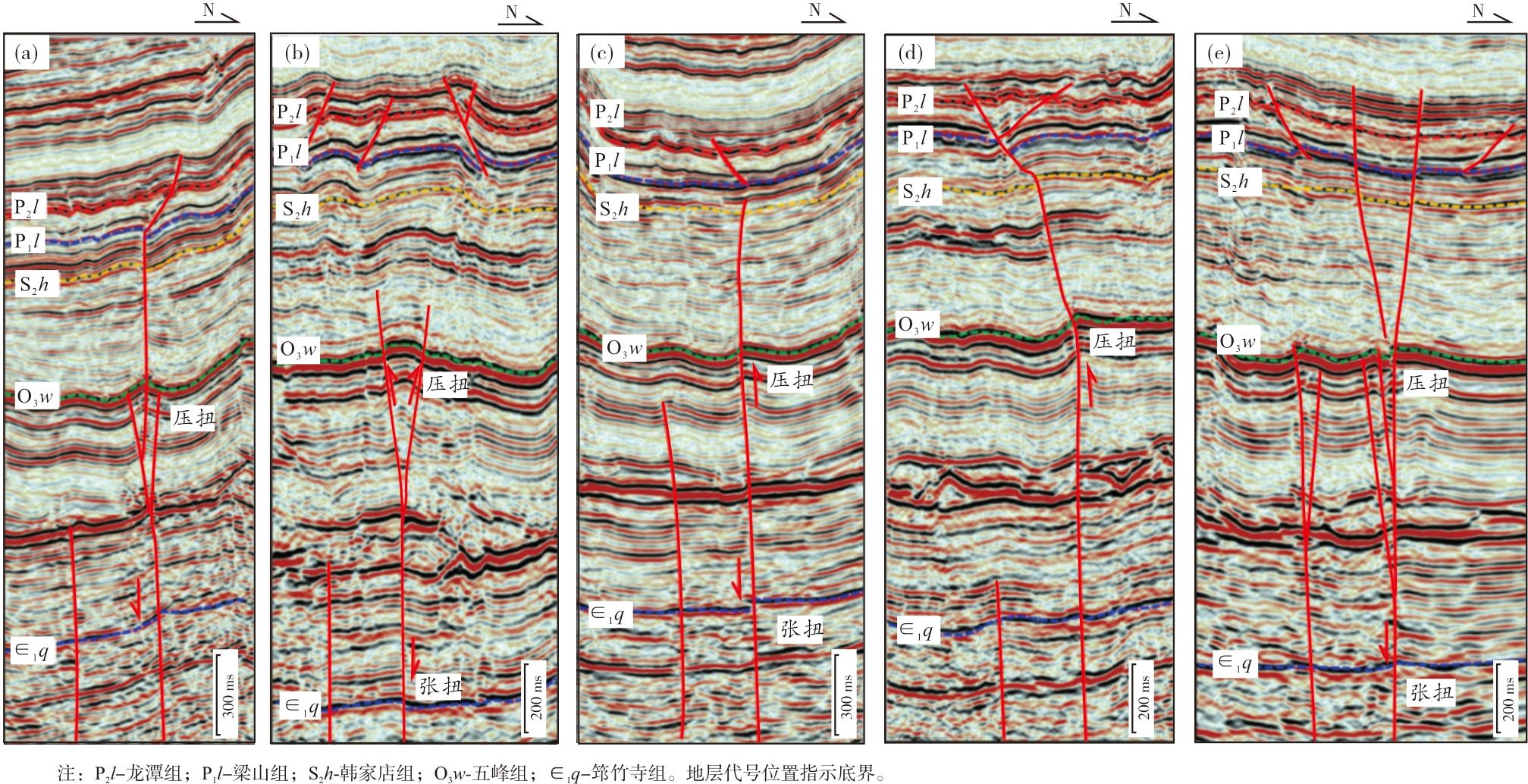
The Permian System in the southern Sichuan Basin serves as the primary target for major natural gas reserve growth in the region. Recent significant breakthroughs in syncline zone have demonstrated that high-yield gas reservoirs in southern Sichuan Basin are not completely controlled by positive structural belts. Instead, strike-slip faults have some control effects on karst paleogeomorphology, high-quality reservoir development and natural gas enrichment in southern Sichuan Basin. However, because the large fold-thrust zones on the shallow surface result in the low seismic resolution and the weak seismic reflection, the strike-slip fault and the characteristics are difficult to determine, and the controlling effect on natural gas enrichment and high yield is unknown, which seriously restricts the exploration and development of fault-controlled gas reservoirs in this area. Therefore, based on artificial intelligence fault identification technology, this paper carries out the identification of deep strike-slip faults, determines the identification marks of strike-slip faults, implements the distribution and characteristics of strike-slip faults in southern Sichuan Basin. Moreover, the controlling effect of strike-slip faults on high-yield gas reservoirs is analyzed based on actual drilling data. The results show that: (1) The artificial intelligence method based on deep learning can improve the identification accuracy of deep hidden strike-slip faults, and can effectively identify hidden strike-slip faults under thrust structures in southern Sichuan Basin. (2) Four planar identification marks and five sectional markers for strike-slip faults in southern Sichuan Basin are defined, thus verifying the development of a rhombus strike-slip fault system in the pre-Permian strata, with a total length of 940 km. (3) The strike-slip fault in southern Sichuan Basin has obvious classification, stratification and staging characteristics. There develop various types of structure such as linear structure, en echelon structure, flower structure and fault horst. Under the geological background of multi-stage extension-convergence, the strike-slip faults develop inheritively from the tension-torsion of the Sinian-Cambrian to the compression-torsional of the Upper Cambrian-Upper Ordovician on the basis of the weak zone of the early basement. (4) The strike-slip fault can connect multiple sets of source rocks in the Cambrian and Silurian, which plays an important role in controlling oil and gas migration and accumulation, and controls the distribution of high-yielding gas reservoirs of the Permian Maokou Formation together with the Permian reverse fault. Deep Cambrian-Ordovician strike-slip faults are a key factor for the high enrichment and productivity of fracture-cave type gas reservoirs controlled by faults in southern Sichuan Basin.
strike-slip fault / artificial intelligence fault identification / gas accumulation model / Permian / southern Sichuan Basin
| [1] |
郑和荣, 胡宗全, 云露, 等. 中国海相克拉通盆地内部走滑断裂发育特征及控藏作用[J]. 地学前缘, 2022, 29(6): 224-238.
走滑断控油气藏作为一种全新类型油气藏,其勘探潜力已初步显现。在对中国三大海相克拉通盆地内部走滑断裂发育特征与控藏作用开展对比分析的基础上,揭示了塔里木盆地、四川盆地、鄂尔多斯盆地内部走滑断裂空间结构与活动特征的相似性与差异性,并结合盆地动力学演化特征探讨了不同盆地内部走滑断裂成因机制,系统分析了三大盆地内部走滑断裂的控藏作用:(1)中国三大海相克拉通盆地内部均发育中小尺度滑移距走滑断裂,普遍具有“纵向分层,平面分段,垂向多期叠加”的空间结构特征。(2)三大克拉通盆地内部走滑断裂体系具有成因、分布和期次的差异性。塔里木盆地内部走滑断裂体系形成时间早,演化时间长,在盆地北部具有“南北对接,东西分区”特征;鄂尔多斯盆地西南缘受燕山期(侏罗纪—白垩纪)陆内挤压影响,形成了北西西向走滑断裂体系;四川盆地受控于二叠纪峨眉山大地幔柱影响,在盆地内部先存基底断裂基础上,形成了北西向、北西西向、近东西向张扭型走滑断裂。(3)中国三大海相克拉通盆地内部走滑断裂对油气成藏和富集具有重要的控制作用。在控储方面,受断裂-流体耦合改造控制,可形成断控缝洞型储集体、断-溶缝洞型或断控裂缝-孔隙型储集体;在控圈方面,在碳酸盐岩地层中可形成断控缝洞型、断溶缝洞型岩性圈闭;在控运方面,走滑断裂产状高陡,可直接沟通烃源岩和储层,构成重要的油气垂向输导体系。
As a new type of petroleum reservoir, the strike-slip fault-controlled oil and gas reservoirs show promising resource potentials. Here, through comparative analysis of the strike-slip fault development characteristics and control on hydrocarbon accumulation in the three largest marine cratonic basins (Tarim, Sichuan and Ordos) in China, the similarities and differences in fault architecture and movement characteristics between the three basins are revealed. In combination with the dynamic evolution of each basin, the formation mechanisms of the strike-slip faults are discussed and the fault controls on oil and gas reservoirs are systematically analyzed. We show that (1) all three basins develop small-medium displacement strike-slip faults, and the fault structures can be characterized by “layered deformation” in profile, segmentation in plan view and superposition architecture—formed as a result of episodic fault activity—in vertical view. (2) The formation mechanisms, distributions and movement periods of the strike-slip fault systems differ between basins. Being the oldest, the strik-slip fault system of the Tarim Basin experiences the longest evolution, where the northern strike-slip faults merge together from north to south while divide into eastern and western regions. In the Ordos Basin, a NWW-trending strike-slip fault forms in the southwestern margin as a result of intracontinental extrusion at the margin. And in the Sichuan Basin, under the influence of the Permian Emeishan mantle plume, the pre-existing basement faults reactivate and form the NW-, NWW- and nearly EW-trending transtensional strike-slip faults. (3) The strike-slip faults in the three basins all have important controls on oil and gas accumulation. For reservoir rock formation, fault-controlled/fault-dissolution fracture-cavity or fault-controlled fracture-pore reservoir rocks can form under coupled fault-fluid interaction/modification. For trap formation, fault-controlled/fault-dissolution fracture-cavity lithologic traps can form in carbonate rocks. And for migration, the steeply dipping strike-slip faults can directly connect source rocks and reservoir rocks to form very important vertical migration conduits for oil and gas. |
| [2] |
邓尚, 邱华标, 刘大卫, 等. 克拉通内走滑断裂成因与控藏机制研究进展: 以塔里木盆地北部为例[J]. 石油与天然气地质, 2024, 45(5): 1211-1225.
|
| [3] |
杨海军, 邬光辉, 韩剑发, 等. 塔里木盆地走滑断裂构造解析[M]. 北京: 石油工业出版社, 2022.
|
| [4] |
江同文, 邬光辉. 走滑断裂识别与构造分析: 以四川盆地为例[M]. 北京: 科学出版社, 2025.
|
| [5] |
焦方正. 塔里木盆地顺托果勒地区北东向走滑断裂带的油气勘探意义[J]. 石油与天然气地质, 2017, 38(5): 831-839.
|
| [6] |
王清华, 杨海军, 李勇, 等. 塔里木盆地富满大型碳酸盐岩油气聚集区走滑断裂控储模式[J]. 地学前缘, 2022, 29(6): 239-251.
塔里木盆地台盆区深层海相油气勘探目标由层间岩溶向断控岩溶转变,并在处于坳陷区的富满地区发现了以走滑断裂为主控因素的断控型油田。富满地区储层特征与盆地内古隆起区、斜坡区均有不同,因此需要建立适合研究区的走滑断裂控储模式。本次研究通过高密度三维地震资料刻画了研究区走滑断裂的分布,利用岩心、测井、试井资料以及缝洞体识别技术明确了不同类型的储层分布,分析了研究区走滑断裂样式与差异变形对储层发育的影响,建立了走滑断裂控储模式。研究结果表明:(1)富满大型碳酸盐岩油气聚集区储集空间主要由多期走滑构造破裂作用与岩溶作用形成的洞穴型、裂缝-孔洞型、裂缝型与孔洞型空间组成;(2)走滑断裂活动性越强,断裂带宽度越大,储层发育规模越大,张扭段与压扭段断层破碎带型储层较平移段平面分布范围更广,纵向发育深度更大;(3)张扭段为汇水区,断裂联通性好,有利于大气流体下渗以及热流体上涌从而对储层进行溶蚀改造;压扭段为分流区,岩溶储层多发育于断裂带两侧,断裂开启程度低,受流体改造程度低于张扭段。
The exploration target for deep marine hydrocarbon in the platform basin area, Tarim Basin has changed from interlayer karst to fault-controlled reservoir, and a strike-slip fault- controlled oilfield is discovered in the Fuman depression area. The strike-slip fault and reservoir characteristics of the Fuman area differ from the paleo-uplift slope area of the basin. Therefore, it is necessary to establish a fault-control reservoir model for the study area. In this paper, the strike-slip fault system is described based on high-density 3D seismic data; the distribution pattern of different types of reservoirs is revealed by core, logging, and fracture-cavity recognition technology; the impact of strike-slip fault style and differential deformation on reservoir development is analyzed; and a strike-slip fault-control reservoir model is established. Here are the main conclusions: (1) The large carbonate hydrocarbon accumulation area of Fuman mainly contains cave, fracture-hole, fracture, and hole-pore type reservoirs formed by multi-stage strike-slip faulting and karstification. (2) Differential deformation of strike-slip faults controls the reservoir type and reservoir distribution by influencing the extent of the fracture zone and the fluid activity range—larger activity range corresponds to larger fracture zone, and reservoir development in the tenso- and compresso-shear sections is better than in the linear section. (3) The tenso-shear section is a catchment area with good fault connectivity conducive to meteoric water infiltration and thermal fluid upwelling for carbonate dissolution. The compresso-shear section, on the other hand, is a distributary area, where karst reservoirs developed mostly on the two sides of the fault zone, with relatively small fracture opening thus lesser fluid transformation compared to the tenso-shear section. |
| [7] |
梁瀚, 唐浩, 冉崎, 等. 四川盆地川中地区走滑断裂的分布、类型与成因[J]. 地质学报, 2023, 97(8): 2609-2620.
|
| [8] |
马兵山, 梁瀚, 邬光辉, 等. 四川盆地中部地区多期次走滑断层的形成及演化[J]. 石油勘探与开发, 2023, 50(2): 333-345.
基于三维地震资料与钻井岩心资料,采用地震-地质解析方法和断层充填碳酸盐胶结物U-Pb定年的年代学方法,综合分析四川盆地中部地区深层走滑断层的形成时期、演化及其成因机制。研究表明:走滑断层在晚震旦世形成雏形,并在早寒武世基本发展为右行张扭断裂系统,在二叠系沉积前叠加至少一期压扭构造变形,在晚二叠世反转为左行弱张扭断裂系统,仅极少数在印支期及以后选择性复活;走滑断层受南华纪裂陷正断层和北西向基底深大断层等先存构造影响,震旦纪末—早寒武世属于斜向板内变换断层,调节德阳—安岳槽盆北强南弱的不均匀伸展,与德阳—安岳槽盆演化具有时间与强度上的匹配性,后期在不同构造背景下发生多次反转及选择性活化。
|
| [9] |
邬光辉, 邹禺, 徐伟, 等. 四川盆地川中古隆起北斜坡震旦系走滑断裂分布及其勘探意义[J]. 天然气工业, 2023, 43(7): 35-43.
|
| [10] |
|
| [11] |
许志琴, 曾令森, 杨经绥, 等. 走滑断裂、"挤压性盆-山构造"与油气资源关系的探讨[J]. 地球科学, 2004, 29(6): 631-643.
|
| [12] |
焦方正, 杨雨, 冉崎, 等. 四川盆地中部地区走滑断层的分布与天然气勘探[J]. 天然气工业, 2021, 41(8): 92-101.
|
| [13] |
马永生, 蔡勋育, 李慧莉, 等. 深层—超深层碳酸盐岩储层发育机理新认识与特深层油气勘探方向[J]. 地学前缘, 2023, 30(6): 1-13.
在深层碳酸盐岩层系中,已陆续发现了塔河、普光、元坝、安岳等一系列大型油气田,并形成了碳酸盐岩“三元控储”等成储理论认识。近年来,四川和塔里木盆地相继在超过7 000 m甚至8 000 m的超深层中发现了优质碳酸盐岩储层。深层储层类型更加多样,控储因素中,相带、流体、压力和断裂,以及它们之间相互作用的内涵更为丰富。结合近期大量新的超深钻探资料,持续开展了深层-超深层碳酸盐岩成储机理的研究。通过塔里木盆地塔河-顺北地区奥陶系和四川盆地二叠系栖霞组、茅口组的深化研究,进一步揭示了构造破裂和多类型流体耦合改造储集体的成储机制;通过上震旦统四川盆地灯影组和塔里木盆地奇格布拉克组的系统分析,揭示了新元古代“白云石海”沉积环境、早期溶蚀和早期油气充注在成储与孔隙保持中的关键作用;通过开展含膏岩层系白云岩成储的物理模拟实验,揭示了膏盐岩封盖及超压、较为封闭的环境下,白云石重结晶作用显著改善了储集物性。深层-超深层储层发育机理新认识丰富了“三元控储”理论,有效引领了超深层,乃至特深层的油气勘探。断控和断-溶双控储集体、古老微生物丘滩相白云岩储层,尤其是寒武系厚层膏盐岩之下的微生物丘滩相白云岩储层,在中西部叠合盆地海相碳酸盐岩层系中广泛分布,有望成为万米特深层钻探的主要对象。
In deep carbonate strata of the Sichuan and Tarim Basins a series of large scale oil and gas fields have been discovered successively, including the Jingbian, Tahe, Puguang and Yuanba fields, and a “ternary reservoir control” theory for reef-shoal carbonate reservoirs has been developed. In recent years, high-quality carbonate reservoir rocks are discovered in ultra-deep layers at depths of greater than 7000 m or even 8000 m. The deep reservoirs show diverse rock types and complex interactions between the reservoir controlling factors such as facies belt, fluid, pressure, and fault. Using the newly obtained ultra-deep drilling data we carried out a systematic investigation into the formation mechanism of the ultra-deep carbonate reservoir rocks. In-depth studies of the Ordovician strata of Tahe-Shunbei-Shunnan area, Tarim Basin and the Permian Qixia and Maokou Formations in the Sichuan Basin provided further insights into reservoir formation by mechanisms of fault-related fracturing and coupled multi-type fluid alteration. Results for the Upper Sinian Dengying Formation in the Sichuan Basin and the Upper Sinian Qigebulake Formation in the Tarim Basin suggested that the Neoproterozoic “dolomite sea” depositional environment, early dissolution, and early hydrocarbon charging are the key factors for reservoir formation and preservation. Physical simulation experiment on dolomite reservoir formation in gypsum-bearing facies revealed that dolomite recrystallization can significantly improve reservoir properties under gypsum-salt capping and overpressure and relatively closed environment. The new insights enriched the “ternary reservoir control” theory and provided guidance for oil and gas exploration in ultra-deep and even extra-deep strata. In superimposed basins in central and western China, fault-controlled and fault/dissolution dual-controlled reservoirs, ancient microbial mound-shoal dolomite reservoirs, especially those with Cambrian thick gypsum-salt caprocks, are widely distributed in marine carbonate rocks and can be considered the main exploration targets at > 10000 m depths. |
| [14] |
漆立新. 塔里木盆地顺北超深断溶体油藏特征与启示[J]. 中国石油勘探, 2020, 25(1): 102-111.
近年来,塔里木盆地顺托果勒低隆起发现了10亿吨级的新类型油藏——顺北超深断溶体油藏。通过深化顺北地区油气成藏地质条件认识,突破了构造低部位岩溶储层欠发育的限制,提出走滑断裂带构造破裂作用为主的叠加后期埋藏流体改造也可形成规模储层。走滑断裂带多期活动对储层改造、圈闭形成和油气运聚具有重要的控制作用,建立了顺北超深断溶体油气藏“寒武纪多期供烃、深埋断溶成储、原地垂向输导、晚期成藏为主、走滑断裂控富”成藏模式,初步提出了顺北断溶体油藏富集的主控因素。顺北超深断溶体油藏作为一种新类型油藏,丰富了海相碳酸盐岩油气成藏理论,展现了超深层海相碳酸盐岩巨大的勘探潜力,是盆地未来油气增储的重点领域。
In recent years, a new type of oil reservoir, with reserves of 1 billion tons, has been discovered in the low uplift of Shuntuoguole in the Tarim Basin - ultra-deep fault-karst oil reservoir in the Shunbei area. By deepening understanding of the geological conditions for oil and gas accumulation in the Shunbei area, the constraint on development represented by the fact that karst reservoirs had not been developed in the lower structure positions has been broken. It is also proposed that large-scale reservoirs can be formed by later superimposed buried fluid reformation, mainly due to structure fracturing of strike slip fault zones. The multi-stage activities of strike slip fault zones play an important role in controlling reservoir reformation, trap formation and hydrocarbon migration and accumulation. The hydrocarbon accumulation mode of "multi-stage hydrocarbon supply in Cambrian, deep buried fault-karst reservoir, in-situ vertical migration, mainly late stage accumulation, strike slip faults controlling enrichment" has been established for ultra-deep fault-karst reservoir in the Shunbei area. The main controlling factors of enrichment of the fault-karst reservoir have been presented. As a new type of reservoir, ultra-deep fault-karst reservoir has extended the theory of hydrocarbon accumulation in marine carbonates, confirms the great exploration potential of ultra-deep marine carbonate formations, and is the key field for reserves increase in the future.
|
| [15] |
丁志文, 汪如军, 陈方方, 等. 断溶体油气藏成因、成藏及油气富集规律: 以塔里木盆地哈拉哈塘油田塔河南岸地区奥陶系为例[J]. 石油勘探与开发, 2020, 47(2): 286-296.
基于构造、断裂演化、岩心、测井、地震、钻录井、生产动态等资料分析,对塔里木盆地哈拉哈塘油田塔河南岸地区跃满区块奥陶系断溶体油气藏的储集空间特征、展布形态、成因进行系统研究,并结合开发实践,对断溶体油气藏的成藏与油气富集进行系统分析。研究结果表明,断溶体油气藏以"体"的形式呈不连续、非均质、不规则性分布,其形成主要受控于断裂的发育程度,建立沿主干深大通源断裂溶蚀、沿次级通源断裂溶蚀和沿次级内幕断裂溶蚀3种断溶体油气藏形成模式;断溶体油气富集受控于成藏期与断裂活动时空上的匹配关系、断裂的级别和断裂的分段性质。研究结果可有效指导哈拉哈塘油田塔河南岸地区奥陶系碳酸盐岩井位部署,实现断溶体油气藏高效开发。图9表2参25
|
| [16] |
|
| [17] |
管树巍, 姜华, 鲁雪松, 等. 四川盆地中部走滑断裂系统及其控油气作用[J]. 石油学报, 2022, 43(11): 1542-1557.
四川盆地中部(川中地区)的走滑断裂与多层系油气聚集关系密切。系统阐述走滑断裂的性质、特征、分布规律、成因与演化机制对于深化川中地区断裂系统控藏与控富集研究,以及完善四川盆地复合含油气系统理论具有重要意义。研究在川中地区下—中三叠统膏盐岩层内部识别出深层走滑断裂的伴生构造,以及导致上震旦统灯影组台缘错动的走滑断裂行迹。研究表明,深层走滑断裂与其伴生构造之间存在2种组合关系,据此识别出6条主干左行走滑断裂带。通过分析代表性生长构造的局部构造活动(LSA)沉降量变化,将川中地区的断裂演化划分为5个阶段:1晚震旦世同沉积断裂阶段;2早奥陶世—早二叠世右行走滑阶段;3晚二叠世—早三叠世伸展走滑断裂阶段;4中—晚三叠世走滑活动沉寂阶段;5中侏罗世至今左行走滑阶段。走滑断裂是控制川中地区多层系立体差异化成藏的关键因素。在晚二叠世—早三叠世伸展走滑断裂阶段,安岳裂陷槽内筇竹寺组烃源岩进入生油高峰,原油沿灯影组台缘及NWW向断裂带充注成藏;在中侏罗世至今左行走滑阶段,特别是晚白垩世以来,深层走滑活动在下—中三叠统膏盐岩层及上覆地层内形成伴生构造,控制了浅层陆相致密油气的分布,同时派生出的NE向伸展破裂则造成深层原油裂解气垂向运移至龙王庙组,甚至在栖霞组、茅口组聚集成藏,形成"上富下贫"的油气成藏模式。
The strike-slip faults are closely related to the multi-layered hydrocarbon accumulation in central Sichuan Basin. A systematic description of the properties, characteristics, distribution, genesis and evolution mechanism of strike-slip faults is of great significance for deepening the study on controlling hydrocarbon accumulation and enrichment by fault system in central Sichuan Basin, and improving the theory of composite petroleum system in Sichuan Basin. This study identifies the associated structures of deep strike-slip faults in the Lower-Middle Triassic gypsum-salt bed, as well as the structural traces of strike-slip fault activities leading to the platform margin dislocation of Upper Sinian Dengying Formation in central Sichuan Basin. The study shows that there are two combinations between the deep strike-slip faults and their associated structures, based on which six main sinistral strike-slip fault zones are identified. Based on analyzing the subsidence changes of the representative growth structures caused by local structural activity (LSA), the fault evolution in central Sichuan Basin can be divided into five stages:(1)the synsedimentary fault stage in Late Sinian; (2)the dextral strike-slip stage from Early Ordovician to Early Permian; (3)the extensional strike-slip fault stage from Late Permian to Early Triassic; (4)the strike-slip activity silent stage in Middle-Late Triassic; (5)the sinistral strike-slip stage from Middle Jurassic to present. Strike-slip fault is the key factor controlling the multi-layered multidimensional differential accumulation in central Sichuan Basin. In the extensional strike-slip fault stage from Late Permian to Early Triassic, the source rocks of Qiongzhusi Formation in Anyue aulacogen reached the oil generation peak, and the crude oil was charged and accumulated along the platform margin of Dengying Formation and NWW-trending fault zone. In the sinistral strike-slip stage from Middle Jurassic to present, especially since Late Cretaceous, the deep strike-slip activities formed associated structures in the Lower-Middle Triassic gypsum-salt bed and overburden strata, controlling the distribution of shallow continental tight oil and gas reservoirs. Meanwhile, the derived NE-trending extensional fractures caused the vertical migration of the deep oil-cracking gas to Longwangmiao Formation, and even accumulated in Qixia Formation and Maokou Formation, thus forming the hydrocarbon accumulation pattern of rich in the upper strata and poor in the lower strata.
|
| [18] |
|
| [19] |
付小东, 张本健, 汪泽成, 等. 四川盆地中西部走滑断裂及其对油气成藏控制作用[J]. 地球科学, 2023, 48(6): 2221-2237.
|
| [20] |
杨勇, 汤良杰, 郭颖, 等. 柯坪冲断带皮羌断裂的新生代构造演化特征[J]. 中国矿业大学学报, 2016, 45(6): 1204-1210.
|
| [21] |
邓尚, 李慧莉, 张仲培, 等. 塔里木盆地顺北及邻区主干走滑断裂带差异活动特征及其与油气富集的关系[J]. 石油与天然气地质, 2018, 39(5): 878-888.
|
| [22] |
宁飞, 金之钧, 张仲培, 等. 塔中北坡走滑断裂成因机理与油气成藏[J]. 石油与天然气地质, 2018, 39(1): 98-106.
|
| [23] |
|
| [24] |
Based on three-dimensional seismic interpretation, structural and sedimentary feature analysis, and examination of fluid properties and production dynamics, the regularity and main controlling factors of hydrocarbon accumulation in the Tazhong uplift, Tarim Basin are investigated. The results show that the oil and gas in the Tazhong uplift has the characteristics of complex accumulation mainly controlled by faults, and more than 80% of the oil and gas reserves are enriched along fault zones. There are large thrust and strike-slip faults in the Tazhong uplift, and the coupling relationship between the formation and evolution of the faults and accumulation determine the difference in complex oil and gas accumulations. The active scale and stage of faults determine the fullness of the traps and the balance of the phase, that is, the blocking of the transport system, the insufficient filling of oil and gas, and the unsteady state of fluid accumulation are dependent on the faults. The multi-period tectonic sedimentary evolution controls the differences of trap conditions in the fault zones, and the multi-phase hydrocarbon migration and accumulation causes the differences of fluid distribution in the fault zones. The theory of differential oil and gas accumulation controlled by fault is the key to the overall evaluation, three-dimensional development and discovery of new reserves in the Tazhong uplift. |
| [25] |
杨海军, 邓兴梁, 张银涛, 等. 塔里木盆地满深1井奥陶系超深断控碳酸盐岩油气藏勘探重大发现及意义[J]. 中国石油勘探, 2020, 25(3): 13-23.
位于塔里木盆地北部坳陷的满深1 井在奥陶系一间房组获得重大突破。通过对满深1 井成藏条件、油藏 特征及富集规律的深入研究,总结了塔里木盆地北部坳陷断控岩溶区高产井油气成藏模式和富集规律。塔里木盆地海相 碳酸盐岩主要发育潜山岩溶、层间岩溶、礁滩岩溶和断控岩溶4 种不同的岩溶类型,满深1 井钻遇断控岩溶;满深1 井 是迄今为止断控岩溶油气藏埋藏最深、单井产量最高的发现井,在埋深7535m 的奥陶系一间房组测试折日产油624m3, 折日产气37.13×10⁴m3;建立了断控岩溶油气藏3 种富集模式,即线性走滑上倾高部位、张扭侧向高部位、压扭局部高 部位。满深1 井的成功钻探,是以断裂为核心的碳酸盐岩断控岩溶油气藏勘探思路的成功实践,实现了塔北隆起与塔中 凸起之间的鞍部油气勘探的突破,对整个塔里木盆地深层—超深层油气勘探具有重大意义。
Well Manshen 1, located in the Northern depression of the Tarim Basin, has achieved a great breakthrough in the Ordovician Yijianfang Formation. Based on in-depth studies of hydrocarbon accumulation conditions, reservoir characteristics, and enrichment patterns of the well, the hydrocarbon accumulation model and enrichment patterns of high-production wells in fault-controlled karst areas in the Northern depression of the Tarim Basin have been summarized. There are four types of marine carbonate rocks in the Tarim Basin: buried hill karst, interlayer karst, reef-shoal karst and fault-controlled karst. Well Manshen 1 penetrated fault-controlled karst. Well Manshen 1 is a discovery well of fault-controlled karst reservoir with the deepest burial depth and the highest single well production so far. In the Yijianfang Formation of the Ordovician, with a buried depth of 7535 m, tested oil production is 624 m3/d and gas production is 37.13×10⁴ m3/d. Three enrichment patterns of fault-controlled karst reservoirs are established: linear strike-slip up-dip high position, transtensional lateral high position, and compressive-shear local high position. The discovery of Well Manshen 1 is a successful practical application of the exploration idea of fault-controlled karst carbonate reservoirs with faults as the core. It has achieved a breakthrough in oil and gas discovery in the saddle position between the Tabei uplift and the Tazhong bulge, which is of great significance for deep and ultra-deep oil and gas exploration in the Tarim Basin as a whole.
|
| [26] |
云露. 顺北东部北东向走滑断裂体系控储控藏作用与突破意义[J]. 中国石油勘探, 2021, 26(3): 41-52.
顺北地区区域断裂体系具有“东西分区”的特点,作为东西部断裂体系之间起转换作用的顺北1号、顺北5号断裂带,北东向顺北1号断裂带平面以拉分段、平移段为主,单井控制规模大;北西向顺北5号断裂带为南北对接形成,其中北段北西向断裂带平面以挤压为主,单井控制规模相对较小。通过对北东向断裂体系顺北4号、顺北8号、顺北12号断裂带解析,认为其平面具有典型“三段式”分段特征,断裂活动强度大,储集体整体规模可能较大,同时其走向与现今区域主应力方向一致,其分段内部储集体连通性好,且东部发育盆地—中外缓坡相原地优质烃源岩,相比北西向断裂体系,其成储与成藏条件更为优越。基于上述认识优选部署顺北42X井、顺北41X井、顺北8X井,测试均获千吨(油当量)高产油气流,新发现一个4~5亿吨级(油当量)资源阵地,进一步证实北东向走滑断裂体系储集体规模大,成藏条件优越,走滑断裂带具有“控储、控圈、控运、控藏、控富”五位一体特征,对中国海相碳酸盐岩走滑断裂带评价具有借鉴意义。
|
| [27] |
王清华, 杨海军, 汪如军, 等. 塔里木盆地超深层走滑断裂断控大油气田的勘探发现与技术创新[J]. 中国石油勘探, 2021, 26(4): 58-71.
|
| [28] |
何骁, 唐青松, 邬光辉, 等. 四川盆地安岳气田震旦系走滑断裂控储作用[J]. 石油勘探与开发, 2023, 50(6): 1116-1127.
通过四川盆地安岳气田深层震旦系走滑断裂、储集层资料综合分析,研究走滑断裂带白云岩储集层主控因素,探讨走滑断裂对优质“甜点”(缝洞)储集层发育与分布的控制方式。结果表明,震旦系灯影组碳酸盐岩基质储集层致密,孔隙度小于4%、渗透率小于0.5×10<sup>-3</sup> μm<sup>2</sup>,但走滑断裂及其溶蚀作用发育,能够使碳酸盐岩渗透率提高1个数量级以上,而且断裂相关溶蚀孔隙度可提高1倍以上,形成沿走滑断裂带广泛分布的走滑断控缝洞型“甜点”储集层。走滑断控储集层主要形成于震旦纪末,具有“相-断-溶”三元复合控储机理,台缘带岩溶控储作用显著,台内断-溶共控优质储集层发育,具有分区、分类与分带差异性。走滑断裂带的结构控制裂缝带与断控“甜点”储集层的差异分布,并形成宽阔的缝洞带。走滑断裂相关“甜点”储集层是深层古老碳酸盐岩高效开发的有利新类型,需要根据走滑断裂控储的多样性与差异性实施针对性的开发部署措施。
|
| [29] |
邹玉涛, 段金宝, 赵艳军, 等. 川东高陡断褶带构造特征及其演化[J]. 地质学报, 2015(11): 2043-2049.
|
| [30] |
裴仰文, 盛受政, 苗正硕, 等. 多滑脱层构造物理模拟试验及其对川东褶皱带形成演化的指示意义[J]. 中国石油大学学报(自然科学版), 2022, 46(2): 38-49.
|
| [31] |
黄涵宇, 何登发, 李英强, 等. 四川盆地东南部泸州古隆起的厘定及其成因机制[J]. 地学前缘, 2019, 26(1): 102-120.
对盆地内部大型古隆起地质结构认识的逐渐加深,往往伴随着重要的油气勘探发现,前期丰富的油气勘探成果表明,泸州古隆起是四川盆地重要的聚油气构造单元之一。同时,泸州古隆起的形成与演化又受到多种地质因素的影响,它是扬子板块内部变形与周缘地块在印支期造山运动的联合响应,是研究盆山耦合关系与盆地叠加改造过程的天然场所。借助于大量的地震反射剖面和钻井资料,对川东南地区印支期泸州古隆起进行详细的厘定。通过不同地区的地层对比分析,识别隆起发育地区的三叠系地层缺失情况。在精细追踪地震层位的基础上,分析了不整合面的发育特征,进而认识泸州古隆起的阶段性演化特征。利用井、震结合的方法,追踪不同时期的地层尖灭点分布范围,较为详细地刻画出泸州古隆起的展布特征。结合研究区大地构造背景,进一步分析泸州古隆起形成与演化的动力学特征,提出泸州古隆起的成因机制模型。研究认为,四川盆地东南部地区发育印支期的泸州古隆起,其经历了3个显著的演化阶段:早三叠世嘉陵江组沉积时期为萌芽期,中三叠世雷口坡组沉积时期为发育期,晚三叠世须家河组沉积时期为隆起的消亡期。泸州古隆起的形成受控于周缘地块的印支期造山运动,是扬子地块东南缘江南雪峰造山带自东向西挤压、迁移过程中形成于山前坳陷带的前缘隆起。
Increased understanding of the geological structure of large paleo-uplift within a basin is often accompanied by great oil and gas discovery. The exploratory findings of abundant oil and gas in the Luzhou paleo-uplift demonstrate that it is one of the most important oil and gas structural units in the Sichuan Basin. Many geological factors influenced the formation and evolution of the Luzhou paleo-uplift from joint response of the intra-plate deformation of the Yangtze Block and the Indosinian Orogeny of the peripheral block, making the paleo-uplift a natural laboratory for studying basin-mountain coupling and basin evolution. In this study, we carried out a detailed determination of the Indosinian Luzhou paleo-uplift in southeastern Sichuan by using a large number of seismic reflection profiles and drilling data. We also determined the loss of Triassic strata in the uplift area by stratigraphic correlation analysis of different regions. Based on the detailed seismic interpretation, we analyzed the developmental characteristic of the unconformities and subsequently revealed the periodic evolutionary characteristic of the Luzhou paleo-uplift. Meanwhile, by combining drilling and seismic data, we tracked the distribution range of pinch out of different periods and described in detail the distribution characteristic of Luzhou paleo-uplift. We further investigated the dynamic characteristics of the Luzhou paleo-uplift formation and evolution by taking into account the tectonic background of the study area and proposed the genetic mechanism model of the Luzhou paleo-uplift. It is believed that the Luzhou paleo-uplift in the southeastern Sichuan Basin has undergone three significant evolutionary stages, i.e. budding stage of the sedimentary period of the Early Triassic Jialingjiang Formation, developmental stage of the Middle Triassic Leikoupo Formation, and extinction stage of the Late Triassic Xujiahe Formation. The formation of the Luzhou paleo-uplift is controlled by the Indosinian Orogeny in the peripheral block. The peleo-uplift can be regarded as crustal uplifted zones in the front of the piedmont depression, during the period of westward migration and extrusion of the Jiangnan Xuefeng Orogen, on the southeastern margin of the Yangtze Block.<br>
|
| [32] |
|
| [33] |
何登发. 中国多旋回叠合沉积盆地的形成演化、地质结构与油气分布规律[J]. 地学前缘, 2022, 29(6): 24-59.
深入认识盆地的地质结构与构造演化,探讨盆地的油气分布规律,将为揭示中国大陆属性、资源能源分布、环境变化及油气勘探新领域奠立重要基础。本文立足于油气勘探的新资料,应用活动论构造历史观与比较大地构造学方法,分析了中国叠合沉积盆地的构造演化、构造分区、地质结构与油气成藏模式,探索油气分布规律。研究表明,中国叠合沉积盆地经历了中新元古代、寒武纪—泥盆纪(或中泥盆世)、(晚泥盆世—)石炭纪—三叠纪与侏罗纪—第四纪4个构造旋回的演化;据东西向两条构造锋线和南北(或北北东)向的两条改造锋线及西太平洋弧后盆地带,可将中国划分为北疆、内蒙古、松辽、塔里木—阿拉善、鄂尔多斯、渤海湾、青藏、四川、华南与海域等10个沉积盆地区;发育有前陆/克拉通、前陆/坳陷、坳陷/断陷、断陷/坳陷、反转断陷、被动陆缘、走滑叠合和改造残留等8种叠合盆地结构类型;发育安岳裂陷槽型、塔北型、苏里格复合三角洲型、玛湖凹陷型、陆梁隆起型、库车冲断带型、大庆长垣型、古潜山型、中央峡谷水道型、柴东生物气型、四川源内型与沁水向斜煤层气型等12种典型油气成模式;盆地内凹陷/断陷的油气分布具有空间有序性,叠合界面油气富集具优势性,油气叠合分布有强的非均一性,中西部前陆/克拉通叠合型盆地的油、气分区分布,海域被动陆缘/断陷叠合型盆地的油、气分带分布。中国多旋回叠合盆地具有独特的“三环带状”油气分布格局。
Understanding basin's geological structure and tectonic evolution and exploring its oil and gas distribution pattern is key to revealing the geological features of China, and the energy resources distributions, environmental changes, and potential hydrocarbon exploration targets in China. Based on the new data of recent petroleum exploration and using the methodology of comparative geo-tectonics, this paper studies the superimposed sedimentary basins in China from the view point of mobile geo-tectonic history, focusing specifically on the basin's tectonic evolution, tectonic subdivision, geologic framework, and pool-formation models, and explores the basin's oil and gas distribution patterns. According to our analysis, the superimposed sedimentary basins in China evolve through four tectonic cycles during the Meso- to Neo-Proterozoic, Cambrian-Devonian (or Middle Devonian), (Late Devonian-) Carboniferous-Triassic, and Jurassic-Quaternary Periods. The sedimentary basins in China can be subdivided into ten sedimentary basin areas: northern Xinjiang, inner Mongolian, Songliao, Tarim-Alax, Ordos, Bohai Bay, Qinghai-Tibet, Sichuan, southern China, and oceanic area. They can be further characterized by eight structural styles as foreland/cratonic-basin, foreland/sag, sag/faulted-depression, faulted-depression/sag, inverted faulted-depression, passive margin, or strike-slip superimposed basins, or as modified residual basins. Twelve types of hydrocarbon pool-formation are developed, which are represented by the Anyue rift trough, northern Tarim, Sulig composite delta, Mahu sag, Luliang uplift, Kuqa thrust belt, Daqing anticline, paleo-buried hill, central canyon channel, eastern Qaidam biogas, Sichuan intra-source rock, and Qinshui syncline coalbed gas. Within a sag/faulted-depression superimposed basin, oil and gas distributions are typically ordered spatially, with the interface area most favorable for hydrocarbon accumulation. However, oil and gas distribution patterns are highly heterogeneous across different structural styles. For example, in the foreland/cratonic-basin superimposed basins of central and western China, oil and gas distribute separately in isolation, whilst in the passive-margin/faulted-depression superimposed basins of the oceanic area, oil and gas zones distribute respectively along the inner and outer sedimentary belts. The multi-cycle superimposed basins in China generally have a distinctive ‘three ring-like’ oil and gas distribution pattern within each basin area. |
| [34] |
李海, 郑马嘉, 李延钧, 等. 四川盆地泸州印支期古隆起嘉陵江组油气分布规律及勘探开发前景[J]. 天然气工业, 2023, 43(7): 10-21.
|
| [35] |
张宇, 曹清古, 罗开平, 等. 四川盆地二叠系茅口组油气藏勘探发现与启示[J]. 石油与天然气地质, 2022, 43(3): 610-620.
|
| [36] |
王红岩, 周尚文, 赵群, 等. 川南地区深层页岩气富集特征、勘探开发进展及展望[J]. 石油与天然气地质, 2023, 44(6): 1430-1441.
|
| [37] |
解国爱, 贾东, 张庆龙, 等. 川东侏罗山式褶皱构造带的物理模拟研究[J]. 地质学报, 2013, 87(6): 773-788.
|
| [38] |
王志勇, 康南昌, 李明杰, 等. 四川盆地川东地区滑脱构造特征[J]. 石油地球物理勘探, 2018, 53(增刊1): 276-286.
|
| [39] |
|
| [40] |
江同文, 昌伦杰, 邓兴梁, 等. 断控碳酸盐岩油气藏开发地质认识与评价技术: 以塔里木盆地为例[J]. 天然气工业, 2021, 41(3): 1-9.
|
| [41] |
|
| [42] |
陈利新, 王胜雷, 万效国, 等. 哈拉哈塘地区共轭走滑断裂差异特征及演化[J]. 西南石油大学学报(自然科学版), 2024, 46(4): 19-37.
塔里木盆地哈拉哈塘地区发育非典型X型共轭走滑断裂,具有分区、分层、分段差异性及差异演化特征,制约了油气勘探开发。以哈拉哈塘地区3 400 km$^2$三维地震为基础,通过详细解析NE向和NW向两条走滑断裂分层及分段特征,分析其差异演化特征,推测其成因机制。结果表明:1)从北向南,断裂成熟度与延伸性变弱,NE向断层扰动增强;从深至浅,NW向断层对北东向干扰越来越弱,NE向断层则此消彼长;NW向断层变形程度与成熟度由深至浅变低,而NE向断层向上变形程度增强。2)哈拉哈塘地区走滑断层具有多期活动特征,可以划分为中奥陶世共轭断裂形成阶段、石炭—二叠纪张扭走滑断裂活化阶段及中—新生代张扭走滑断层活动阶段,不同方向走滑断裂演化有差异。3)不同时期断层的成因机制有所差异,中奥陶世走滑断裂受控于纯剪和单剪的叠加变形,并受控应力场、先存构造以及区域厚度等影响,自北向南应力的衰减及其相应的应力场变化造成南北断裂样式的差异性。
|
| [43] |
李凤磊, 林承焰, 张国印, 等. 塔北地区多期走滑断裂地球物理响应特征及精细识别[J]. 中国石油大学学报(自然科学版), 2024, 48(3): 1-14.
|
| [44] |
|
| [45] |
Mapping fault planes using seismic images is a crucial and time-consuming step in hydrocarbon prospecting. Conventionally, this requires significant manual efforts that normally go through several iterations to optimize how the different fault planes connect with each other. Many techniques have been developed to automate this process, such as seismic coherence estimation, edge detection, and ant-tracking, to name a few. However, these techniques do not take advantage of the valuable experience accumulated by the interpreters. We have developed a method that uses the convolutional neural network (CNN) to automatically detect and map fault zones using 3D seismic images in a similar fashion to the way done by interpreters. This new technique is implemented in two steps: training and prediction. In the training step, a CNN model is trained with annotated seismic image cubes of field data, where every point in the seismic image is labeled as fault or nonfault. In the prediction step, the trained model is applied to compute fault probabilities at every location in other seismic image cubes. Unlike reported methods in the literature, our technique does not require precomputed attributes to predict the faults. We verified our approach on the synthetic and field data sets. We clearly determined that the CNN-computed fault probability outperformed that obtained using the coherence technique in terms of exhibiting clearer discontinuities. With the capability of emulating human experience and evolving through training using new field data sets, deep-learning tools manifest huge potential in automating and advancing seismic fault mapping.
|
| [46] |
Seismic fault detection using machine-learning techniques, in particular the convolution neural network (CNN), is becoming a widely accepted practice in the field of seismic interpretation. Machine-learning algorithms are trained to mimic the capabilities of an experienced interpreter by recognizing patterns within seismic data and classifying them. Regardless of the method of seismic fault detection, interpretation or extraction of 3D fault representations from edge evidence or fault probability volumes is routine. Extracted fault representations are important to the understanding of the subsurface geology and are a critical input to upstream workflows including structural framework definition, static reservoir and petroleum system modeling, and well planning and derisking activities. Efforts to automate the detection and extraction of geologic features from seismic data have evolved in line with advances in computer algorithms, hardware, and machine-learning techniques. We have developed an assisted fault interpretation workflow for seismic fault detection and extraction, demonstrated through a case study from the Groningen gas field of the Upper Permian, Dutch Rotliegend; a heavily faulted, subsalt gas field located onshore, northeast Netherlands. Supervised using interpreter-led labeling, we apply a 2D multi-CNN to detect faults within a 3D prestack depth migrated seismic data set. After prediction, we apply a geometric evaluation of predicted faults, using a principal component analysis to produce geometric attribute representations (strike azimuth and planarity) of the fault prediction. Strike azimuth and planarity attributes are used to validate and automatically extract consistent 3D fault geometries, providing geologic context to the interpreter and input to dependent workflows more efficiently.
|
| [47] |
Delineating faults from seismic images is a key step for seismic structural interpretation, reservoir characterization, and well placement. In conventional methods, faults are considered as seismic reflection discontinuities and are detected by calculating attributes that estimate reflection continuities or discontinuities. We consider fault detection as a binary image segmentation problem of labeling a 3D seismic image with ones on faults and zeros elsewhere. We have performed an efficient image-to-image fault segmentation using a supervised fully convolutional neural network. To train the network, we automatically create 200 3D synthetic seismic images and corresponding binary fault labeling images, which are shown to be sufficient to train a good fault segmentation network. Because a binary fault image is highly imbalanced between zeros (nonfault) and ones (fault), we use a class-balanced binary cross-entropy loss function to adjust the imbalance so that the network is not trained or converged to predict only zeros. After training with only the synthetic data sets, the network automatically learns to calculate rich and proper features that are important for fault detection. Multiple field examples indicate that the neural network (trained by only synthetic data sets) can predict faults from 3D seismic images much more accurately and efficiently than conventional methods. With a TITAN Xp GPU, the training processing takes approximately 2 h and predicting faults in a 128 x 128 x 128 seismic volume takes only milliseconds.
|
| [48] |
吴永宏, 刘嘉伟, 冯亮, 等. 四川盆地开江—梁平海槽东南台缘带走滑断裂特征及其控藏作用[J]. 海相油气地质, 2023, 28(3): 291-300.
|
| [49] |
邓兴梁, 常少英, 陈方方, 等. 塔里木盆地富满油田超深断裂破碎体油藏地质特征与启示[J]. 海相油气地质, 2025, 30(3): 228-238.
|
| [50] |
朱秀香, 赵锐, 赵腾. 塔里木盆地顺北1号断裂带走滑分段特征与控储控藏作用[J]. 岩性油气藏, 2023, 35(5): 131-138.
塔里木盆地顺北地区沿走滑断裂带展布的特深层断控缝洞型油气藏具有明显的分段性。通过三维地震断裂精细解释,综合钻井、测井、试采等资料对顺北1号断裂带走滑分段特征及分段内部储集体结构差异性及成因进行了研究,优选出有利的储集体类型。研究结果表明: ①顺北1号断裂带由8个几何分段斜列叠置而成,每个几何分段形成一套独立的储集单元,单个储集单元的内部缝洞结构基本一致,但相邻储集单元的内部缝洞结构差异明显,且彼此间油气藏不连通。②几何分段的内部缝洞结构由走滑构造的活动强度控制,据此可以划分出内洞外缝结构、双重洞-缝结构与大型“均质”储集体等内部储集体结构类型,其中大型“均质”储集体发育多套缝洞体,缝洞尺寸大、数量多、内部连通性强,有利于油气富集。
The extra-deep fault-controlled fractured-vuggy reservoirs distributed along strike-slip fault zones in Shunbei area of Tarim Basin have obvious subsection differences. Through interpretation of 3D seismic data, combined with data of drilling,logging and production test,the characteristics of the strike-slip segments of Shunbei No. 1 fault zone and the differences and causes of internal reservoir structure in different geometric segments were studied,and favorable reservoirs were selected. The results show that: (1)Shunbei No. 1 fault zone is formed by the oblique superposition of eight geometric segments,each of which forms a set of independent reservoir units. The internal fracture cave structure of a single reservoir unit is basically the same,but the internal fracture cave structure of adjacent reservoir units is obviously different,and the oil and gas reservoirs are not connected with each other.(2)The internal fracture cavity structure of the geometric segments is controlled by the activity intensity of strike-slip structure,according to which,internal and external fracture structures,double hole fracture structures,large-scale homogeneous reservoirs and other internal reservoir structure can be divided. Among them,large-scale homogeneous reservoirs develop multiple sets of fracture cavity bodies,with large size, large number and strong internal connectivity, which is conducive to oil and gas enrichment.
|

/
| 〈 |
|
〉 |