PDF(10363 KB)

Genesis mechanisms and reservoir-controlling mechanisms of deep dolomite of the Middle Permian Maokou Formation in central Sichuan Basin
CHEN Manfei, ZHANG Benjian, CHEN Hongbin, LI Sheng, KANG Qiang, GAO Heting, GAO Zhaolong, LI Changwei
Marine Origin Petroleum Geology ›› 2026, Vol. 31 ›› Issue (1) : 33-47.
PDF(10363 KB)
PDF(10363 KB)
Genesis mechanisms and reservoir-controlling mechanisms of deep dolomite of the Middle Permian Maokou Formation in central Sichuan Basin
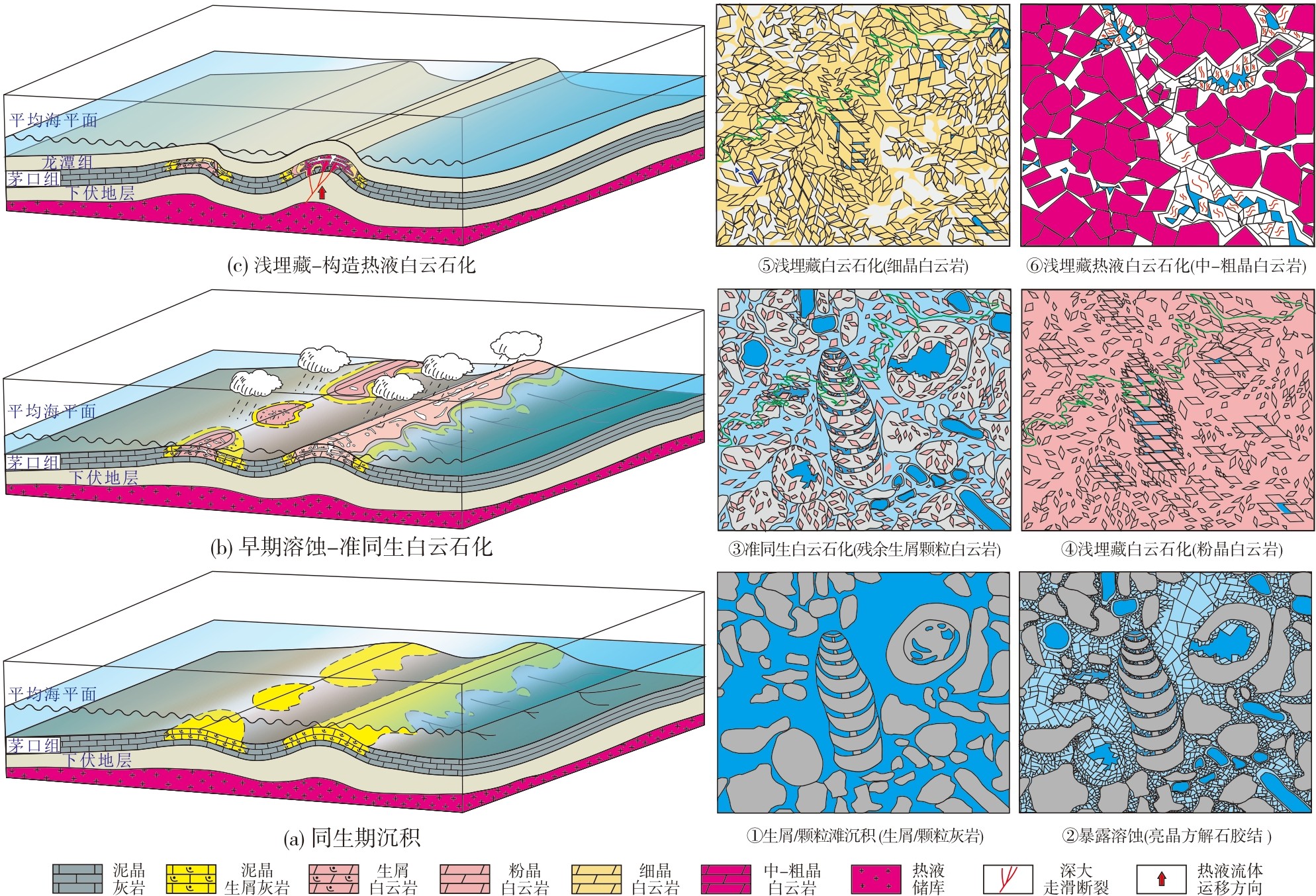
The dolomites of the Middle Permian Maokou Formation in the central Sichuan Basin are important targets for deep oil and gas exploration in the Sichuan Basin. To gain an in-depth understanding of their genesis and reservoir formation mechanisms, this study, based on systematic core and thinsection observations combined with geochemical analysis such as rare earth elements, carbon and oxygen isotopes, and U-Pb dating, has yielded the following insights: (1) The dolomites of the Maokou Formation were primarily formed through three stages of dolomitization: residual bioclastic grain dolomite is the product of penecontemporaneous sea water dolomitization; very fine-crystalline and fine-crystalline dolomite formed in a shallow burial environment, controlled by dolomitization of marine-sourced pore water; while medium- to coarse-crystalline dolomites were related to the Emeishan large igneous province event and formed by the replacement of pre-existing dolomite or limestone through shallow burial structural-hydrothermal dolomititation. (2) The reservoir spaces of the Maokou Formation dolomites underwent a complex diagenetic evolution process, with the diagenetic sequence being: cementation→meteoric freshwater dissolution→penecontemporaneous dolomitization→shallow burial dolomitization→mechanical compaction→tectonic fracturing→hydrothermal alteration→pressure dissolution→hydrocarbon charging. (3) The development of the Maokou Formation dolomite reservoirs is controlled by a "sedimentation-diagenesis-tectonics" triple control mechanism: high-energy platform-margin shoals laid the foundation for primary porosity; penecontemporaneous dissolution and dolomitization were key to the development of large-scale porosity; and tectonic-hydrothermal activities played an important adjusting role in the reservoirs through the dynamic balance between dissolution-enhanced porosity and cementation-reduced porosity. Based on the above understanding, it is inferred that large-scale dolomite reservoirs of the Maokou Formation in the central Sichuan Basin are mainly distributed in high-energy platform-margin shoals or areas adjacent to faults. The results of this study enhance the understanding of the formation process of complex dolomite reservoirs and provide clear directions and solid theoretical support for the next phase of deep oil and gas exploration in this area.
dolomite origin / reservoir controlling factors / Maokou Formation / Middle Permian / central Sichuan Basin
| [1] |
朱光有, 姜华, 黄士鹏, 等. 中国海相油气成藏理论新进展与万米深层超大型油气区预测[J]. 石油学报, 2025, 46 (4): 816-842.
海相碳酸盐岩是中国陆上油气勘探的重要组成部分,近年来取得了一系列勘探突破,为保障中国能源安全发挥了重要作用。结合近期中国三大克拉通盆地油气勘探成效,系统梳理了中国海相油气成藏理论、勘探技术与油气发现等最新进展。①中国三大克拉通的海相油气勘探成效显著:塔里木盆地富满地区、顺北地区发现两个地质储量达10亿吨级超深层断控型特大油气田,四川盆地川中古隆起北斜坡区发现万亿立方米级大气区,鄂尔多斯盆地在奥陶系盐下马家沟组五段6亚段—马家沟组四段白云岩中发现了多个勘探新区带。②在储层预测与成储过程示踪方面取得了一系列重要进展:Mg同位素示踪白云石化过程的研究推动了白云岩成因机理的发展;通过分析深部断溶体等多类碳酸盐岩储集空间特征及保持机制,明确了碳酸盐岩洞穴储层勘探深度的下限远远超过可钻深度;断溶体刻画、礁滩体表征、储层透明与定容表征等技术进步推动了高效勘探的进程,显著提高了钻井成功率。③成藏过程与流体示踪方面进展显著:轻烃、同位素、生物标志化合物等分析技术的创新,提升了油—气—源对比的有效性;多种成藏定年技术取得的重要进展有效指导了成藏有利区的确定;油气藏演化与重建技术的不断发展推动了中国复杂构造背景下海相碳酸盐岩的成藏过程分析由定性向定量转变。④系统分析中国海相碳酸盐岩油气成藏的富集规律与主控要素,明确了中国海相油气藏具有面积分布大、油气柱幅度大、高产井受烃源岩与规模储层联合控制、走滑断裂控制富集区、油气藏寿命超长的鲜明特征。⑤中国海相盆地万米深层资源潜力巨大,潜在发育5个万亿立方米级大气区和1个10亿吨级大油田区。中国海相油气成藏理论的发展丰富了特色小克拉通盆地的油气成藏理论,推动了石油地质理论的不断进步,并在中国万米深层油气勘探实践中发挥着重要作用。
Marine carbonate rocks are an important part of onshore oil-gas exploration in China. A series of exploration breakthroughs have been made in recent years, which play an important role in ensuring energy security. Based on the recent achievements of petroleum exploration in the three craton basins of China, this paper systematically reviews the latest advances in the theory and technology of marine petroleum accumulation in China, and forms the following understandings and advances. (1)Significant achievements have been made in marine oil and gas exploration in three major cratons. For example, two ultra-deep fault-controlled giant oil-gas fields with 1 billion tons of geological reserves have been discovered in in Fuman and Shunbei areas of Tarim Basin, the trillion cubic meters of large gas field has been initially established in the northern slope of central Sichuan Basin, and several new exploration zones have been discovered in the dolomites from the Ordovician pre-salt submember 6 of Member 5 of Majiagou Formation to Member 4 of Majiagou Formation in Ordos Basin. (2)A series of important advances have been made in reservoir prediction and reservoir tracing. For example, the study of Mg isotope tracing dolomitization process has promoted the development of genetic mechanism analysis of dolomite. By analyzing the spatial characteristics and retention mechanism of carbonate reservoirs such as deep fault solution, it is clear that the lower limit of exploration depth of carbonate cavern reservoir is far beyond the drilling depth. Advances in fault solution characterization, reef bank characterization, reservoir transparency and constant volume characterization have promoted efficient exploration and significantly improved drilling success. (3)Remarkable progress has been made in hydrocarbon accumulation process and fluid tracing. For example, technological innovations such as light hydrocarbons, isotopes and biomarkers have been used to improve the effectiveness of hydrocarbon source correlation. Important progress has been made in the dating techniques of accumulation with various methods, which can effectively guide the determination of favorable accumulation areas. With the development of hydrocarbon reservoir evolution and reconstruction technology, the marine carbonate reservoir formation process under complex tectonic background has been transformed from qualitative analysis to quantitative study. (4)By systematically analyzeing the accumulation law and main controlling factors of marine carbonate oil and gas in China, it is clear that marine oil and gas reservoirs in China are characterized by large area distribution, large amplitude of oil and gas column, high production well controlled by source rock and large-scale reservoir, oil and gas richment controlled by strike-slip fault, and ultra-long life of hydrocarbon reservoirs. (5)The deep and ultra-deep resource potential of marine basins in China is huge, with the potential development of 5 trillion cubic meter gas fields and 1 billion-ton oilfield. The development of marine oil and gas theory enriches the accumulation theory of small craton basins, promotes the progress of petroleum geology theory, and plays an important role in the practice of oil and gas exploration.
|
| [2] |
|
| [3] |
The 10 000-m ultradeep dolomite reservoir holds significant potential as a successor field for future oil and gas exploration in China's marine craton basin. However, major challenges such as the genesis of dolomite, the formation time of high-quality reservoirs, and the preservation mechanism of reservoirs have always limited exploration decision-making. This research systematically elaborates on the genesis and reservoir-forming mechanisms of Sinian–Cambrian dolomite, discussing the ancient marine environment where microorganisms and dolomite develop, which controls the formation of large-scale Precambrian–Cambrian dolomite. The periodic changes in Mg isotopes and sedimentary cycles show that the thick-layered dolomite is the result of different dolomitization processes superimposed on a spatiotemporal scale. Lattice defects and dolomite embryos can promote dolomitization. By simulating the dissolution of typical calcite and dolomite crystal faces in different solution systems and calculating their molecular weights, the essence of heterogeneous dissolution and pore formation on typical calcite and dolomite crystal faces was revealed, and the mechanism of dolomitization was also demonstrated. The properties of calcite and dolomite (104)/(110) grain boundaries and their dissolution mechanism in carbonate solution were revealed, showing the limiting factors of the dolomitization process and the preservation mechanism of deep buried dolomite reservoirs. The in situ laser U-Pb isotope dating technique has demonstrated the timing of dolomitization and pore formation in ancient carbonate rocks. This research also proposed that dolomitization occurred during the quasi-contemporaneous or shallow-burial periods within 50 Ma after deposition and pores formed during the quasi-contemporaneous to the early diagenetic periods. And it was clear that the quasi-contemporaneous dolomitization was the key period for reservoir formation. The systematic characterization of the spatial distribution of the deepest dolomite reservoirs in multiple sets of the Sinian and the Cambrian in the Chinese craton basins provides an important basis for the distribution prediction of large-scale dolomite reservoirs. It clarifies the targets for oil and gas exploration at depths over 10 000 m. The research on dolomite in this study will greatly promote China's ultradeep oil and gas exploration and lead the Chinese petroleum industry into a new era of 10 000-m deep oil exploration. |
| [4] |
|
| [5] |
|
| [6] |
戴金星. 威远气田成藏期及气源[J]. 石油实验地质, 2003, 25(5): 473-480.
|
| [7] |
马永生. 四川盆地普光超大型气田的形成机制[J]. 石油学报, 2007, 28(2): 9-14, 21.
普光气田是在四川盆地勘探过程中发现的最大气田,也是我国海相碳酸盐岩层系最大的气藏。除储量规模最大外,普光气田也是四川盆地目前已发现的气藏中埋藏深度最大、资源丰度最高、储层性质最好、优质储层最厚、天然气中硫化氢含量最高、天然气干燥系数最大的整装气藏。普光大型气田的特殊性与该区经历过独特的成烃、成岩和成藏作用有关,油气的高度富集源自:多套烃源岩和优质烃源岩的多期次充注;疏导体系与生、排烃过程形成动态匹配;储层发育在蒸发岩台地边缘高能鲕粒滩相沉积相带中,并受到后期白云化作用和深埋条件下酸类的强烈溶蚀改造,致使次生孔隙空前发育;构造古隆起与长期接受供烃,硫酸盐热化学反应(TSR)的发生与储层次生孔隙的大量生成和储集性能的优化,飞仙关组上覆嘉陵江组和雷口坡组厚层膏岩的有效遮挡。
Puguang Gas Field as the largest gas field of Sichuan Basin is also the biggest marine carbonate formational gas reservoir. In addition, Puguang Gas Field has highlights in several aspects such as the deepest burial condition, the highest reserves abundance, excellent reservoir quality, the thickest reservoir bed, the highest quantity of H<SUB>2</SUB>S and the biggest dry coefficient of natural gas. Puguang Gas Field has the special condition of reservoir-forming, which is in virtue of some factors, including the repeated infusion of the multiple hydrocarbon and high quality of hydrocarbon, the dynamic matches of channel system and the processes of generation and expulsion of hydrocarbon, the development of reservoir bed at the edge of evaporated plateau and the high-energy oolite facies, the highly formation of the secondary porosity due to the late dolomization and intense acid corrosion, the paleo-tectonic bulges and long-term received hydrocarbon, the occurrence of thermochemical sulfate reduction and the highly development of secondary porosity in reservoir bed, the optimism of the performance of reservoir bed, as well as the effectiveness barrier of thick gypsum rock in Jialingjiang and Leikoupo formations overlying Feixianguan Formation.
|
| [8] |
郭彤楼. 元坝气田长兴组储层特征与形成主控因素研究[J]. 岩石学报, 2011, 27 (8): 2381-2391.
|
| [9] |
|
| [10] |
肖钦仁, 袁海锋, 叶子旭, 等. 川中北部地区八角场构造二叠系茅口组白云岩储层成因机制[J]. 天然气地球科学, 2023, 34 (7): 1218-1236.
结合前人对四川盆地二叠系茅口组白云岩储层的研究成果,利用薄片观察、阴极发光、碳氧同位素和原位激光微区分析等技术手段,对八角场构造角探1井茅口组白云岩储层进行了较为系统的地球化学分析,讨论了其成因机制。研究认为:①角探1井茅口组茅二<sup>a</sup>段滩相白云岩储层主要发育在台洼边缘滩相沉积之中,储层的发育受沉积相带和白云石化作用的共同控制。②茅口组共存在2期白云石化作用。第一期白云石化作用主要形成细—中晶白云石,以半自形—自形晶体为主,阴极发光强度较弱,主要发暗红光—红光,δ<sup>13</sup>C<sub>VPDB</sub>值和∑REE浓度与泥晶灰岩相当,稀土元素存在Ce负异常和Y正异常特征,表明白云石化流体主要为同时期的局限海水;第二期白云石化作用形成鞍状白云石,阴极发光强度最强,发红光—亮红光,具有明显的δEu正异常特征,具有高<sup>87</sup>Sr/<sup>86</sup>Sr值,Sr含量低但Mn含量高,同时具有较高的流体包裹体均一化温度和盐度,表明白云石化流体为深部的高盐度热液卤水。③在同生—准同生期—浅埋藏期,发生第一期白云石化作用,局限海水中的Mg<sup>2+</sup>交代亮晶生屑灰岩,形成大量晶间溶孔和晶间孔,由于白云岩较灰岩有更强的抗压实作用,孔隙空间得到较好的保存;进入埋藏期,受构造运动影响,发生第二期白云石化作用,主要形成鞍状白云石,充填在第一期白云石化作用形成的孔隙空间中,对储层起破坏性作用。
Based on the previous research results of the dolomite reservoir of the Permian Maokou Formation in the Sichuan Basin, the authors made a systematic geochemical analysis of the dolomite reservoir of the Maokou Formation in the Well JT1 of the Bajiaochang structure by means of thin section observation, cathodoluminescence, carbon and oxygen isotope and in-situ laser microanalysis, and discussed the genetic mechanism of the dolomite reservoir. According to the research: (1) The shoal facies dolomite reservoir of a section of Mao 2 Member of Maokou Formation in Well JT1 is mainly developed in the shoal facies deposition at the edge of the platform depression, and the development of the reservoir is controlled by the sedimentary facies belt and dolomitization. (2) There are two stages of dolomitization in the Maokou Formation. The first phase of dolomitization mainly formed fine-medium crystalline dolomite, mainly semi-euhedral to euhedral crystals, with weak cathodoluminescence intensity, mainly dark red to red light. δ13C VPDB value and ∑REE concentration are equivalent to those of micritic limestone, and rare earth elements have the characteristics of Ce negative anomaly and Y positive anomaly. It indicates that the dolomitization fluid is mainly confined seawater at the same period. The second stage of dolomitization forms saddle-shaped dolomite, and the intensity of cathodoluminescence is the strongest, red to bright red light, with obvious positive δEu anomaly features, high 87Sr/86Sr ratio, low Sr content but high Mn content, and high fluid inclusion homogenization temperature and salinity, indicating that its dolomitization fluid is deep high-salinity hydrothermal brine. (3) The dolomitization time is syngenetic - penecontemporaneous to shallow burial period, the first stage of dolomitization occurs, and Mg2+ in limited seawater metasomatizes sparry bioclastic limestone, forming a large number of intercrystalline dissolution pores and crystals. Because dolomite has a stronger anti-compaction effect than limestone, the pore space is better preserved; in the burial period, affected by tectonic movement, the second stage of dolomitization occurred, mainly forming saddle-shaped dolomite, filling in the pore space formed by the first stage of dolomitization. It has a destructive effect on the reservoir. |
| [11] |
陈轩, 赵文智, 张利萍, 等. 川中地区中二叠统构造-热液白云岩的发现及其勘探意义[J]. 石油学报, 2012, 33 (4): 562-569.
<p>Integrated with seismic profile interpretations, Petro-mineralogic observations and geochemical analyses, the present paper proposed that dolomites in the Middle Permian Qixia Formation-Maokou Formation of the central Sichuan Basin are of a structure-controlled hydrothermal origin. The characterization of the dolomites showed that:1) they are relatively thicker in a single layer, commonly in lenticular form, poor in lateral continuity, sometimes accompanied with developed strike-slip faults and having a “concave-down” reflection in seismic sections corresponding to dolomite intervals concerned; 2) matrix dolomites composed mainly of meso- or macro-crystalline grains have the saddle-shaped dolomite with undulatory extinction stuffed in their fractures and vugs, where a large amount of breccias with white dolomites filled between them develops, forming zebralike fabrics; and 3) homogenization temperatures of matrix and interstitial saddle-shaped dolomites are commonly 5℃ higher than those of strata during dolomitization, ranging between 105.8~159.6℃ and 113.2~138.6℃,respectively. In addition, they show lighter oxygen isotopes (-7.64‰~-7.95‰) and higher <sup>87</sup>Sr / <sup>86</sup>Sr ratios(0.708 369~0.709 684). The development and distribution of structure-controlled hydrothermal dolomites are dominated by strike-slip faults. There would be a good lithologic reservoir if hydrothermal dolomites combine well with overlying tight limestones.</p>
|
| [12] |
何文渊, 白雪峰, 蒙启安, 等. 碳酸盐台内斜坡认识突破与重大发现: 以川中地区中二叠统茅口组二段气藏勘探为例[J]. 中国石油勘探, 2023, 28 (1): 59-70.
目前川中古隆起规模性勘探发现主要集中在深部震旦系—寒武系的高能滩相,中部二叠系处于台内斜坡相,以低能环境为主,勘探未受重视。为了进一步落实川中地区中二叠统气藏富集规律,通过岩心描述、薄片分析、U—Pb 测年与印模法古地貌恢复等手段,开展岩相古地理、储层成因及成储模式与气藏特征分析,对全盆地茅口组二段(茅二段)进行了重新认识。结果表明:(1)四川盆地茅二段发育南带、中带与北带3个北西向古地貌高带,川中地区处于南部古地貌高带中南部,发育规模滩体;(2)茅二段古地貌高带控制了沉积期滩体分布以及准同生期的岩溶、白云岩化作用,据此构建了川中地区茅二段白云岩储层发育模式,认为川中地区茅二段发育大面积优质白云岩储层;(3)创新建立茅二段薄层白云岩地震预测技术,古地貌高带控制了茅二段优质白云岩储层分布与气藏的高产富集。新认识带来勘探领域新突破,指导部署的潼深4井等5口井试气获超百万立方米高产,实现了四川盆地茅二段台内天然气勘探的重大突破,提交探明储量超千亿立方米。目前,川中地区茅二段气藏已成为“十四五”期间提交天然气探明储量的重要领域。
At present, large-scale discoveries in Central Sichuan paleo-uplift are mainly concentrated in the deep Sinian-Cambrian system of high-energy beach facies, while the exploration of the Permian is ignored by considering that it was generally developed in low-energy environment of intraplatform slope facies. In order to further identify the enrichment law of gas reservoirs in the Middle Permian in Central Sichuan Basin, the lithofacies paleogeography, reservoir genesis, reservoir development pattern and gas reservoir characteristics are analyzed by means of core description, thin section analysis, U-Pb dating and ancient landform restoration (impression method), and the second member of Maokou Formation (hereinafter referred to as Mao 2 member) is re understood at the basin level. The study results show that: (1) Three NW trending paleo high zones were developed in Sichuan Basin during the deposition period of Mao 2 member, namely, the southern zone, the middle zone and the northern zone. Central Sichuan Basin was located in the central-southern part of the southern paleo high zone and largescale beach body was developed; (2) The paleo high zones controlled the distribution of beach body, karstification in the penecontemporaneous period and dolomitization of Mao 2 member. On this basis, the reservoir development pattern is constructed, which indicates that high-quality dolomite reservoirs were widely developed in Mao 2 member in Central Sichuan Basin; (3) The seismic prediction technology of thin bedded dolomite of Mao 2 member is innovatively established, which shows that the distribution of high-quality reservoirs and the enrichment and high yield of gas reservoir in Mao 2 member were controlled by the paleo high zone. As a result, breakthroughs were obtained in the new exploration field guided by new geological understanding, achieving high gas flows of more than one million cubic meters during the test of five wells (including Well TS4), and marking a major breakthrough in gas exploration of Mao 2 member in Sichuan Basin, with the submitted proven gas reserves of exceeding 100 billion cubic meters. Now, the gas reservoir in Mao 2 member in Central Sichuan Basin is a major resource base for increasing proven reserves during the 14th Five-Year Plan period.
|
| [13] |
张赫驿, 杨帅, 张玺华, 等. 川东地区中二叠统茅口组沉积微相与环境演变: 以重庆市武隆区羊角剖面为例[J]. 石油与天然气地质, 2024, 45 (2): 457-470.
|
| [14] |
杨雨, 谢继容, 赵路子, 等. 四川盆地茅口组滩相孔隙型白云岩储层天然气勘探的突破及启示: 以川中北部地区JT1井天然气立体勘探为例[J]. 天然气工业, 2021, 41 (2): 1-9.
|
| [15] |
王珏博, 谷一凡, 陶艳忠, 等. 川中地区茅口组两期流体叠合控制下的白云石化模式[J]. 沉积学报, 2016, 34 (2): 236-249.
|
| [16] |
任梦怡, 江青春, 汪泽成, 等. 川南地区中二叠统茅口组成岩流体来源及演化过程[J]. 天然气工业, 2020, 40 (4): 40-50.
|
| [17] |
沈华, 杨光, 屈卫华, 等. 四川盆地自贡地区中二叠统茅口组多类型储层特征及分布预测[J]. 中国石油勘探, 2023, 28 (3): 49-63.
苏里格气田勘探发现以后效益开发面临极大挑战,为吸收借鉴国际先进的开发技术和管理经验实现开发突破,确立了与法国道达尔公司共同开发、中方担任作业者的国际合作开发模式。10余年的合作开发实践表明,在相同的储层地质条件下国际合作区单井开发指标明显高于自主开发区,系统梳理关键开发技术并进行系统总结对提升自主开发区开发效果具有重要意义。与自主开发区追求规模效益与低成本控制的开发理念不同,国际合作区以经济效益、正现金流策略为目标,以风险控制为核心。经过多年集中攻关与实践检验,形成了三维地震—地质融合储层评价、网格分区棋盘丛式标准化井网部署、批量实施工厂化钻完井作业、TAP Lite分层压裂储层改造、适度放压间歇生产气井管理、速度管柱主导的措施增产6项关键核心特色开发技术,通过与自主开发区技术对比,落实了5项可供借鉴的特色开发技术,并总结了3条重要启示:(1)持续深化地质研究支撑高质量部署;(2)加强顶层优化设计支撑科学有序实施;(3)强化全过程管理与质量控制助推开发效果提升。国际合作区关键核心开发技术与重要经验的吸收借鉴可对致密气新区开发效果的提升提供有力支撑。
In order to identify the differential development mechanism and distribution law of reservoirs in the Middle Permian Maokou Formation in Zigong area in Sichuan Basin, reservoir types and main controlling factors are comprehensively analyzed by using abundant wireline logging, mud logging, core samples and well testing data. The study results show that there are two main reservoir types in the study area, i.e., limestone and dolomite. The dolomite reservoirs were mainly developed in the second member (Mao 2) and the fourth member (Mao 4) of Maokou Formation, with a single layer thickness of over ten to tens of centimeters, and generally developed at the top of upward shallowing sedimentary sequence. Laterally, the dolomite reservoir in Mao 2 member is mainly distributed in Weiyuan-Zigong-Fushun area and that in Mao 4 member mainly in Guanyinchang-Qinggangping area. The limestone reservoirs show a large variation in thickness and strong heterogeneity, which are distributed in Mao 2-Mao 4 members vertically, and the paleo highland or slope zone of the depositional or weathering crust karst geomorphology laterally. The further analysis shows that the formation of dolomite reservoirs was related to evaporation concentration-reflux infiltration dolomitization and short-term karst exposure driven by high-frequency sea level drop, and the limited evaporative seawater environment was intensified in the study area by the relative slope break during the depositional period and overlapping migration of beach bodies; The genesis of limestone reservoirs was classified into types, i.e., beach controlled early diagenetic karst, weathering crust karst and fault dissolution reconstruction, which were controlled by slope break, highland or slope of karst landform and fault, respectively. It is concluded that the highly heterogeneous and multi-genetic reservoirs in Maokou Formation were jointly controlled by “four-paleo” factors, namely, paleo geomorphology during the depositional period, paleo environment, paleo weathering crust karst geomorphology, and paleo faults. The favorable reservoirs are distributed along the “circum-slope highland”. The exploration orientation in the near future includes the stereoscopic exploration of multi-layer and multi-type reservoirs in Zigong-Fushun area in the northeast and the large-scale dolomite reservoirs in Guanyinchang-Qinggangping area in the southwest.
|
| [18] |
陈明启. 川西南下二叠阳新统白云岩成因探讨[J]. 沉积学报, 1989, 7(2): 45-50.
|
| [19] |
张荫本. 四川盆地二迭系中的白云岩化[J]. 石油学报, 1982, 3(1): 29-33.
四川盆地二迭系是一个气候温暖、潮湿、生物极端繁盛的浅水碳酸岩台地。其中的白云化有三种成因:一是沿缝孔交代的粗大的白云石;二是沿缝合线交代的小菱面体的白云石;三是咸淡水混合成因的粗大的白云石,前两种数量不多,后一种却形成了大规模的云岩体,其控制因素是生物滩或生物礁等古代碳酸岩高地。
The Permian System in Sichuan basin is composed of shallow water carbonate rocks deposited on a platform in a warm and humid climate with very flourishing biota.Dolomitization occurred under the following circumstances:(1)replcement by large coarse-grained dolomites along the fractures and pores;(2)replacement by small rhombohedral dolomites along the suture lines and(3)replacement by large coarse-grained dolomites of fresh-saline water origin.The last mentioned dolomites predominate the other two,with the ancient carbonate rock upland of biolith origin in neighboring provinces playing the controlling role. |
| [20] |
何幼斌, 冯增昭. 四川盆地及其周缘下二叠统细—粗晶白云岩成因探讨[J]. 江汉石油学院学报, 1996, 18(4): 15-20.
|
| [21] |
王运生, 金以钟. 四川盆地下二叠统白云岩及古岩溶的形成与峨眉地裂运动的关系[J]. 成都理工学院学报, 1997 (1): 12-20.
|
| [22] |
金振奎, 冯增昭. 滇东—川西下二叠统白云岩的形成机理:玄武岩淋滤白云化[J]. 沉积学报, 1999, 17(3): 383-389.
|
| [23] |
刘宏, 马腾, 谭秀成, 等. 表生岩溶系统中浅埋藏构造-热液白云岩成因: 以四川盆地中部中二叠统茅口组为例[J]. 石油勘探与开发, 2016, 43 (6): 916-927.
|
| [24] |
李毅, 沈浩, 石学文, 等. 川东—川中地区茅口组白云岩成因初探及“热次盆”概念的提出[J]. 天然气勘探与开发, 2013, 36 (4): 1-3, 29.
|
| [25] |
江青春, 胡素云, 汪泽成, 等. 四川盆地中二叠统中-粗晶白云岩成因[J]. 石油与天然气地质, 2014, 35 (4): 503-510.
|
| [26] |
李祖兵, 欧加强, 陈轩, 等. 川中地区下二叠统白云岩储层特征及发育主控因素[J]. 大庆石油地质与开发, 2017, 36 (4): 1-8. DOI:10.19597/J.ISSN.1000-3754.201611047.
|
| [27] |
胡安平, 潘立银, 郝毅, 等. 四川盆地二叠系栖霞组、茅口组白云岩储层特征、成因和分布[J]. 海相油气地质, 2018, 23 (2): 39-52.
Carbonates of Middle Permian Qixia Formation and Maokou Formation had been gas-producing reservoir mainly in southern Sichuan Basin in the last century. It had been accepted that these reservoirs were fractured limestones, resulting in low gas ratio (5.80,) and failure to discover uncompartmentalized gas fields. Based on the investigations and analysis of 6 outcrops, 10 exploration wells, 500 thin sections, and other data of isotope, minor element, rare earth element, fluid inclusion and isotopic age get from 80 samples, three findings are presented as follows:(1)Dolostones with intercrystaline pores, dissolution-enlarged intercrystaline pores and vugs are widespread in Qixia Formation and Maokou Formation; (2) Dolostone reservoirs was predominantly constrained by shoal water carbonate sediments, and the dissolution in freshwater during early diagenetic processes, and the tectonic and hydrothermal events during burial; (3)The dolostone reservoirs are mainly distributed in the 2nd member of Qixia Formation in west and central Sichuan Basin, and in the 2nd and 3rd member of Maokou Formation in west, central and south Sichuan Basin.
|
| [28] |
蒋裕强, 谷一凡, 李开鸿, 等. 四川盆地中部中二叠统热液白云岩储渗空间类型及成因[J]. 天然气工业, 2018, 38 (2): 16-24.
|
| [29] |
|
| [30] |
施泽进, 夏文谦, 王勇, 等. 四川盆地东南部茅口组古岩溶特征及识别[J]. 岩石学报, 2014, 30 (3): 622-630.
|
| [31] |
李大军, 陈辉, 陈洪德, 等. 四川盆地中二叠统茅口组储层形成与古构造演化关系[J]. 石油与天然气地质, 2016, 37 (5): 756-763.
|
| [32] |
黎荣, 胡明毅, 潘仁芳, 等. 川中地区中二叠统断溶体发育特征及形成机制[J]. 中国石油勘探, 2019, 24 (1): 105-114.
川中地区中二叠统碳酸盐岩经历了多期构造变形和岩溶作用,并沿溶蚀断裂带形成了各种不规则的断溶体。为了明确断溶体形成及发育特征,预测断溶体发育区,对断溶体类型及形成机制进行研究。根据岩心、薄片、测井和地震资料,在川中地区识别出溶洞-裂缝型、裂缝型和裂缝-溶洞型3种类型的断溶体,断溶体类型受断裂和岩溶储层发育规模和期次控制。溶洞-裂缝型断溶体主要是同沉积断裂带叠加茅口组暴露剥蚀的岩溶洞而形成的;裂缝型断溶体是加里东期及海西期形成的深大断裂在后期复活后受到大气淡水溶蚀、热液溶蚀以及有机酸溶蚀共同作用下形成的;而裂缝-溶洞型断溶体是加里东期和海西运动产生的次生断裂在大气淡水和有机酸溶蚀中二叠统颗粒滩形成的断控复合面状溶蚀体。断溶体作为一个复合的储集体为油气提供了良好的储集空间,其主要分布于深大断裂带及其伴生的次生断裂带溶蚀面,且叠加颗粒滩的裂缝-溶洞型断溶体为最有利的储集体。
The Middle Permian carbonate rocks in the central Sichuan Basin have experienced multi-stage tectonic deformation and karstification, and accordingly various irregular fault-karst carbonate rocks have been formed along the dissolved fault zone. In order to clarify the forming and development characteristics, and predict where fault-karst carbonate rocks are developed, the type and forming mechanism of fault-karst carbonate rocks have been studied. According to core, thin section, logging and seismic data, three types of fault-karst carbonate rocks were identified, including vug-fracture type, fracture type and fracture-vug type, which depend on the development scales and periods of karst reservoirs and faults. The vug-fracture type is based on the karst vugs from the superposition of syn-depositional fault belts and the exposure of the Maokou Formation. The fracture type is the result of the joint dissolution action among meteoric water, thermal fluids and organic acid on the resurrecting deep and large faults formed in the Caledonian and Hercynian periods. The fracture-vug type is the fault controlling composite formed in the Caledonian and Hercynian Movements, which are formed by the secondary faults and plane fault-karst carbonate rocks as the result of meteoric water and organic acid dissolving the Middle Permian granular beach. As a type of composite reservoir, fault-karst carbonate rocks provide good spaces for oil and gas, and are mainly distributed in the dissolution planes of large and deep faults and its associated secondary fault belts. The fracture-vug type is the most favorable reservoir.
|
| [33] |
罗文军, 叶宁, 兰雪梅, 等. 川中龙女寺地区二叠系中统茅口组储层特征及成因机制[J]. 天然气勘探与开发, 2025, 48 (3): 14-26.
四川盆地中部龙女寺地区二叠系中统茅口组是该区近年来天然气勘探开发的重要层系之一,但受制于储层非均质性强、成因机制不明等因素,延缓了其天然气高效勘探开发进程。为了解决上述问题,采用岩心观察、薄片鉴定、测井资料分析等手段和方法,研究了该区茅口组沉积特征、储层岩石学特征、储集空间类型及储层类型,探讨了储层成因机制及控制储层演化的主要地质过程,建立了储层演化模式。研究结果表明:①该区茅口组储层主要发育在茅二下亚段细—中晶白云岩中,白云岩普遍具有残余颗粒幻影特征,属于低孔隙度、特低渗透率储层;②储集空间类型包括晶间孔、晶间溶孔、针状孔、连通缝洞及裂缝,储层类型可划分为裂缝—孔洞型、孔洞型以及孔隙型,其中前两者为优势储层类型;③白云岩储层发育区域与颗粒滩体分布范围高度重合,砂屑滩相带和生屑滩相带的孔隙度显著高于滩间海相带和台坪相带;④准同生期大气淡水溶蚀形成初始孔隙,白云岩化作用保存储集空间,早期热液流体沿断裂侵入引发水力压裂并形成鞍形白云石充填,最终构建了“砂屑滩为基础,准同生溶蚀成储,白云岩化保储,热液改造优储”的储层演化模式。结论认为,该区茅口组储层非均质性受沉积相带与多期成岩作用的共同控制,准同生期溶蚀作用奠定储层基础,热液改造扩大储集空间,滩体结构与断裂体系是优质储层发育的主控因素。
The Middle Permian Maokou Formation has recently emerged as one of vital reservoirs for natural-gas exploitation in Longnvsi area. However, Maokou reservoirs are characterized by strong heterogeneity resulting in uncertain forming mechanisms, which may retard their efficient exploration and development. Thus, the depositional and petrological characteristics, and reservoir space and types were analyzed for this formation after core observation, thin-section identification, and logging-data analysis. Moreover, reservoir-forming mechanisms and the main geological process controlling reservoir evolution were discussed to create an evolution model. Results show that (i) Maokou reservoirs in the study area are dominantly developed with fine- to medium- crystalline dolomite in the lower part of the second member of Maokou Formation (Maokou 2 Member). Generally, unreal images of residual grain are visible in the dolomite. And such reservoirs belong to low porosity and ultra-low permeability ones; (ii) their space consists of intercrystalline pores, intercrystalline dissolution pores, needle-like pores, contiguous fractures and vugs, and fractures. And they can be classified into three types, such as fractured-vuggy, vuggy, and porous reservoirs, with the first two as the predominant; (iii) dolomite reservoirs are mostly extended into grain-beach bodies. And not only fragmental shoal but bioclastic beach facies belts exhibit remarkably higher porosity than that in inter-beach sea and platform-flat facies belts; and (iv) initial pores are stemmed from meteoric freshwater of penecontemporaneous dissolution. Dolomitization preserves reservoir space. Early hydrothermal fluid invasion along faults induces hydraulic fractures to generate saddle-shaped dolomite filling. Accordingly, the created model is in line with the fragmental shoal as the basis, the penecontemporaneous dissolution for forming reservoirs, the dolomitization for reservoir preservation, and the hydrothermal alteration for making reservoirs better. In conclusion, strong heterogeneity in these Maokou reservoirs is jointly conditioned by sedimentary facies belts and multiepisodic diagenesis, with the dissolution attributing to reservoir basis, the expanded space due to the alteration, and beach bodies’ structure and fault system as the major controls on the development of quality reservoirs. |
| [34] |
李红, 王良军, 柳益群, 等. 四川盆地东部中二叠统茅口组热液活动特征[J]. 古地理学报, 2021, 23 (1): 153-174.
四川盆地中二叠统茅口组存在丰富的热液流体活动。在野外剖面和岩心观察的基础上,利用多种分析测试方法,对四川盆地东部茅口组碳酸盐岩中的热液活动特征进行了探讨。研究区茅口组热液活动包括2类,一类为硅质热液,表现为薄层硅质岩或硅质团块;另一类为碳酸盐型热液,表现为粗晶方解石和白云石充填在张性构造裂缝中或呈“雪片状”集合体,偶见少量黄铁矿、闪锌矿等金属硫化物伴生。硅质岩主量元素之间的关系表明硅质来源具有多样性,是热液硅与壳源硅的混合;黄铁矿、闪锌矿原位S同位素 δ<sup>34</sup>S 介于-3.91‰~-6.87‰之间,推测可能受到了微生物和基性岩浆岩的双重影响;方解石脉和具鞍状双晶的白云石脉普遍具有CaO高于标准计量、相对富Sr和U、贫REE和Ti、Ce/Ce<sup>*</sup>明显负异常、Eu/Eu<sup>*</sup>主体正异常、Y正异常等特征,表明碳酸盐脉为热液活动的产物,流体来源也呈现出火山活动相关流体与富钙地下水混合的特点。闪锌矿富集Ge和Cd,Zn/Cd及Zn/Fe值反映了中等成矿温度。硅质岩和碳酸盐流体包裹体均一温度变化范围较大,介于54.7~294.3 ℃之间,与稀土元素和微量元素比值所揭示的特征吻合。研究结果表明,穿层状硅质结核和团块的首次出现往往标志着茅口组热液活动的开始,而张性构造裂缝和碳酸盐型热液活动带来的围岩白云化作用则有效地改善了白云岩储集层的物性。
|
| [35] |
杨跃明, 杨雨, 文龙, 等. 四川盆地中二叠统天然气勘探新进展与前景展望[J]. 天然气工业, 2020, 40 (7): 10-22.
|
| [36] |
刘建强, 郑浩夫, 刘波, 等. 川中地区中二叠统茅口组白云岩特征及成因机理[J]. 石油学报, 2017, 38 (4): 386-398.
川中地区茅口组白云岩主要位于茅口组二段中、上部和茅口组三段下部,根据岩石学特征可分为含灰质细-中晶白云岩、细-中晶白云岩、角砾白云岩,且以后两者为主。对比泥晶灰岩与不同类型白云岩样品地球化学特征后发现,白云岩相对于同层灰岩具有较低的Fe含量、较高的Mn含量和较低的Sr含量;泥晶灰岩与不同类型白云岩具有相似的稀土配分特征,均表现为LREE亏损、轻微正La异常和负Ce异常,且白云岩样品具有微弱的Eu正异常;细-中晶白云岩与角砾白云岩δ<sup>18</sup>O值均明显低于原始灰岩,而<sup>87</sup>Sr/<sup>86</sup>Sr比值则明显高于原始泥晶灰岩。不同类型白云岩与灰岩相似的稀土配分特征表明茅口组白云岩形成过程中保留了原始灰岩的部分地球化学特征,而白云岩微弱Eu正异常及其与灰岩同位素差异性可能是由于白云岩化过程中高温地质热流体的参与而引发的。茅口组白云岩化作用受多种因素控制:地层残余海水和岩浆活动伴生的热液流体为白云岩化作用中Mg的主要来源;峨眉山大火成岩省热效应为白云岩化提供异常高的古地温背景;断裂系统为异常地温对流和白云岩化流体提供了快速运移通道;颗粒滩相灰岩较好的孔、渗性使之比泥晶灰岩更易发生白云岩化。峨眉山大火成岩省伴生的异常地温和充足Mg供给是茅口组发生白云岩化的关键,不同类型白云岩形成于白云岩化过程的不同阶段。
<p>The dolomites in Maokou Formation, central Sichuan area are mainly developed in the mid-upper Member 2 and the lower Member 3 of Maokou Formation, which can be divided into fine-medium calcareous dolomite, fine-medium crystalline dolomite and brecciaous dolomite according to petrological characteristics, and the latter two are dominant. As viewed from the contrast in geochemical characteristics between micritic limestone and other types of dolomite samples, dolomites have lower Fe content, higher Mn content and lower Sr content than other limestone at the same layer. The micritic limestone and different types of dolomite present similar rare earth element (REE) distribution patterns with depletion of light REE, weak positive anomaly of La and negative anomaly of Ce, and dolomite sample also has weak positive anomaly of Eu. Fine-medium dolomite and brecciaous dolomite have lower δ<sup>18</sup>O values than primitive limestone, and obviously higher <sup>87</sup>Sr/<sup>86</sup>Sr ratios than primitive micritic limestone. The similar REE distribution patterns between limestone and different types of dolomite indicate that some geochemical characters of primitive limestone are preserved during the dolomitization process in Maokou Formation, while the difference between the weak positive anomaly of Eu in dolomite and the limestone isotopes may be caused by the participation of high-temperature geo-hydrotherm during the dolomitization process. The dolomitization of Maokou Formation is dominated by multiple factors as follows: (1) the stratigraphic residual seawater and hydrotherm associated with magmatism are the major sources of Mg in dolomitization;(2) the thermal effect of Emeishan large igneous province provides abnormally high paleo-geothermal context for dolomitization;(3) the fault systems offer rapid migration channels for abnormal geothermal convection and dolomitization fluid;(4) the limestone with grain beach facies possesses favorable porosity and permeability, and thus have a higher possibility of dolomitization than micritic limestone. The abnormal geotherm associated with Emeishan Large igneous province in and abundant Mg content are the two key factors for dolomitization in Maokou Formation, and different types of dolomites were formed in different phases of dolomization process.</p>
|
| [37] |
汪泽成, 江青春, 黄士鹏, 等. 四川盆地中二叠统茅口组天然气大面积成藏的地质条件[J]. 天然气工业, 2018, 38 (1): 30-38.
|
| [38] |
匡明志, 张小兵, 袁海锋, 等. 川中地区茅口组碳酸盐岩层序地层及沉积相特征[J]. 古地理学报, 2024, 26 (5): 1201-1220.
四川盆地二叠系茅口组碳酸盐岩是油气勘探的重要层位,川中八角场—磨溪—龙女寺地区茅二段目前已获得勘探突破,但因其层序地层结构尚不明确,制约了茅口组沉积演化研究与储集层预测。本研究基于川中广安华蓥山二崖剖面茅口组高精度岩相特征,综合实际钻井资料,开展茅口组沉积相和层序地层格架分析,并解释层序格架对储集层发育特征和分布规律的控制作用。研究结果表明: (1)川中地区茅口组碳酸盐岩可分为8类岩石微相,在茅口组沉积中晚期,构造作用驱动茅口组由缓坡沉积体系向“台地—台内海槽”沉积体系转换。(2)栖霞组上部层序界面SB1和茅二下亚段上部层序界面SB2均为Ⅱ型岩相转换界面,茅二上亚段顶界面SB3为Ⅰ型淹没不整合界面,茅三段顶界面SB4为Ⅰ型剥蚀不整合面。(3)二崖剖面茅口组可划分为3个三级层序、5个四级层序: 茅一段构成三级层序SQ1的海侵体系域; 茅二下亚段中—下部对应三级层序SQ1的高位体系域,而上部发育三级层序SQ2陆架边缘体系域; 茅二上亚段和茅三段分别对应三级层序SQ2和SQ3。(4)磨溪—龙女寺地区茅二下亚段云化储集层分布在三级层序SQ1高位体系域和三级层序SQ2陆架边缘体系域,分别以准同生晚期和准同生早期云化作用为主,受控于Ⅱ型层序界面SB2;广安—八角场地区茅二上亚段台缘滩相白云岩储集层分布在三级层序SQ2高位体系域并且受控于Ⅰ型层序界面SB3,经历了准同生早期基质云化—准同生晚期颗粒溶蚀—埋藏期云化作用阶段。该研究为四川盆地茅口组白云岩储集层分布规律的预测和成因研究提供了层序和沉积约束,对茅口组的油气勘探具有一定的参考意义。
The carbonate rocks of the Permian Maokou Formation in the Sichuan Basin are crucial for oil and gas exploration. Significant breakthroughs have been achieved in the exploration of the Maokou Formation in the Bajiaochang-Moxi-Longnüsi area of central Sichuan Basin. However,the unclear stratigraphic structure impedes the study of sedimentary evolution and reservoir prediction of the Maokou Formation. This research is based on high-precision lithofacies characteristics of the Maokou Formation at the Er’ya section in the Huaying Mountain of Guang’an in central Sichuan Basin. It integrates actual drilling data to analyze the sedimentary facies and sequence stratigraphic framework of the Maokou Formation,explaining the influence of the sequence framework on the development characteristics and distribution patterns of the reservoirs. The research findings indicate that: (1)The carbonate rocks of the Maokou Formation in the central Sichuan Basin can be divided into eight lithofacies. During the late stage of deposition of the Maokou Formation,tectonic activity facilitated the transition from a gentle slope sedimentary system to a “platform-platform interior sea trough” sedimentary system. (2)The upper sequence interface SB1 of the Qixia Formation and the upper sequence interface SB2 of the lower submember of Member 2 of the Maokou Formation are both classified as type II lithofacies transition interfaces. The top interface SB3 of the upper submember of Member 2 of the Maokou Formation is identified as a type I drowning unconformity interface,while the top interface SB4 of Member 3 of the Maokou Formation is classified as a type I erosion unconformity interface. (3)The Maokou Formation in the Er’ya section can be divided into three third-order sequences and five fourth-order sequences. Member 1 of the Maokou Formation constitutes the transgressive system tract of third-order sequence SQ1. The middle to lower parts of the lower submember of Member 2 correspond to the high-position system tract of third-order sequence SQ1,while the upper part develops the transgressive system tract of third-order sequence SQ2 at the margin of the continental shelf. The upper submember of Member 2 and Member 3 of the Maokou Formation correspond to third-order sequences SQ2 and SQ3,respectively. (4)In the Moxi-Longnüsi area,the dolomitized reservoirs of the lower submember of Member 2 of the Maokou Formation are distributed in the high-position system tract of third-order sequence SQ1 and the continental shelf margin system tract of third-order sequence SQ2. These reservoirs are primarily dominated by late diagenetic dolomitization and early diagenetic dolomitization,controlled by type II sequence boundary SB2. In the Guang’an-Bajiaochang area,the dolomite reservoirs of the upper submember of Member 2 of the Maokou Formation in the platform margin shoal facies are found in the high-position system tract of third-order sequence SQ2 and are controlled by type I sequence boundary SB3. These reservoirs undergo stages of early diagenetic matrix dolomitization,late diagenetic grain dissolution,and burial dolomitization. This study provides constraints on sequence and sedimentation for predicting the distribution patterns and investigating the genesis of dolomite reservoirs in the Maokou Formation in the Sichuan Basin,which is significant for oil and gas exploration in the Maokou Formation.
|
| [39] |
何斌, 徐义刚, 王雅玫, 等. 用沉积记录来估计峨眉山玄武岩喷发前的地壳抬升幅度[J]. 大地构造与成矿学, 2005, 29(3): 316-320. DOI:10.16539/j.ddgzyckx.2005.03.004.
|
| [40] |
李旭兵, 曾雄伟, 王传尚, 等. 东吴运动的沉积学响应: 以湘鄂西及邻区二叠系茅口组顶部不整合面为例[J]. 地层学杂志, 2011, 35 (3): 299-304.
|
| [41] |
沈安江, 郑剑锋, 陈永权, 等. 塔里木盆地中下寒武统白云岩储集层特征、成因及分布[J]. 石油勘探与开发, 2016, 43 (3): 340-349.
基于盆地钻遇中下寒武统18口井的岩心、薄片和单井资料及两条露头剖面,开展微区(指在不同成岩作用事件中形成的同类成岩矿物)地球化学分析和储集层溶蚀模拟实验,研究塔里木盆地中下寒武统白云岩储集层类型、成因和分布。塔里木盆地中下寒武统发育台缘礁滩、台内丘滩和台内膏云岩3类白云岩储集层,其中,台内膏云岩储集层又可分为潜山型和内幕型两个亚类;储集层岩石类型有藻礁(丘)白云岩、砂屑白云岩和膏云岩,藻礁(丘)白云岩储集层以藻格架(溶)孔为主,砂屑白云岩储集层以粒间、粒内(溶)孔及晶间(溶)孔为主,膏云岩储集层以石膏铸模孔及微孔隙为主。礁滩相和膏云坪沉积中的沉积原生孔是储集层发育的关键,准同生期未白云石化的灰质、膏质为早表生溶蚀孔洞的发育奠定了物质基础,准同生白云石化作用形成的白云岩构成坚固的岩石格架对孔隙起到保护作用。中下寒武统台缘礁滩储集层既有规模,储集层物性又好,是非常现实的勘探对象,而下寒武统肖尔布拉克组台内礁滩储集层和中下寒武统内幕型膏云岩储集层的潜力较好。图9参12
Based on cores, thin sections and drilling data of 18 wells and two outcrop profiles of the Lower-Middle Cambrian in the Tarim Basin, geochemical analysis of multi-parameters in micro-area (the same type of diagenetic minerals formed in different diagenetic events) and reservoir dissolution modeling were carried out to find out the types, origin and distribution of Lower-Middle Cambrian dolomite reservoirs. There develop three types of dolomite reservoirs, margin reef-shoal reservoir, platform interior mound-shoal reservoir and platform interior gypsodolomite reservoir. The rock types include algae dolomite, grain dolomite, and gypsodolomite; the pore types in them include algae framework pores in algae dolomite; intergranular pores, intra-granular dissolved pores, inter-crystalline dissolved pores in grain dolomite and gypsum-dissolved pore gypsodolomite. The primary pores in sediments of reef-shoal facies and gypsodolomite flat are the key to the development of the dolomite reservoirs, some aragonite and calcite are the material basis of dissolution in early supergene stage, and the dolomite formed in penecontemporaneous dolomitization acts as strong rock skeleton to protect the primary pores from destructive effect in burial stage. The margin reef-shoal reservoirs, large in scale and good in physical properties, are the most practical exploration targets; furthermore, the platform interior reef-shoal reservoirs in Lower Cambrian Xiaoerbulake Formation and platform interior gypsodolomite reservoir in the Middle-Lower Cambrian have higher oil and gas potential.
|
| [42] |
|
| [43] |
|
| [44] |
朱光有, 李茜. 白云岩成因类型与研究方法进展[J]. 石油学报, 2023, 44 (7): 1167-1190.
白云岩储层具备巨大的油气勘探潜力,但白云岩成因问题始终存在争议,这极大地干扰了优质白云岩储层的有效预测。为进一步推动白云岩成因问题的研究,系统回顾了近20年来白云岩的成因类型和传统研究方法,以及Mg同位素、团簇同位素、晶体结构和激光原位U-Pb定年等非传统研究方法的研究进展,并对其中存在的问题进行了总结。目前已建立的白云岩成因模式多达20多种,但从本质出发白云岩成因类型可划分为原生白云岩和次生白云岩两类。通过不断探索使白云岩成因理论愈加深入和丰富,其中微生物诱导理论的兴起为原生白云岩的成因提供了更有利的证据,部分次生交代白云岩成因理论也得到了拓展和挑战。基础岩石学、阴极发光、主/微量元素、稀土元素、流体包裹体、碳/氧同位素、锶同位素等传统分析方法为探究白云岩成因做出了卓越的贡献,是探究白云岩成因的基础。非传统白云岩成因研究方法的迅速发展,为白云岩的形成和演化提供了更多有用的信息。Mg同位素可有效示踪富Mg流体来源和重建白云石化的演化过程;团簇同位素测温技术在揭示白云岩成岩温度、恢复白云石化流体性质等方面有着重要意义;白云石晶体结构中保存了其形成过程中的环境、结晶、晶体生长、流体等方面特有的证据,可作为研究白云石形成环境、形成机理的有效手段;激光原位U-Pb定年的绝对年龄对于认识白云岩成岩过程和演化具有重要的价值。然而,白云岩的形成是一个涉及不同地质条件和不同时期的多阶段综合过程,无论是传统还是非传统白云岩研究方法都存在一定的优缺点,在许多情况下,仅用某种单一成因模式或研究手段难以完全解释白云岩的成因。因此,在研究白云岩成因时,切勿简单套用甚至滥用成因模式,而是应该针对具体情况具体分析,并将传统和非传统白云岩分析手段相互结合,综合地质背景、流体性质、来源、动力学和热力学机制,从而给出更为准确和合理的白云岩成因解释。通过对白云岩成因研究的系统回顾和分析,以期为研究白云岩成因提供一些参考和新的启示。
Dolomite reservoirs have huge oil and gas exploration potential, but there are always disputes on the genesis of dolomite, which greatly affects the effective prediction of high-quality dolomite reservoirs. To further push the study of dolomite genesis, the paper systematically reviews the genetic types and traditional research methods of dolomite, as well as the research progress of non-traditional methods involving Mg isotope, clumped isotope, crystal structure and laser in-situ U-Pb dating in the past two decades, and also summarizes the existing problems. At present, there are more than 20 genetic models of dolomite, and the genetic types of dolomite can be essentially divided into primary dolomite and secondary dolomite. Through continuous exploration, the genetic theories of dolomite have been expanded, and also face challenges; among them, the emerging microbial induction theory has provided a more favorable evidence for the genesis of dolomite, and the genetic theory of some secondary metasomatic dolomite has also been expanded and challenged. The traditional analytical methods of basic petrology, cathodoluminescence, major and trace elements, rare earth elements, fluid inclusions, carbon and oxygen isotopes, and strontium isotopes have made great contributions to the exploration of dolomite genesis, laying a foundation for exploring the genesis of dolomite. The rapid development of non-traditional research methods for dolomite genesis provides more useful information for the formation and evolution of dolomite. Mg isotopes can effectively trace the source of Mg-rich fluid and reconstruct the evolution process of dolomite. Clumped isotope thermometry is of great significance for analyzing the diagenetic environment and diagenetic fluid in terms of dolomite diagenetic temperature and recovery of oxygen isotope value of dolomitized fluid. The crystal structure of dolomite has preserved the unique evidence of environment, crystallization, crystal growth and fluid in its formation process, which can be used as an effective means to study the formation environment and formation mechanism of dolomite. The absolute age determined by laser in-situ U-Pb dating is of great value for understanding the diagenesis and evolution of dolomite. However, the formation of dolomite is a multi-stage comprehensive process involving different geological conditions and different periods, and both traditional and non-traditional dolomite research methods have certain advantages and disadvantages. In many cases, it is difficult to explain the genesis of dolomite only using a single genetic model or research method. Therefore, we shall not simply apply or even abuse the genetic model in the study of dolomite genesis, and shall analyze the specific situation, combine the traditional and non-traditional dolomite analysis methods, and comprehensively consider the geological background, fluid properties, sources, dynamic and thermodynamic mechanisms, so as to give a more accurate and reasonable explanation on dolomite genesis. Through a systematic review and analysis of researches on dolomite genesis, it is expected to provide some reference and new enlightenments for the study of dolomite genesis.
|
| [45] |
李茜, 朱光有, 李婷婷, 等. 中国海相盆地深层白云岩储层特征及成因机理[J]. 世界石油工业, 2024, 31 (4): 35-47.
|
| [46] |
|
| [47] |
廖芸, 张建勇, 鲁鹏达, 等. 川中北斜坡中二叠统茅口组多期流体活动与成藏过程[J]. 天然气地球科学, 2023, 34 (11): 1927-1940.
川中北斜坡中二叠统茅口组岩性主要为生屑灰岩,发育岩溶缝洞型储层。通过岩心观察、镜下薄片鉴定,结合阴极发光特征,确定了茅口组溶蚀孔洞及裂缝中的矿物充填序列。在此基础上对不同期次成岩矿物中捕获的流体包裹体特征进行分析,结合川中北斜坡二叠系埋藏热演化史及成岩矿物U—Pb定年数据,明确茅口组油气成藏过程。结果表明:茅口组储层储集空间以残余溶蚀孔洞及裂缝、溶蚀缝为主;孔洞中见粉—细晶方解石→细—中晶方解石→粗—巨晶方解石3期充填。第二期方解石U—Pb年代学定年时间为晚二叠世(244.1±6.3 Ma),流体包裹体特征表现为高成熟度液烃包裹体与盐水包裹体混生,测得均一温度峰值主要集中在120~130 ℃之间,第三期粗—巨晶方解石发育高密度甲烷包裹体及沥青包裹体,其均一温度峰值主要集中在165~170 ℃之间。川中地区中二叠统茅口组经历了3期成藏事件:第一期为晚二叠世—早三叠世下寒武统筇竹寺组生成的原油充注形成古油藏;第二期为中侏罗世—早白垩世油藏裂解形成气藏;第三期为晚白垩世喜马拉雅期构造抬升气藏调整形成现今混合气藏。中二叠统天然气主要为筇竹寺组烃源岩生成的原油裂解气,混有少量中二叠统自身烃源岩的贡献,川中地区发育的继承性断裂具有较好的沟通源储作用。
The lithology of Middle Permian Maokou Formation in the northern slope area of central Sichuan Basin is mainly bioclastic limestone, and the reservoir type is karst fracture and cave. Through core observation, microscopic thin section identification and cathodoluminescence characteristics, the mineral filling sequences of Maokou Formation are determined. On this basis, the characteristics of fluid inclusions captured in different stages of diagenetic minerals are analyzed, and combined with Permian burial thermal evolution history and diagenetic mineral U-Pb dating data in central Sichuan Basin, the process and time of oil and gas accumulation in Maokou Formation are determined. The results show that the reservoir space of the second member of Maokou Formation is mainly composed of residual dissolution pores, fractures and dissolution fractures. The reservoir space of the Maokou Formation is dominated by residual dissolution cavity, fracture and dissolution fracture. Three stages of calcite filling were observed in the pores, with the sequence of powder - fine crystal calcite → fine - medium crystal calcite → coarse - giant crystal calcite filling. The U-Pb chronological dating of the second stage calcite is the Late Permian (244.1 ±6.3 Ma). The fluid inclusions are characterized by the mixing of high maturity liquid hydrocarbon inclusions and brine inclusions. The peak homogenization temperature is mainly between 120℃ and 130℃. In the third stage of coarse-giant calcite, there are high-density methane inclusions and asphalt inclusions, and their homogenization temperature peaks are mainly concentrated in the range of 165-170 ℃. It is revealed The Maokou Formation of Middle Permian in central Sichuan Basin has three stages of hydrocarbon accumulation, the first stage is the filling of oil from Late Permian to Early Triassic Lower Cambrian Qiangzhusi Formation to form fossil oil reservoir, the second stage is in the Middle Jurassic-Early Cretaceous fossil oil reservoir cracking to form gas reservoir, and the third stage is the adjustment of Late Cretaceous Himalayan structural uplift gas reservoir to form present mixed gas reservoir. The Middle Permian natural gas is mainly crude oil cracking gas generated by the source rocks of the Qiongzhusi Formation, mixed with a small amount of Middle Permian source rocks, and the inherited faults developed in central Sichuan Basin play a good role in communicating source and storage. |
| [48] |
肖钦仁, 袁海锋, 谌辰, 等. 川中北部地区茅口组白云岩成因分析: 来自岩石学、原位地球化学及年代学证据[J]. 天然气地球科学, 2024, 35 (7): 1160-1186.
近期川中北部地区茅口组白云岩储层勘探获重大突破。为探讨白云岩储层成因,通过岩心观察、薄片镜下观察、阴极发光、激光原位主微量元素分析和U⁃Pb同位素定年等技术手段,对川中北斜坡地区茅口组白云岩储层进行了系统的地球化学特征研究,建立了研究区茅口组白云岩的成岩序列,并厘定了各类型白云岩的成岩流体特征,最终建立了研究区茅口组白云石化模式。主要认识有:①研究区主要发育生屑白云岩、晶粒白云岩和鞍状白云岩3种类型白云岩,根据岩石学特征和地球化学特征建立的成岩序列为第一世代生屑白云岩(D1⁃1)→第二世代它形细晶白云岩(D2⁃1)→第三世代非典型鞍状白云岩(SD1)→第四世代典型鞍状白云岩(SD2)→第五世代砂糖状白云岩(D2⁃2)。其中残余生屑白云岩先后受到第二世代它形细晶白云岩和第三世代非典型鞍状白云岩的影响所形成。②白云岩的地球化学特征均显示出明显的Ce负异常和Y正异常特征,表明各类型白云岩受到海源流体及其衍生流体不同程度的影响。同时各类型白云岩甚至生屑灰岩的部分样品存在δEu值正异常,表明存在后期构造—热液作用。③在同生期—中深埋藏期先后发育5期白云石化作用,在同生期—准同生期先后发生第一期白云石化作用和第二期白云石化作用,形成生屑白云岩和它形细晶白云岩等白云岩基质;在准同生期—浅埋藏期受构造作用的影响发生2期构造—热液白云石化作用,形成鞍状白云岩,并交代部分基质白云石;进入中—深埋藏期的第五期白云石化作用交代生屑白云岩和它形细晶白云岩形成大量砂糖状白云岩。④第一期白云石化作用和第二期白云石化作用由于发生时间很早,有利于原生孔隙的保存,第三期白云岩化作用和第四期白云石化作用属于典型的构造—热液白云石化作用,对白云岩储层的孔隙建造和破坏作用并重,而第五期埋藏期白云石化作用是在封闭体系中发生的,是研究区白云岩储层形成的最重要的成岩作用。
Recently, significant breakthroughs have been made in the exploration of dolomite reservoirs in the Maokou Formation in the northern slope area of central Sichuan. In order to explore the genesis of dolomite reservoirs, the author used techniques such as core observation, thin section microscopy, cathodoluminescence, laser in-situ analysis of major and trace elements, and U⁃Pb isotope dating to systematically study the geochemical characteristics of the Maokou Formation dolomite reservoirs in the northern slope area of central Sichuan, and established the diagenetic sequence of the Maokou Formation dolomite in the study area. And the diagenetic fluid characteristics of various types of dolomite were determined, ultimately establishing a dolomitization model for the Maokou Formation in the study area. The main understanding includes: (1) Three types of dolomite are mainly developed in the study area, namely, biotite dolomite, crystalline dolomite and saddle dolomite, and the diagenetic sequence based on petrological and geochemical characteristics is as follows: the first generation of D1-1 → the second generation of D2-1 → the third generation of SD1 → the fourth generation of SD2 → the fifth generation of D2-2. The D1-2 was successively formed by the influence of the second-generation D2-1 and the third-generation SD1. (2) The geochemical characteristics of the dolomites show obvious Ce-negative and Y-positive anomalies, indicating that each type of dolomite has been affected by the sea-derived fluids and their derivatives to different degrees. At the same time, the positive δEu anomalies in some samples of each type of dolomite and even clastic tuffs indicate the existence of late tectonic-hydrothermal effects. (3) Five phases of dolomitization were developed successively in the syn- and medium-deep burial periods, and the first and second phases occurred successively in the syn- and quasi-syncline periods, resulting in the formation of the dolomite matrix, such as clastic dolomite and its fine-crystal dolomite, etc.; the tectonic effects were influenced by the tectonic effect in the quasi- and shallow burial periods; and the dolomites in the quasi-and shallow burial periods were influenced by the tectonic effect. In the quasi-symbiotic period, two phases of tectonic-hydrothermal dolomitization occurred under the influence of tectonics, forming saddle-shaped dolomite and accounting for part of the matrix dolomite; the fifth phase of dolomitization in the middle-deep burial period accounted for the formation of a large number of trachyte dolomite and other fine-crystalline dolomite. (4) Phase I dolomitization and Phase II dolomitization are beneficial to the preservation of primary pore space because of their early occurrence. Phase III dolomitization and Phase IV dolomitization are typical tectonic-hydrothermal dolomitization, which have both constructive and destructive effects on the pore space of dolomite reservoirs, and Phase V dolomitization of the buried period occurs in a closed system, which is the most important diagenesis for the formation of the dolomite reservoirs in the study area. |
| [49] |
徐诗雨, 曾乙洋, 林怡, 等. 川中地区中二叠统茅口组储层特征及有效物性下限[J]. 天然气勘探与开发, 2024, 47 (4): 38-45.
储层有效物性下限是识别有效储层、确定储层有效厚度的关键参数,是提交天然气地质储量的一项必要研究内容。川中地区中二叠统茅口组储层有效物性下限常类比川东地区下三叠统飞仙关组、上二叠统长兴组碳酸盐岩储层,但其区域地质条件、沉积环境、成岩作用、岩石类型等均存在明显差异,严重影响了地质储量估算的精度,制约着该区茅口组气藏的勘探开发。本次研究基于钻井、测井、岩心、分析化验等资料,系统分析川中地区茅口组气藏储层特征,综合利用最小流动孔喉半径法、产能模拟法、单层试气法确定储层有效物性下限。研究结果表明:①川中地区茅口组储集岩类包括细晶云岩、少量砂屑云岩、灰质云岩以及云质灰岩;②研究区储集空间以各类溶蚀孔洞为主,裂缝和喉道是重要的渗流通道,储渗空间类型多、几何形态复杂,具较强的非均质性;③受溶蚀孔洞及微裂缝发育等因素影响,采用全直径样品实验结果反映研究区物性水平,总体表现为低孔低渗、局部发育高孔渗段的特征;④3种方法综合确定储层有效孔隙度下限为1.97%,渗透率下限0.009 0 mD,为识别有效储层、确定有效储层厚度、估算地质储量等提供参考依据。
The lower limit of physical properties is a key parameter for identifying effective reservoirs and determining their net pays, as well as a necessary subject in estimating gas in place (GIP). The lower limits of physical properties of effective reservoirs in the Middle Permian Maokou Formation, central Sichuan Basin, are often in analogy to those of carbonate reservoirs in the Lower Triassic Feixianguan and Upper Permian Changxing Formations, eastern Sichuan Basin. However, the Maokou Formation reservoirs are significantly different in regional geological conditions, sedimentary environments, diagenesis, and rock types, seriously impacting the accuracy of GIP estimation and restricting the exploration and development. The reservoir characteristics of the Maokou Formation were systematically analyzed based on drilling, logging, core, and analytic data. And then the lower limits of physical properties were determined by utilizing the methods of minimum flow pore-throat radius, productivity simulation, and single-layer gas testing. The results show that, (i) the Maokou Formation reservoirs are composed of fine-crystalline dolomites, as well as a small amount of psammitic dolomites, limy dolomites, and dolomitic limestones; (ii) the reservoir spaces in the study area are dominated by various dissolution pores/vugs, with fractures and throats acting as key flow pathways; such spaces are diverse in types and complex in geometry, with strong heterogeneity; (iii) considering the development of dissolution pores/vugs and microfractures, the experimental results of full-diameter samples were used to reflect the physical properties, showing generally low porosity and permeability and locally high porosity and permeability; and (iv) by using the above-mentioned three methods, the lower limits of porosity and permeability are determined as 1.97% and 0.009 0 mD, respectively. The study provides a reference for identifying effective reservoirs, determining net pays, and estimating GIP.
|
| [50] |
李双建, 杨天博, 韩月卿, 等. 四川盆地中二叠统热液白云岩化作用及其储层改造意义[J]. 石油与天然气地质, 2021, 42 (6): 1265-1280.
|
| [51] |
高兆龙, 淡永, 张玺华, 等. 四川盆地不同地区二叠系茅口组缝洞粗晶方解石碳氧同位素差异及其古岩溶环境意义[J]. 中国岩溶, 2024, 43 (3): 684-693.
|

/
| 〈 |
|
〉 |