PDF(15667 KB)

Reservoir characteristics and physical property control factors in deep water and low-permeability oil and gas reservoirs: a case study of the 3rd member of Lingshui Formation on the southern slope of Baodao Sag in Qiongdongnan Basin
XU Xiaoting, ZHOU Wei, ZHANG Chong, QIN Lijuan, MENG Di
Marine Origin Petroleum Geology ›› 2026, Vol. 31 ›› Issue (1) : 48-60.
PDF(15667 KB)
PDF(15667 KB)
Reservoir characteristics and physical property control factors in deep water and low-permeability oil and gas reservoirs: a case study of the 3rd member of Lingshui Formation on the southern slope of Baodao Sag in Qiongdongnan Basin
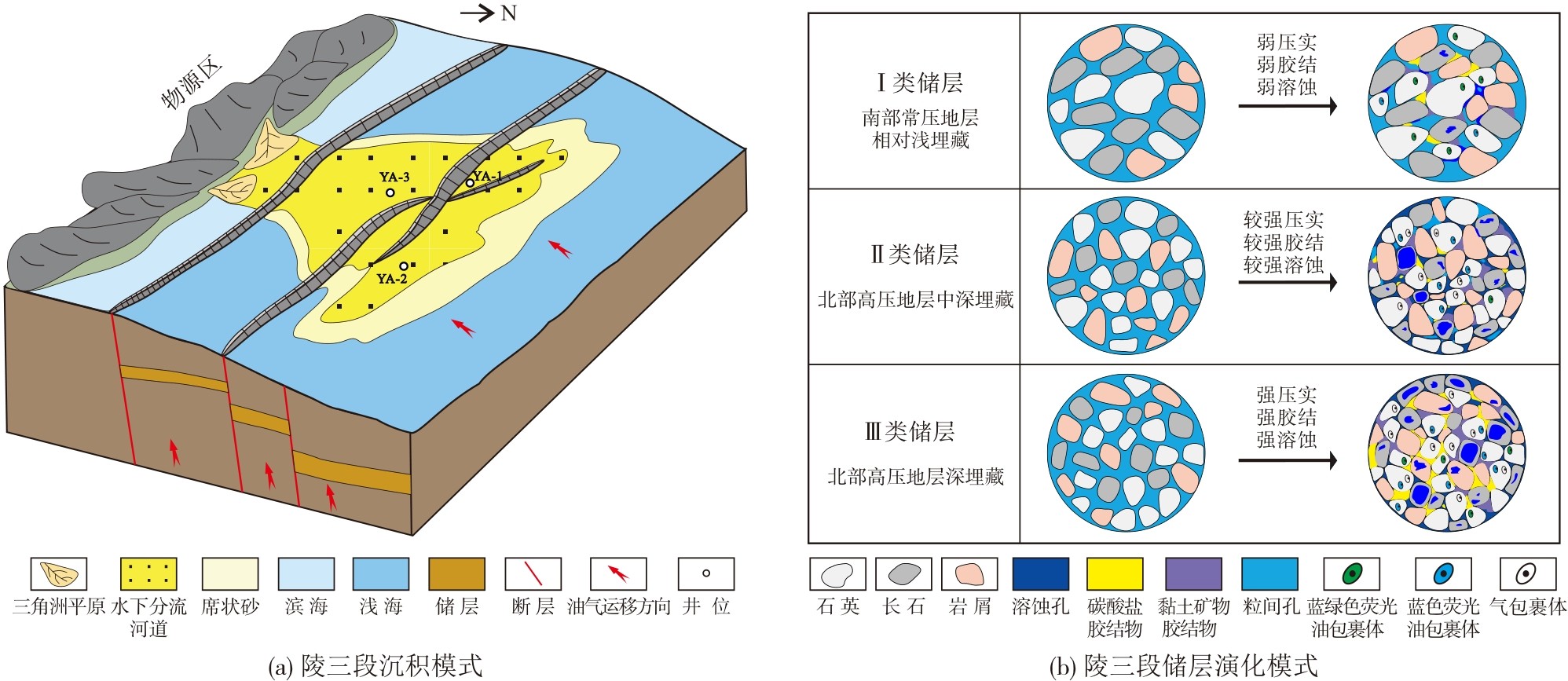
The controlling mechanisms of physical properties and distribution laws of deep water and low-permeability reservoirs have become key scientific issues urgently to be solved in China offshore oil and gas exploration and development. Taking the 3rd member of Lingshui Formation reservoir in YL10 structure on the southern slope of Baodao Sag, Qiongdongnan Basin as the research object, this paper systematically studies the petrological characteristics, pore-throat structure and physical property distribution laws of the reservoir by comprehensively using experiments such as cast thin sections, scanning electron microscopy (SEM), high-pressure mercury intrusion and fluid inclusions. The results show that: (1) The 3rd member of Lingshui Formation in the study area has strong heterogeneity and complex pore-throat structure, generally developing medium-porosity, low to ultra-low permeability reservoirs, with "sweet spot" reservoirs of high porosity and high permeability existing in some areas. (2) The difference in reservoir physical properties is controlled by the sedimentary-diagenetic coupling effect. Sedimentation lays the material foundation for the Lingshui Member 3 reservoir, and diagenesis is the main controlling factor affecting the reservoir type. Compaction, affected by burial depth, is the main cause of reservoir differentiation. Cementation intensifies the differentiation of reservoir physical properties, and the differences in the type, content and occurrence of cements lead to the differentiation between low-permeability and ultra-low-permeability reservoirs. Dissolution controlled by oil and gas charging plays a constructive role in reservoir porosity, and the formation of a large number of mold pores results in maintaining medium porosity while low permeability in the deeply buried reservoir. (3) The shallow, weak-diagenetic zone in the south is a favorable reservoir distribution area, where thick underwater distributary channel sand bodies exhibit high porosity and permeability characteristics; the deep reservoirs in the north require special attention to zones with developed dissolution pores and weak cementation.
low-permeability reservoir / reservoir characteristics / diagenesis / main controlling factor / Baodao Sag / Lingshui Formation / Qiongdongnan Basin
| [1] |
范廷恩. 中国海上低渗油气田开发历程、关键技术及攻关方向[J]. 中国海上油气, 2024, 36(3): 95-109.
|
| [2] |
张迎朝, 蒋一鸣, 刁慧, 等. 东海盆地西湖凹陷低渗—特低渗天然气勘探开发实践、地质新认识及资源潜力[J]. 石油学报, 2025, 46(6): 1074-1088.
东海盆地西湖凹陷是中国近海面积最大的含油气凹陷,也是中国海上天然气勘探开发的主战场之一。近5年,基于"正韵律河道砂甜点"地震预测随钻监测技术、"渗透率分级-甜点厚度占比"高效井型设计与产能评价技术和油基泥浆长裸眼产能释放技术开展地质工程一体化技术体系创新与有效实践,西湖凹陷在多个低渗—特低渗领域获得商业性气流,展现出良好的低渗—特低渗天然气增储上产潜力。综合岩心、录井、测井、地震等地质资料和典型气藏勘探开发实践剖析,系统分析了西湖凹陷低渗—特低渗天然气藏的成藏特征及资源潜力。西湖凹陷始新统平湖组发育斜坡带三角洲平原—潮坪亚相煤系烃源岩和凹陷区潮坪—潟湖亚相含腐泥腐殖型烃源岩两类烃源岩,平湖组潮坪沉积体系发育"自生自储自盖"的天然气近源富集条件,天然气成藏条件优越。受"东西分带、南北分块"构造格局的控制,西湖凹陷中央背斜带发育3类天然气差异富集新模式。西部斜坡带平湖组岩性油气藏具有"纵向叠置、横向连片"的油气分布规律。优选中央背斜带北部的大型构造圈闭、中南部背斜翼部的岩性圈闭、南部深层平湖组和西部斜坡带近洼区为西湖凹陷低渗—特低渗气藏的重点勘探方向,天然气资源量超5千亿立方米。
Xihu sag in the East China Sea Basin is the largest hydrocarbon-bearing sag in China's offshore area, and is also one of the main battlefields for offshore natural gas exploration and development in China. In the past five years, based on the "positive rhythm channel sand dessert" seismic prediction while drilling monitoring technology, "permeability classification-dessert thickness ratio" high-efficiency well type design and productivity evaluation technology, and oil-based mud long open hole productivity release technology, the geological-engineering integration technology system innovation and effective practice have been carried out. Xihu sag has obtained commercial gas flow in many low-ultra-low permeability fields, showing good potential for low-ultra-low permeability natural gas storage and production. Based on the analysis of core, mud logging, logging, seismic and other geological data and the exploration and development practice of typical gas reservoirs, the accumulation characteristics and resource potential of low permeability and ultra-low permeability natural gas reservoirs in Xihu sag are systematically analyzed. The Eocene Pinghu Formation in the Xihu sag develops two types of source rocks:the delta-tidal flat facies coal measure source rock in the slope zone and the tidal flat-lagoon facies sapropelic humic source rock in the sag area, showing a full-sag distribution pattern. The tidal flat sedimentary system of Pinghu Formation has the near-source enrichment conditions of natural gas with "self-generation, self-storage and self-cover", and the natural gas accumulation conditions are superior. Controlled by the structural pattern of "east-west zoning and north-south block", three new models of differential enrichment of natural gas are developed in the central anticline belt of Xihu sag. The lithologic oil and gas reservoirs of Pinghu Formation in the western slope zone have the oil and gas distribution law of "vertical superposition and horizontal connection". The large-scale structural traps in the north of the central anticline belt, the lithologic traps in the wing of the central and southern anticlines, the deep Pinghu Formation in the south and the near-sag areas in the western slope belt are the key exploration directions for the low-permeability and ultra-low-permeability gas reservoirs in Xihu sag. The natural gas resources exceed 500 billion cubic meters.
|
| [3] |
谢玉洪, 袁全社. 中国近海深水深层油气地球物理勘探实践与展望[J]. 石油物探, 2023, 62(2): 183-193.
随着中国海洋油气勘探程度的提高, 近海浅层规模构造油气藏发现越来越少, 深水、深层等复杂油气藏成为重点勘探方向和领域。针对深水、深层面临的油藏地质问题, 开展了一系列勘探实践, 形成了潜山宽照明三维地震勘探技术、深层古近系岩性圈闭高精度地震勘探技术、富含煤地层下薄储层高分辨率地震勘探技术和深水宽频地震勘探技术等创新成果, 并在渤海深层潜山、南海深水和东海深层低孔渗等领域取得一系列勘探突破。但是, 深水、深层勘探仍然面临构造复杂、裂缝发育和各向异性特征强等问题, 造成地震波场复杂、信噪比低, 成像质量差和岩石物理关系不清等难题, 需要在采集装备、采集方式、关键处理方法、基于复杂介质理论的勘探技术和重、磁、震一体化勘探等方面开展进一步的攻关研究。
Large-scale structural oil and gas reservoirs in shallow formations are becoming less common as China's offshore oil and gas exploration increases, and complex reservoirs in deep water and deep formations are becoming the primary exploration targets.CNOOC has formulated a series of exploration practices to address geological problems in deep-water and deep-formation exploration, and has achieved a variety of innovations including wide-illumination 3D seismic exploration technologies for buried hills, high-precision seismic exploration technologies for Paleogene lithologic traps in mid-deep formations, high-resolution seismic exploration technologies for thin reservoirs in coal-rich strata, and deep-water broadband seismic exploration technologies.These technologies have aided in the discovery of buried hills in the Bohai Sea, deep water in the South China Sea, and low-porosity and low-permeability reservoirs in deep formations of the East China Sea.Currently, deep-water and deep-formation exploration still faces a series of problems, such as complex structures in deep formations, a chaotic seismic wave field, a low signal-to-noise ratio, poor imaging quality, fracture development, strong anisotropy, and unclear petrophysical relationships.Therefore, further research in the fields of acquisition equipment, acquisition geometry, processing methods, complex-medium-theory-based exploration technologies, and integrated gravity, magnetic, and seismic exploration is required. |
| [4] |
徐长贵. 中国近海油气勘探新进展与勘探突破方向[J]. 中国海上油气, 2022, 34(1): 9-16.
|
| [5] |
甘军, 张亚震, 林璐, 等. 琼东南盆地宝岛凹陷天然气差异聚集主控因素与成藏模式[J]. 地球科学, 2023, 48(2): 439-450.
|
| [6] |
汪锴, 王根厚, 贾庆军, 等. 琼东南盆地深水区松南—宝岛凹陷的构造演化及其与油气成藏关系[J]. 现代地质, 2023, 37(2): 245-258.
|
| [7] |
雷超, 任建业, 李绪深, 等. 琼东南盆地深水区结构构造特征与油气勘探潜力[J]. 石油勘探与开发, 2011, 38(5): 560-569.
|
| [8] |
戴娜, 钟宁宁, 邓运华, 等. 中生代—新生代大陆边缘盆地海相烃源岩成因类型[J]. 石油学报, 2015, 36(8): 940-953.
中生代-新生代大陆边缘盆地海相烃源岩虽沉积于海洋环境,但有机质生源输入复杂。海相烃源岩显微组分组成中不仅有代表低等水生生物输入的腐泥组分,而且有较多指示陆生高等植物成因的镜质组、惰质组或壳质组。烃源岩生物标志化合物的分布特征也呈现出有机质生源输入二元性的特点,具体表现在饱和烃正构烷烃的分布面貌以双峰态为主,部分呈单峰态。C<sub>27</sub>-C<sub>29</sub>规则甾烷的分布型式以不对称的"V"字型为主,部分呈"L"型或反"L"型分布;除指示水生生物输入的C<sub>23</sub>三环萜烷外,代表陆源有机质输入的奥利烷、四环萜烷和其他低分子量的三环萜烷均有分布。中生代-新生代大陆边缘盆地海相烃源岩生源组成复杂,这一特殊现象是大陆边缘盆地海洋和大陆两种地质营力、低等水生生物和陆生高等植物双重生源输入共同作用的结果。根据生源构成可将中生代-新生代大陆边缘盆地海相烃源岩划分为3种成因类型,即以藻类生源输入为主的内源型、以高等植物输入为主的陆源型及介于两者之间的混合生源型,并进一步揭示海相烃源岩的成因类型与干酪根类型之间可以通过显微组分组成、有机元素组成以及生物标志化合物分布联系起来。
Marine source rocks in Meso-Cenozoic continental margin basins are deposited under marine environment, but with complex biogenesis of organic matters. The maceral composition of marine source rocks not only include the sapropelic components representing the input of lower aquatic organisms, but also contain more vitrinite, inertinite and exinite indicating the genesis of terrestrial higher plants. The distribution of source rock biomarker is characterized by binary biogenic input of organic matters, shown as the distribution of saturated n-alkanes dominated by a bimodal state with partial unimodality. The distribution pattern of regular sterane C27-C29 is dominated by asymmetric "V" shape, partially with "L" and anti-"L" shape. Except C23T indicating the input of aquatic organisms, there are distributed oleanane, tricyclic terpane and other tetracyclic terpane with low molecular weight representing the input of terrestrial organic matters. The biogenic compositions of marine source rocks in Meso-Cenozoic continental margin basins are complicated, which is a special phenomenon resulted from the combined effects of marine-continental geological stresses in continental margin basins and dual biogenic input of lower hydrobiont and terrestrial higher plant. Based on biogenic structure, marine source rocks in Meso-Cenozoic continental margin basins can be divided into three genetic types, i.e., endogenous type dominated by algae biogenic input, terrigenous type dominated by higher plant input, and hybrid biogenic type between the both, further revealing the relation between the genetic types of marine source rocks and kerogen types through maceral composition, organic element components and biomarker distribution. |
| [9] |
黄保家, 李绪深, 王振峰, 等. 琼东南盆地深水区烃源岩地球化学特征与天然气潜力[J]. 中国海上油气, 2012, 24(4): 1-7.
|
| [10] |
张功成, 屈红军, 刘世翔, 等. 边缘海构造旋回控制南海深水区油气成藏[J]. 石油学报, 2015, 36(5): 533-545.
南海边缘海构造旋回包括古南海形成与萎缩及新南海形成与萎缩2个旋回。边缘海构造旋回控制南海深水区盆地分布与性质,南海北部为被动大陆边缘裂谷盆地,南沙地块区盆地为漂移裂谷盆地,南部为复合型活动大陆边缘挤压盆地,西部为转换大陆边缘剪切拉张盆地,东部为俯冲大陆边缘增生楔盆地,深水区盆地主要分布在陆坡区和南沙地块上。边缘海构造旋回控制南海深水区主力烃源岩发育与类型,南海北部大陆边缘深水区发育始新世陆相、渐新世早期海陆过渡相、渐新世晚期海相3套烃源岩;南沙漂移裂谷盆地发育晚白垩世—早渐新世1套陆源海相烃源岩;南海南部大陆边缘深水区发育渐新世、早中新世和中中新世3套海陆过渡相烃源岩;南海西部大陆边缘深水区发育渐新世、早中新世、中中新世3套海陆过渡相烃源岩。边缘海构造旋回控制南海深水区大型储集体的形成,南海北部深水区发育4套储集体以深海扇为主,南沙地块发育2套储集体以三角洲与生物礁为主,南海南部以深水扇和生物礁为主;在大河入海口前缘的区域形成大型水道砂体等碎屑岩储集体,在隆起区形成生物礁滩。边缘海旋回控制深水区储盖组合,南海北部大陆边缘深水区油气成藏组合主要为渐新统—上新统,南沙地块区主要为始新统—渐新统下部,南海南部大陆边缘深水区成藏组合为渐新统—上新统,南海西部大陆边缘深水区成藏组合为渐新统—中新统。南海深水区主要油气藏类型与构造圈闭、深水扇及生物礁相关。南海深水区成盆、成烃、成藏特征受控于边缘海构造旋回,油气勘探潜力巨大。
The tectonic cycle of marginal sea in South China Sea(SCS) includes two cycles which are formation and contraction of Proto-SCS and Neo-SCS. The distribution and features of deep-water basins in SCS are controlled by tectonic cycle of marginal sea. The north of SCS is an extensional basin on passive continental margin, while the Nansha block is a drifting rift basin, and the south is a foreland basin on subduction continental margin, the west is a transtensional basin on transform continental margin, the east is a accretionary wedge basin on subduction continental margin, and the deep-water basins are distributed mainly in the slope zone and Nansha block. The development and types of major source rocks in deep-water areas are dominated by the tectonic cycle of marginal sea. There are three sets of source rocks in deep-water areas of the northern continental margin in SCS, and they are Eocene terrestrial facies, the early Oligocene transitional facies and marine facies in late Oligocene marine facies. Three sets of transitional facies are noticed in deep-water areas of both the southern continental margin in SCS, and they are Oligocene, early Miocene and middle Miocene. The distribution of the main reservoir rocks which mainly developed in Oligocene and Pliocene are also dominated by the tectonic cycle of marginal sea, and they are clastic reservoir rocks that are formed in firth, underwater incised valley and frontal area of the slope, and then became biological reef in the uplift area. The reservoir assemblages in deep-water areas of the northern and the southern continental margin in SCS are present in Oligocene-Pliocene, while the ones in Nansha block are Eocene-lower Oligocene, the ones in the western continental margin are Oligocene- Miocene. The types of reservoir in abyssal zone consists of structural trap, deep-water fan and reef, so there is great potential for exploration in deep-water areas of SCS. |
| [11] |
袁朱晔斐, 田杨, 熊小峰, 等. 琼东南盆地宝岛凹陷南北断阶带古近系陵水组三段天然气差异富集机理[J]. 吉林大学学报(地球科学版), 2024, 54(6): 1998-2013.
|
| [12] |
张迎朝, 甘军, 徐新德, 等. 琼东南盆地深水东区Y8-1含气构造天然气来源及侧向运聚模式[J]. 地球科学, 2019, 44(8): 2609-2618.
|
| [13] |
裴健翔, 罗威, 呙诗阳, 等. 琼东南盆地宝岛凹陷南部渐新统陵水组三段三角洲的发现及石油地质意义[J]. 石油勘探与开发, 2024, 51(2): 299-310.
基于琼东南盆地三维地震资料及钻井获取的岩性、电性、薄片及测年等分析测试数据,开展宝岛凹陷南部断阶带渐新统陵水组三段(简称陵三段)源-汇体系特征及源-汇耦合定量分析等研究。研究表明:①陵三段沉积期YL10剥蚀区发育东、西2大物源水系,在宝岛凹陷南部形成了2大优势输砂通道及2个三角洲朵叶体,整体具有西大东小的特征,可划分为初始期、昌盛期、间歇期和回春期4个演变阶段;②综合三角洲砂体发育期次、展布面积、碾平厚度及不同类型母岩区面积、成砂系数等参数进行源-汇耦合定量计算,结果显示研究区具备形成规模储集体的物质基础;③钻井揭示陵三段三角洲沉积以细砂岩为主,砂岩总厚度为109~138 m,最大单层厚度为15.5~30.0 m,砂地比为43.7%~73.0%,不同断阶间储层物性差异明显;④断阶带多期隆升背景下小物源区规模三角洲发育模式揭示幕式隆升提供充足的物源供给,物源水系及流域面积控制砂体的规模,多级活动断阶控制砂体的输送通道,局部断槽控制砂体的侧向推进方向。陵三段三角洲砂体与断块耦合形成多类型圈闭,成为凹陷南部重要的勘探突破口和新领域,有望为盆地内其他构造背景相似区域油气勘探及储层研究提供借鉴。
|
| [14] |
张尚锋, 童茜倩, 唐武, 等. 源汇格局差异性及其对储层的控制作用: 以琼东南盆地宝岛—长昌凹陷陵水组为例[J/OL]. 长江大学学报(自然科学版), 2025: 1-15 (2025-03-21). https://doi.org/10.16772/j.cnki.1673-1409.20250321.001.
|
| [15] |
王旖旎, 张百涛, 王允洪, 等. 琼东南陵水凹陷北坡构造特征及构造演化分析[J]. 海洋石油, 2024, 44(3): 31-38.
|
| [16] |
龚宇, 佟殿君, 焦垚祺, 等. 琼东南盆地松南—宝岛凹陷北部断阶带演化过程及对成藏的控制作用[J]. 天然气地球科学, 2024, 35(2): 300-312.
松南—宝岛凹陷是琼东南盆地继陵水凹陷之后所发现的又一个具有巨大油气勘探潜力的重要深水勘探区,其北部断阶带构造背景复杂,新生代以来经历了多期应力场的变形和叠加演化,所形成的复杂的构造系统对深水区大中型油气田的形成具有重要的控制作用。运用覆盖研究区的新采集和处理的高精度3D地震资料以及新的勘探成果资料,在精细地震剖面构造地层综合解释的基础上,结合断层活动性定量分析、沉降史反演以及构造演化史恢复等技术,系统地开展北部断阶带的几何学、运动学以及动力学研究。研究结果表明,北部断阶带为由F2断裂、F2?1断裂、F12断裂和F12?1断裂所构成的右阶斜列式同向叠覆式断阶带,经历了由始新世NE向的高角度正断层向渐新世的近EW向的低角度伸展拆离断层的演变过程,并控制了中央坳陷带大型拆离盆地的发育。断层相互叠接部位形成的大型转换带成为控制源—汇系统、始新统和崖城组主力烃源岩和陵三段扇三角洲和辫状河三角洲大型储集体的关键构造因素。
The Songnan-Baodao Sag is another important deepwater exploration area with huge oil and gas exploration potential discovered after the Lingshui Sag in the Qiongdongnan Basin. The structural background of the northern step-fault zone is complex, and it has undergone multiple stages of stress field deformation and superimposed evolution since the Cenozoic era. The complex structural system formed has an important controlling effect on the formation of large and medium-sized oil and gas fields in the deep water area. This paper systematically studies the geometry, kinematics, and dynamics of the Songnan-Baodao northern step-fault zone using newly collected and processed high-precision 3D seismic data and new exploration results covering the research area, based on comprehensive interpretation of fine seismic profile structures and strata, combined with techniques such as quantitative analysis of fault activity, inversion of subsidence history, and restoration of tectonic evolution history. The research results show that the Songnan-Baodao northern step-fault zone is a right step oblique and co directional superimposed step-fault zone composed of No.2 fault, No.2-1 fault, No.12 fault, and No.12-1 fault. It has undergone the evolution process from a high angle normal fault in the direction of Eocene NE to a high angle and low angle extensional detachment fault in the direction of Oligocene near EW, and has controlled the development of large detachment basins in the central depression zone. The large transition zones formed at the overlapping positions of the faults have become the key structural factors controlling the main source rocks, source sink systems, and large reservoirs in the fan delta and braided river delta of the third member of the Eocene and Yacheng Formation. |
| [17] |
吴克强, 解习农, 裴健翔, 等. 超伸展陆缘盆地深部结构及油气勘探意义: 以琼东南盆地为例[J]. 石油与天然气地质, 2023, 44(3): 651-661.
|
| [18] |
施和生, 杨计海, 张迎朝, 等. 琼东南盆地地质认识创新与深水领域天然气勘探重大突破[J]. 中国石油勘探, 2019, 24(6): 691-698.
琼东南盆地深水区是南海北部重要的天然气勘探区带之一,也是大中型气田储量持续增长的主战场。在 上中新统中央峡谷L17 大气田等发现后,类似中央峡谷气田的浅层目标日益减少,深水勘探面临转型,新的大中型 气田领域研究、勘探迫在眉睫。近5 年来,通过思路创新、理论创新和技术创新,加强盆地区域构造、石油地质条件 研究,深化凹陷生烃和油气优势运聚区带规律认识,引领深水勘探转型。研究表明,处于琼东南盆地东部超深水区的 松南低凸起中生界潜山及古近系圈闭群具备“多凹环抱、大型输导脊侧向运移及厚层深海泥岩封盖”的优势运聚成藏 条件,资源潜力大,是勘探转型、新领域突破的首选方向。近期该区带的天然气勘探突破证实了中生界潜山天然气新 领域,拉开了深水区潜山千亿立方米气田发现的序幕,也极大拓展了南海西部海域特提斯构造域中生界潜山勘探领域。
The deep-water area in the Qiongdongnan Basin is one of the most important natural gas exploration areas in the north of the South China Sea. It is also the main battlefield for continuous reserve increases of large and medium gas fields. After the discovery of the large L17 gas field in the Upper Miocene central canyon, shallow targets similar to the central canyon gas field have been decreasing, and it is necessary to carry out more researches on deep water exploration for finding new large and medium-sized gas fields. In the past five years, innovations of ideas, theory and technology have focused on regional structure, petroleum geology and understanding of laws of hydrocarbon generation, migration and accumulation in sags, for the purpose of transforming deep water exploration in the Qiongdongnan Basin. The study shows that, in the Songnan low bulge in the eastern ultra-deep-water area, the Mesozoic buried hills and the Paleogene trap group are surrounded by multiple sags, and have a large transport ridge as a lateral migration pathway, and thick deep-water mudstone as a caprock. The favorable transport and accumulation conditions mean a large potential of resources, which makes the Mesozoic buried hills and the Paleogene trap group the preferred direction for exploration transformation and new breakthroughs. The recent breakthrough in natural gas exploration in this area confirmed abundant natural gas resources in the Mesozoic buried hill. It opened the prelude to the discovery of large gas fields at the scale of 100 billion m3 in the deep-water area, and greatly expanded the exploration of the Mesozoic buried hill in the Tethys tectonic domain in the western South China Sea.
|
| [19] |
张迎朝, 徐新德, 甘军, 等. 琼东南盆地深水大气田地质特征、成藏模式及勘探方向研究[J]. 地质学报, 2017, 91(7): 1620-1633.
|
| [20] |
江汝锋, 曹立成, 邓孝亮, 等. 琼东南盆地宝岛21-1区陵水组沉积特征及其油气地质意义[J]. 地质科技通报, 2024, 43(5): 31-44.
|
| [21] |
|
| [22] |
徐长贵, 侯明才, 吴克强, 等. 琼东南盆地二叠纪—三叠纪长英质岩浆作用: 对南海北部陆缘构造属性与演化过程的启示[J]. 岩石学报, 2024, 40(8): 2450-2468.
|
| [23] |
杨金海, 杨希冰, 周杰, 等. 琼东南盆地深水区松南—宝岛凹陷反转构造带发育特征及油气地质意义[J]. 海洋学报, 2019, 41(5): 97-106.
|
| [24] |
郭帅, 曾清波, 杨海长, 等. 琼东南盆地松南—宝岛凹陷三亚组“源—汇”体系与主控因素分析[J]. 天然气地球科学, 2023, 34(12): 2062-2074.
琼东南盆地松南—宝岛凹陷主体位于琼东南盆地深水区东部,是已被钻探证实的富烃凹陷。中新统三亚组是深水区重要的勘探目的层,储集体规模和粒度是制约松南—宝岛凹陷三亚组油气成藏的关键因素。应用最新的三维地震和已钻井资料,结合区域地质背景,系统分析松南—宝岛凹陷三亚组“源—汇”体系及主控因素,预测有利砂体平面展布。研究表明,松南—宝岛凹陷三亚组沉积期,发育海南隆起和松南低凸起2个“源—汇”体系:中新世构造活跃的海南隆起主控北部“源—汇”体系,供源能力强,凹陷北部发育陆架坡折,发育“陆架三角洲和陆坡沟谷+深水扇”沉积体系;松南—宝岛凹陷以斜坡向松南低凸起过渡,不发育陆架坡折,南部“源—汇”体系具有“近源、沟谷汇聚阶槽控制下的多期深水扇”特征。搬运距离、构造活动和底流改造等因素主控三亚组储集体的发育,优选凹陷南缘为三亚组最有利的储集体发育区;优选松南区和宝岛区东部海底扇为三亚组有利储集体发育区。
The main part of Songnan-Baodao Sag is located in eastern part of deep-water area, Qiongdongnan Basin, which has been proved by drilling to be a hydrocarbon rich sag. Miocene Sanya Formation is an important exploration target in the areas, and the scale and particle size of reservoir are the key factor to the hydrocarbon accumulation of Sanya Formation in Songnan-Baodao Sag. Based on 3D seismic and drilled data, combined with regional geological background analysis, the source to sink system and main controlling factors of the Sanya Formation in the area are systematically analyzed to predict the favorable reservoirs distribution. Research has shown that during the period of Sanya Formation in the area, two source-sink systems were developed: the northern system with strong sediment supply capacity, whose provenance is Hainan Uplift, with strong uplifting in the Miocene; the northern part of the sag developed a continental shelf slope break with "shelf delta+slope canyon+fan" sedimentary system. The sag transitions from a slope to Songnan Low Uplift, with no development of continental shelf slope breaks. The southern system controlled by Songnan Low Uplift is a multi-stage fan model controlled by short transport distance and converging channels. The factors such as transportation distance, tectonic activity, and bottom-current transformation control the development of the reservoirs in Sanya Formation. The southern edge of the sag is selected as the most favorable reservoir development area; the favorable reservoir development areas are the Songnan area and the eastern part of Baodao area. |
| [25] |
潘辉, 蒋裕强, 朱讯, 等. 河流相致密砂岩气地质甜点评价: 以四川盆地川中地区侏罗系沙溪庙组二段1亚段为例[J]. 石油与天然气地质, 2024, 45(2): 471-485.
|
| [26] |
赵伟全, 杨磊磊, 何文军, 等. 准噶尔盆地玛湖凹陷风城组云质泥页岩储层成岩作用及其对储层发育的指示意义[J]. 地质学报, 2024, 98(7): 2233-2244.
|
| [27] |
姜平, 张冲, 叶青, 等. 琼东南盆地宝岛凹陷深水深层“富孔隙型”低渗透砂岩储层成因与“甜点”预测[J]. 天然气工业, 2025, 45(6): 121-135.
|
| [28] |
刘爱群, 范彩伟, 邓勇, 等. 南海琼东南高压盆地压力结构与油气成藏关系[J]. 地球物理学进展, 2017, 32(4): 1817-1822.
|
| [29] |
王子嵩, 刘震, 王振峰, 等. 琼东南盆地深水区中央坳陷带异常压力分布特征[J]. 地球学报, 2014, 35(3): 355-364.
|
| [30] |
苏龙, 郑建京, 王琪, 等. 琼东南盆地超压研究进展及形成机制[J]. 天然气地球科学, 2012, 23(4): 662-672.
基于国内外相关文献的调研和剖析,综合前人的研究成果,总结了琼东南盆地超压的分布特点及深水区压力预测等方面的研究进展。结合现有的钻井、实测压力、地质、地球物理及地球化学等资料,分析了琼东南盆地的超压成因及其形成机制。分析表明:新构造期(5.3Ma)以来,琼东南盆地表现为快速的沉积沉降,特别是西部晚期的巨幅沉降,沉积地层很厚,且泥岩发育,这种独特的快速沉积沉降是该盆地超压形成的重要地质条件。低渗透性沉积层在快速沉积沉降过程中受到上覆岩层欠压实作用而产生超压,其实质是孔隙流体供与排不平衡,是该盆地超压形成的主要机制。同时,水热增压及新生流体等的辅助作用,会使压力进一步升高,使超压进一步加剧。研究成果对琼东南盆地的勘探与开发具有理论指导和现实意义。
It is a typical sedimentary basin of both high temperature and overpressure in the Qiongdongnan basin.Based on collecting the literatures from foreign or our country as well as previous research achievements related to overpressure, we conclude the research progress of pressure prediction in the continental slope area, and the distribution characteristics of overpressure in the basin.In combination with logging data, test pressure data, and geological background, physical geography and geochemistry, we discuss the overpressure genesis and its main formation mechanism in the basin.It is an important geological condition for overpressure formation to be rapid subsidence and high sedimentation rate, especially higher sedimentation rate in the western area than other area of the basin which results in the thick sediments with a certain thickness of mudstone since the Neotectonic event (5.3Ma).Overpressure formation in the basin is mainly resulted from rapid subsidence of low permeability sediments and disequilibrium compaction of overlying strata.Thus, it is essential for the overpressure formation to be imbalance between supply and discharge of pore fluid in the Qiongdongnan basin.Meanwhile, the overpressure is exacerbated further by gas generation and thermal expansion of fluid.So, it is significant in theoretical and practical aspects to oil and gas exploration and development in the Qiongdongnan basin. |
| [31] |
尤丽, 吴仕玖, 代龙, 等. 琼东南盆地乐东—陵水凹陷梅山组海底扇高温超压储层成岩-孔隙演化[J]. 海相油气地质, 2024, 29(3): 280-290.
The deep-water submarine fans of the Miocene Meishan Formation in Ledong-Lingshui sags in the west area of Qiongdongnan Basin,are the main gas exploration area.A comprehensive analysis is conducted to study the diagenesis and its influence on the porosity evolution of deep-water submarine fan reservoir under the background of high temperature and overpressure,by means of thin section,X diffraction,scanning electron microscopy(SEM),cathodoluminescence,stable isotope,and fluid inclusion analysis.The results show that:(1)The rock types of deep-water submarine fan reservoir in Meishan Formation are mainly lithic quartz sandstone and feldspar lithic sandstone.The reservoir properties are mainly characterized by low-medium porosity and low to ultra-low permeability,with strong heterogeneity.(2)The reservoirs evolved as follows:early compaction and clay mineral cementation→the first phase of low mature oil filling→feldspar dissolution,secondary enlargement of quartz,ferrocalcite cementation→the second phase of higher mature oil-gas filling→(ferrodolomite)dolomite cementation,quartz and its secondary enlargement dissolution,overpressure formation→the third phase of high mature natural gas accumulation→late CO2 charging,hydrothermal action.(3)The reservoir pore evolution is controlled by the compaction-cementation with overpressure protection and dissolution.Early compaction and cementation are the main destructive factors.The pore preservation of overpressure and dissolution are the main constructive factors.The influence degree of diagenesis on the deep-water submarine fan reservoir is different in the different tectonic zones,resulting in the current differential pore characteristics.
|
| [32] |
陈红果, 张凤奇, 江青春, 等. 松辽盆地徐家围子断陷白垩系沙河子组超压形成机制及其演化特征[J]. 岩性油气藏, 2025, 37(1):102-114.
综合利用钻井、测井、压力测试以及分析化验等资料,对松辽盆地徐家围子断陷白垩系沙河子组现今超压特征及形成机制进行了分析,采用数值模拟方法对不同构造单元、不同岩性烃源岩超压的演化进行了定量恢复,并对超压贡献率进行了计算。研究结果表明:①徐家围子断陷白垩系沙河子组现今为常压-弱超压系统,凸起区超压最大;烃源岩超压以生烃增压作用为主,其次为欠压实作用,而储层超压为烃源岩超压对其的超压传递造成,与断裂及背斜的形成和发育密切相关。②研究区沙河子组烃源岩超压主要为煤层和富有机质泥岩的生烃增压作用,通常煤层生烃增压贡献率最大,富有机质泥岩次之,贫有机质泥岩超压较低,而生烃凹陷及周缘富有机质泥岩生烃增压贡献率高于煤层;凹陷区烃源岩生烃增压贡献率高于斜坡带和凸起区。③研究区沙河子组超压的演化可分为3个阶段,白垩纪早—中期为缓慢增压阶段,烃源岩因欠压实作用和缓慢生烃作用产生超压,经沙河子组—营城组沉积期活动性断裂和背斜传递至储层,储层超压缓慢增长;白垩纪晚期为快速增压阶段,烃源岩大量生气,生烃增压作用和欠压实作用产生的超压持续传递,储层超压快速升高,该阶段造成的储层超压占现今总超压的90%;古近纪早期至今为保持稳定阶段,构造稳定,烃源岩的生烃增压作用和欠压实作用稳定,超压基本保持不变,储层超压稳定增长。④研究区沙河子组不同岩性地层超压的差异性演化控制着天然气的分布,源、储过剩压力差为油气运移提供了动力条件,贫有机质泥岩盖层为下覆储层提供了封闭条件。
Using the data of drilling,logging,pressure testing and analysis test,the current overpressure characteristics and the formation mechanism of overpressure of Cretaceous Shahezi Formation in Xujiaweizi fault depression of Songliao Basin were analyzed The overpressure evolution of source rocks with different structural units and different lithology is quantitatively restored by numerical simulation method,and the contribution of each overpressure to total overpressure is calculated. The results show that:(1)The present pressure of Cretaceous Shahezi Formation in Xujiaweizi fault depression are normal pressure-weak overpressure system, and the overpressure in the uplift is largest in the sag. Overpressure in the source rock is mainly driven by hydrocarbon generation and its second origin is undercompaction,while overpressure in the reservoir is the overpressure transfer effect from source rock overpressure,which is closely related to the formation and development of faults and anticlines.(2)The overpressure of source rocks in the Shahezi Formation in the study area is mainly caused by hydrocarbon generation of coal seam and organic-rich mudstone. Generally,the contribution ratio of hydrocarbon generation to total overpressure is the largest in coal seam,followed by organicrich mudstone,and organic-poor mudstone is lower,while the contribution ratio of hydrocarbon generation to total overpressure in the organic-rich mudstone is higher than that of coal seam in the sag and its periphery. The contribution ratio of hydrocarbon generation to total overpressure in the sag is higher than that in the slope zone and the uplift.(3)The evolution of overpressure in Shahezi Formation in the study area can be divided into three stages. The early to middle Cretaceous period is a slow pressurization stage. Overpressure was generated by undercompaction and slow hydrocarbon generation of source rocks,and was transmitted to the reservoir through active faults and anticline formation in Shahezi and Yingcheng formations,and overpressure in the reservoir increased slowly. The late Cretaceous period was a stage of rapid pressurization,with a large amount of gas generation in source rocks. In this stage,continuous transfer of overpressure caused by hydrocarbon generation and undercompaction make the overpressure in the reservoir be rapidly increased. The overpressure in the reservoir in this stage accounted for 90% of the total overpressure at present. The early Paleogene to the present is a stable stage. During this period,the tectonic is stable,overpressure induced by the hydrocarbon generatation and undercompaction in the source rock basically unchanged. Otherwise,the overpressure in the reservoir increases steadily. (4) The differential evolution of overpressure in different lithologic strata of Shahezi Formation in the study area controls the distribution of natural gas,overpressure difference between source and reservoir provides dynamic conditions for oil and gas migration,and the overpressure developed by organic-poor mudstone cap layer provides overpressure sealing conditions for the underlying reservoir.
|
| [33] |
刘华, 王伸, 蒋子月, 等. 塔里木盆地阿满过渡带奥陶系油气成藏期压力特征[J]. 中国石油大学学报(自然科学版), 2025, 49(2):82-92.
|
| [34] |
|

/
| 〈 |
|
〉 |