PDF(7865 KB)

Research on fracture prediction and fluid identification methods for shale reservoirs considering pore shape
XUE Gang, LI Yanjing, GUAN Linlin, SUN Bin, XUE Ye, SHAN Zhongqiang, LIU Haojuan, ZENG Yongjian
Marine Origin Petroleum Geology ›› 2026, Vol. 31 ›› Issue (1) : 97-108.
PDF(7865 KB)
PDF(7865 KB)
Research on fracture prediction and fluid identification methods for shale reservoirs considering pore shape
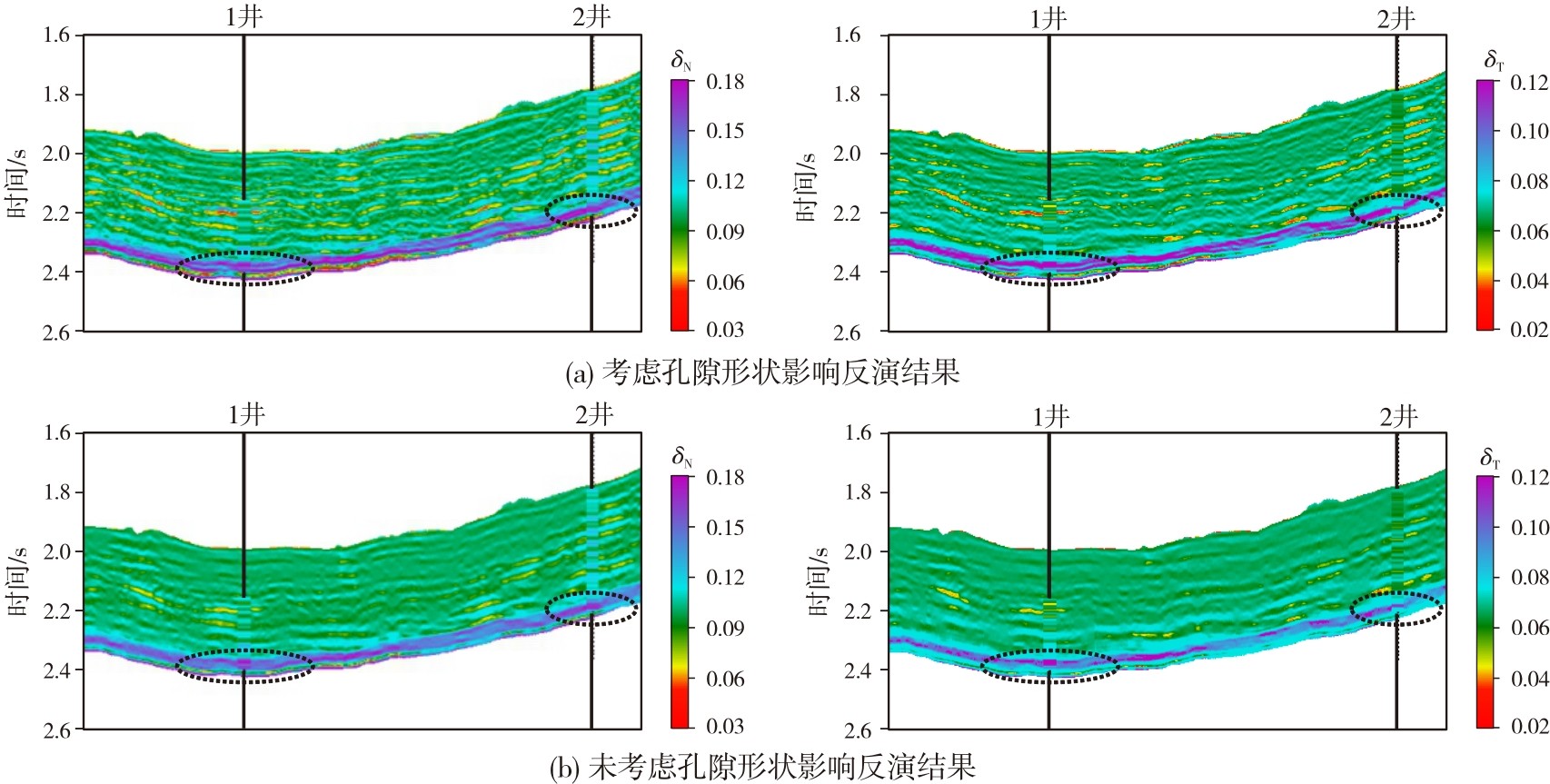
The fracture development characteristics and fluid distribution in shale reservoirs are key factors for evaluating shale gas exploration and development. However, the influence of pore shape on reservoir elasticity and physical properties is often neglected by existing methods, resulting in limited prediction accuracy. To address this issue, this study proposes an improved method centered on considering the effect of pore shape. Firstly, based on the cross-plot analysis of logging petrophysical parameters, the Gassmann fluid term is selected as the fluid identification factor for gas-bearing shale in the target area. Secondly, shale reservoirs with high-angle fractures are approximated as horizontal transverse isotropy (HTI) media. Combined with petrophysical modeling, an anisotropic reflection coefficient equation for HTI media (considering the effect of pore shape) is derived and established. On this basis, a two-step pre-stack anisotropic inversion method based on the Bayesian framework is constructed to realize the direct inversion of fluid identification factors and fracture parameters. Synthetic seismogram tests show that the inversion results of this method have high consistency with model values and strong noise resistance. Field test results of the shale gas reservoirs of the Wufeng-Longmaxi Formations in the Daozhen syncline, Northern Guizhou area indicate that the inversion results have high consistency with logging interpretation, and can effectively characterize the development characteristics of high-angle fractures and the distribution of gas-bearing shale. The research results provide new theoretical and technical support for fracture prediction and fluid identification in shale reservoirs, and have important practical application value.
gas-bearing shale / pore shape / fracture parameters / fluid identification factor / anisotropic seismic inversion
| [1] |
赵文智, 贾爱林, 位云生, 等. 中国页岩气勘探开发进展及发展展望[J]. 中国石油勘探, 2020, 25(1): 31-44.
中国页岩气进入了快速发展的黄金时期,随着天然气在能源消费结构中的比重不断攀升,以及在川南地区页岩气商业化开发的成功,页岩气成为中国未来最可靠的能源接替类型。文章系统梳理了近10年来中国页岩气在勘探开发实践中的理论认识和开发技术进展,总结了中国页岩气商业开发的成功经验,明确了页岩气在中国未来天然气发展中的前景与地位。中国页岩气资源潜力巨大,是未来天然气产量增长的现实领域;获得工业性页岩气资源的条件包括“两高”(含气量高、孔隙度高)、“两大”(高TOC集中段厚度大、分布面积大)、“两适中”(热演化程度适中、埋藏深度适中)和“两好”(保存条件好、可压裂性好);中国海相页岩气最具勘探开发潜力,是目前页岩气上产的主体,已形成适用于四川盆地及周缘奥陶系五峰组—志留系龙马溪组页岩气开发的六大主体技术系列(地质综合评价技术、开发优化技术、水平井优快钻井技术、水平井体积压裂技术、工厂化作业技术、高效清洁开采技术)。中国页岩气商业开发的成功经验可总结为四点:①选准最佳水平井靶体层位;②配套优快钻进和高效体积改造技术;③促进地质工程一体化数据融合;④探索先进组织管理模式。对中国页岩气未来发展的三点建议:①加强非海相及深层海相页岩气低成本开发关键技术与装备攻关;②重视提高区块页岩气采收率问题,实现整体规模效益开发;③重视非资源因素对页岩气上产节奏的影响。
Shale gas exploration and development in China has entered a golden age of rapid progress. The increasing proportion of natural gas in the energy consumption structure of the nation, and the success of commercial shale gas development in the southern Sichuan Basin, indicate that shale gas will be the most reliable succession energy source for the future in China. This paper reviews achievements in theoretical understanding and technologies related to shale gas development over the past 10 years, summarizes successful experiences in commercial shale gas development, and clarifies the prospects for, and status of, shale gas in future natural gas development in China. China's shale gas resources have enormous potential, and provide a practical base for future growth in natural gas production. The conditions for obtaining industrial shale gas resources are described as ‘2 highs’ (high gas content and high porosity), ‘2 larges’ (large thickness of intervals with high TOC and large distribution areas), ‘2 moderates’ (moderate thermal evolution and moderate burial depth), and ‘2 goods’ (good preservation conditions and good fracability). Marine shale gas in China is of the highest potential, and at present is the major objective for natural gas production growth. Exploitation of the Ordovician Wufeng Formation and Silurian Longmaxi Formation shale gas in the Sichuan Basin and its surroundings has relied on developments in six technology areas: comprehensive geological evaluation; development optimization; fast drilling of horizontal wells; volume fracturing of horizontal wells; factory-like operation, and efficient and clean production. The successful achievement of commercial development of shale gas in China can be summarized as stemming from four key factors: ① optimized horizontal section targets; ② supporting technologies for effective and fast drilling and volume fracturing stimulation; ③ geological and engineering integration, and ④ advanced organization and management. Three proposals for the future development of shale gas in China are: ① to develop key technologies and equipment for low-cost development of non-marine and deep marine shale gas; ② to enhance block-scale shale gas recovery and achieve efficient development of the entire Sichuan basin; ③ to pay attention to the influence of non-resource factors on shale gas production.
|
| [2] |
魏水建, 徐天吉, 唐建明, 等. 考虑储层力学性质与破裂条件的裂缝预测方法及应用: 以四川盆地WR页岩气田为例[J]. 中国海上油气, 2025, 37(3): 142-156.
|
| [3] |
杜炳毅, 杨午阳, 王恩利, 等. 基于杨氏模量、泊松比和各向异性梯度的裂缝介质AVAZ反演方法[J]. 石油物探, 2015, 54(2): 218-225.
为了全面地描述裂缝介质的储层特征、流体性质和各向异性特征,提出了由宽方位叠前道集数据直接获取裂缝介质弹性参数和各向异性梯度参数的振幅随方位角变化(Amplitude Versus Azimuth,AVAZ)反演方法。首先推导了基于杨氏模量、泊松比和各向异性梯度的各向异性AVO方程,通过与Ruger近似进行对比,分析了该方程的近似精度。然后利用实际测井资料和二维逆掩断层模型建立了不同方位角的合成叠前角度道集,对未加噪声和信噪比为3的宽方位叠前角度道集进行了AVAZ反演方法测试,结果表明,未加噪声和信噪比为3的合成宽方位叠前道集均能反演得到符合地震反演精度的杨氏模量(E),泊松比(σ)和各向异性梯度(Γ),噪声对杨氏模量的反演影响较小,不含噪声时泊松比和各向异性梯度的反演精度更高,与真实值吻合程度较高。
<p> In order to fully describe the reserroir characteristics,fluid properties and anisotropy in fractured media,we proposed an algorithm of Amplitude Versus Azimuth (AVAZ) inversion to obtain elastic parameters and anisotropy parameters of fractured media by using wide azimuthally pre-stack seismic data.Firstly,a new P-wave azimuth AVO approximate equation based on Young’s modulus,Poisson’s ratio and anisotropy gradient is deduced.The precision of this new equation was analyzed and compared with Ruger’s equation.Then,we utilized actual log data and 2D overthrust model to generate synthetic pre-stack angle gathers of wide-azimuth data.The algorithm is tested through the wide-azimuth synthetic angle gathers without noise and with random noise (SNR=3) respectively.The result shows that the inverted Young’s modulus,Poisson’s ratio and anisotropy gradient without noise is estimated exactly and agreed with the original data.Meanwhile,the inversion result of the data with random noise (SNR=3) is stable and can meet the demand of seismic inversion.Noise causes less influence on the inversion of Young’s modulus,the invesion accuracy of Poisson’s ratio and anisotropy gradient is higher without noise which is well coinciding with the actual data.</p>
|
| [4] |
董大忠, 邹才能, 戴金星, 等. 中国页岩气发展战略对策建议[J]. 天然气地球科学, 2016, 27(3): 397-406.
从中国页岩气资源状况、勘探开发重要进展、关键技术与装备重要突破等方面,系统总结、分析了中国页岩气发展形势,指出现阶段中国页岩气发展仍存在认识误区、页岩气资源落实程度低且经济性不确定性大、3 500m以深核心勘探开发技术与装备尚未突破、勘探开发成本居高不下、多种非技术因素严重制约其发展等5大挑战。针对这5大挑战,提出了促进中国页岩气进一步发展的5条建议:①制定符合中国国情及勘探开发阶段的页岩气发展战略和目标,2020年确保实现页岩气年产量200×10<sup>8</sup>m<sup>3</sup>,力争实现300×10<sup>8</sup>m<sup>3</sup>;②重视海相低产低压页岩气成藏富集地质理论和勘探开发关键工程技术攻关,有序推动非海相页岩气勘探开发示范区建设;③国家应进一步出台政策并设立专项创新基金,支持各企业开展页岩气勘探开发相关技术与装备研发,强化3 500m以深页岩气勘探开发技术、装备、工艺体系研发,推动中国深层页岩气勘探开发突破;④持续推动中国页岩气地质理论、勘探开发技术与管理创新,强化钻井、压裂等全过程成本控制,努力实现中国页岩气经济有效规模开发;⑤改革矿权管理制度,建立页岩气勘探开发数据信息平台,正确引导非油气企业参与页岩气勘探开发。
<p>From the aspects of shale gas resource condition,main exploration and development progress,important breakthrough in key technologies and equipment,this paper systematically summarized and analyzed current situation of shale gas development in China and pointed out five big challenges such as misunderstandings,low implementation degree and high economic uncertainty of shale gas resource,and still no breakthrough in exploration and development core technologies and equipment for shale gas buried depth more than 3 500m,high cost and other non-technical factors that restrict the development pace.Aiming at the above challenges,we put forward five suggestions to promote the shale gas development in China: (1) Make strategies and set goals according to our national conditions and exploration and development stages.That is,make sure to realize shale gas annual production of 20×10<sup>9</sup>m<sup>3</sup>,and strives to reach 30×10<sup>9</sup>m<sup>3</sup>.(2)Attach importance to the research of accumulation and enrichment geological theory and exploration and development key engineering technologies for low-production and low-pressure marine shale gas reservoir,and at the same time orderly promote the construction of non-marine shale gas exploration & development demonstration areas.(3)The government should introduce further policies and set special innovation funds to support the companies to carry out research and development of related technologies and equipment,especially to strengthen the research and development of technology,equipment and process for shale gas bellow 3 500m in order to achieve breakthrough in deep shale gas.(4)Continue to promote the geological theory,innovation in technology and management,and strengthen cost control on drilling,fracturing and the whole process in order to realize efficient,economic and scale development of China’s shale gas.(5)Reform the mining rights management system,establish information platform of shale gas exploration and development data,and correctly guide the non-oil and gas companies to participate in shale gas exploration and development.</p>
|
| [5] |
杜炳毅, 高建虎, 张广智, 等. 裂缝密度反演的页岩储层地应力地震预测方法及应用[J]. 石油地球物理勘探, 2024, 59(2): 279-289.
|
| [6] |
Young’s modulus and Poisson’s ratio are related to quantitative reservoir properties such as porosity, rock strength, mineral and total organic carbon content, and they can be used to infer preferential drilling locations or sweet spots. Conventionally, they are computed and estimated with a rock physics law in terms of P-wave, S-wave impedances/velocities, and density which may be directly inverted with prestack seismic data. However, the density term imbedded in Young’s modulus is difficult to estimate because it is less sensitive to seismic-amplitude variations, and the indirect way can create more uncertainty for the estimation of Young’s modulus and Poisson’s ratio. This study combines the elastic impedance equation in terms of Young’s modulus and Poisson’s ratio and elastic impedance variation with incident angle inversion to produce a stable and direct way to estimate the Young’s modulus and Poisson’s ratio, with no need for density information from prestack seismic data. We initially derive a novel elastic impedance equation in terms of Young’s modulus and Poisson’s ratio. And then, to enhance the estimation stability, we develop the elastic impedance varying with incident angle inversion with damping singular value decomposition (EVA-DSVD) method to estimate the Young’s modulus and Poisson’s ratio. This method is implemented in a two-step inversion: Elastic impedance inversion and parameter estimation. The introduction of a model constraint and DSVD algorithm in parameter estimation renders the EVA-DSVD inversion more stable. Tests on synthetic data show that the Young’s modulus and Poisson’s ratio are still estimated reasonable with moderate noise. A test on a real data set shows that the estimated results are in good agreement with the results of well interpretation.
|
| [7] |
Detection of fracture properties can be implemented using azimuth-dependent seismic inversion for optimal model parameters in time or frequency domain. Considering the respective potentials for sensitivities of inversion resolution and anti-noise performance in time and frequency domain, we propose a more robust azimuth-dependent seismic inversion method to achieve fracture detection by combining the Bayesian inference and joint time-frequency-domain inversion theory. Both Cauchy Sparse and low-frequency constraint regularizations are introduced to reduce multi-solvability of model space and improve inversion reliability of model parameters. Synthetic data examples demonstrate that the frequency bandwidth of inversion result is almost the same for time, frequency and joint time-frequency domain inversion in seismic dominant frequency band using the noise-free data, but the frequency bandwidth in joint time-frequency domain is larger than that in time and frequency domains using low- signal-to-noise-ratio (SNR) data. The results of cross-correlation coefficients validate that the joint time-frequency-domain inversion retains both the excellent characteristics of high resolution in frequency-domain inversion and the advantage of strong anti-noise ability in time-domain inversion. A field data example further demonstrates that our proposed inversion approach in joint time-frequency domain may provide a more stable technique for fracture detection in fractured reservoirs.
|
| [8] |
严彬, 张广智, 李林, 等. 裂缝诱导的TTI介质固液解耦反射系数方程及裂缝和流体参数反演方法[J]. 地球物理学报, 2023, 66(10): 4349-4369.
|
| [9] |
For seismic wave propagation in media with horizontal transverse isotropy (HTI), kinematic and dynamic attributes are anisotropic. P waves propagate slower in perpendicular to fracture azimuth than parallel to it, whereas reflection strength and frequency vary with azimuth. The azimuthal effects on reflection coefficients and seismic wave velocities in an HTI medium are quantitatively analyzed. The resulting theory-based and real-world azimuth gathers demonstrate the anisotropic nature of such media. The fitting of the ellipse is used to quantitatively predict the direction and strength of anisotropy in the study area, which is consistent with that obtained by the S-wave splitting prediction method. In wide-azimuth data processing, measures are taken to eliminate the influence of azimuthal anisotropy, and the coherent spectrum pickup method is used to accurately calculate the azimuthal velocity of underground HTI media and perform azimuthal anisotropy correction processing, which eliminates the time difference between fast and slow wave caused by azimuthal anisotropy. The achieved results provide support for subsequent high-resolution imaging.
|
| [10] |
Horizontal layered formations with a suite of vertical or near-vertical fractures are usually assumed to be an approximate orthotropic medium and are more suitable for estimating f racture properties with wide-azimuth prestack seismic data in shale reservoirs. However, the small contribution of anisotropic parameters to the reflection coefficients highly reduces the stability of anisotropic parameter estimation by using seismic inversion approaches. Therefore, a novel model parameterization approach for the reflectivity and a pragmatic inversion method are proposed to enhance the stability of the inversion for orthotropic media. Previous attempts to characterize orthotropic media properties required using four or five independent parameters. However, we have derived a novel formulation that reduces the number of parameters to three. The inversion process is better conditioned with fewer degrees of freedom. An accuracy comparison of our formula with the previous ones indicates that our approach is sufficiently precise for reasonable parameter estimation. Furthermore, a Bayesian inversion method is developed that uses the amplitude variation with angle and azimuth (AVAZ) of the seismic data. Smooth background constraints reduce the similarity between the inversion result and the initial model, thereby reducing the sensitivity of the initial model to the inversion result. Cauchy and Gaussian probability distributions are used as prior constraints on the model parameters and the likelihood function, respectively. These ensure that the results are within the range of plausibility. Synthetic examples demonstrate that the adopted orthotropic AVAZ inversion method is feasible for estimating the anisotropic parameters even with moderate noise. The field data example illustrates the inversion robustness and stability of the adopted method in a fractured reservoir with a single well control.
|
| [11] |
陈珂磷, 杨扬, 井翠, 等. 页岩裂缝型储层模型参数化及AVAZ反演预测方法研究[J]. 地球物理学进展, 2022, 37(6): 2364-2372.
|
| [12] |
李红梅, 曲志鹏, 张云银, 等. HTI介质下五维地震脆性稳定预测方法研究[J]. 石油物探, 2025, 64(1): 151-162.
|
| [13] |
潘辉. 考虑孔隙形状影响的叠前地震反演方法与流体识别应用研究[D]. 青岛: 中国石油大学(华东), 2022.
|
| [14] |
Seismic estimation of the fluid factor and shear modulus plays an important role in reservoir fluid identification and characterization. Various amplitude variation with offset inversion methods have been used to estimate these two parameters, which are generally based on approximate formulations of the Zoeppritz equations. However, the accuracy of these methods is limited because the forward modeling ability of approximate equations is incorrect under the conditions of strong impedance contrast and large incidence angles. Therefore, to improve the estimation accuracy, we have used the Zoeppritz equations to directly invert for the fluid factor and shear modulus. Based on the poroelasticity theory, we derive the Zoeppritz equations in a new form containing the fluid factor, shear modulus, density, and dry-rock velocity ratio squared. The objective function is then constructed using these equations in a Bayesian framework with the addition of a differentiable Laplace distribution blockiness constraint term to the prior model to enhance the fluid boundaries. Finally, the nonlinear objective function is solved by combining the Taylor expansion and the iterative reweighted least-squares algorithm. Numerical experiments indicate that the inversion accuracy of our method may heavily depend on the parameter of the dry-rock velocity ratio square that is assumed to be static. However, tests on synthetic and field data show that our method can estimate the fluid factor and shear modulus with satisfactory accuracy in the case of choosing a reasonable static value of this parameter. In addition, we determine that the accuracy of this method is higher than that of the linearized formulation.
|
| [15] |
张洪学. 裂缝型储层五维地震反演方法研究[D]. 青岛: 中国石油大学(华东), 2022.
|
| [16] |
|
| [17] |
In 1995, S. Xu and R. E. White described a method for estimating compressional and shear-wave velocities of shaley sandstones from porosity and shale content. Their model was able to predict the effect of increasing clay content on compressional-wave velocity observed in laboratory measurements. A key step in the Xu-White method estimates dry rock bulk and shear moduli for the sand/shale mixture. This step is performed numerically by applying the differential effective medium method to the Kuster-Toksöz equations for ellipsoidal pores. This step is computationally intensive. Using reasonable assumptions about dry rock elastic properties, this step can be replaced with a set of approximations for dry rock bulk and shear moduli. Numerical experiments show an extremely close match between velocities obtained with these approximations and velocities computed with the differential effective medium method. These approximations simplify the application of the Xu-White method, and make the method computationally more efficient. They also provide insight into the Xu-White method. For example, these approximations show how the Xu-White model is related to the critical porosity model.
|
| [18] |
Based on a theory of porous solids previously developed by the author, the elasticity of a hexagonal close packing of equal spheres is treated. The packing is anisotropic and because of the weight of the spheres, also inhomogeneous. The velocities of propagation of elastic waves have been calculated for evacuated interspaces and for interspaces filled with a liquid or gas. In the case of evacuated or air-filled interspaces, the wave rays and travel times have been computed. The packing which has been treated may be of use as a model for a dry or wet loose material such as gravel or sand. Though the model is very simplified, the results obtained show some typical effects such as anisotropy, inhomogeneity, and a 90 degrees angle of emergence.
|
| [19] |
Gassmann's (1951) equations commonly are used to predict velocity changes resulting from different pore-fluid saturations. However, the input parameters are often crudely estimated, and the resulting estimates of fluid effects can be unrealistic. In rocks, parameters such as porosity, density, and velocity are not independent, and values must be kept consistent and constrained. Otherwise, estimating fluid substitution can result in substantial errors. We recast the Gassmann's relations in terms of a porosity-dependent normalized modulus Kn and the fluid sensitivity in terms of a simplified gain function G. General Voigt-Reuss bounds and critical porosity limits constrain the equations and provide upper and lower bounds of the fluid-saturation effect on bulk modulus. The “D” functions are simplified modulus-porosity relations that are based on empirical porosity-velocity trends. These functions are applicable to fluid-substitution calculations and add important constraints on the results. More importantly, the simplified Gassmann's relations provide better physical insight into the significance of each parameter. The estimated moduli remain physical, the calculations are more stable, and the results are more realistic.
|
| [20] |
A simple method for including the effects of geologically realistic fractures on the seismic propagation through fractured rocks can be obtained by writing the effective compliance tensor of the fractured rock as the sum of the compliance tensor of the unfractured background rock and the compliance tensors for each set of parallel fractures or aligned fractures. The compliance tensor of each fracture set is derivable from a second rank fracture compliance tensor. For a rotationally symmetric set of fractures, the fracture compliance tensor depends on only two fracture compliances, one controlling fracture compliance normal, the other, tangential, to the plane of the fractures. The stiffness tensor, which is more useful in the consideration of elastic wave propagation through rocks, can then be obtained by inversion. The components of the excess fracture compliance tensor represent the maximum amount of information that can be obtained from seismic data. If the background rock is isotropic and the normal and shear compliance of each fracture are equal, although different from those of other fractures, the effective elastic behavior of the fractured rock is orthorhombic for any orientation distribution of fractures. A comparison of the theory with recent ultrasonic experiments on a simulated fractured medium shows near equality of the normal and shear compliance for the case of air-filled fractures.
|
| [21] |
|
| [22] |
The conventional Amplitude variation with offset (AVO) inversion has been mainly developed for the isotropic media and therefore it is generally inapplicable to the anisotropic fractured formations. A set of tilted fractures in isotropic medium can be regarded as a transversely isotropic (TTI) medium. The reflection coefficient equation in TTI media contains many parameters such as anisotropic parameters, velocities, azimuth and dip angles. The selection of objective functions can significantly affect its performance in searching for the optimal solution. The seismic inversion of the TTI medium remains challenging because of its many parameters, and is very complicated after conversion into solving function problems. The genetic algorithm (GA) provides a universal framework to solve the optimization problem in complex systems, and it is independent of the types and disciplines of problems. In this study, the GA-based seismic prestack inversion of the TTI medium is implemented by constructing the objective functions of anisotropic parameters based on the TTI medium reflection coefficient approximation. The inversion performance is shown to be satisfactory on the one-dimensional well logging model, modified Hess model and the field datum. Furthermore, fracture filling materials are well predicted according to the theories of the equivalent medium for fractured materials and fracture weakness. The inversion results demonstrate the proposed method to be feasible and robust. The findings of this research are expected to provide theoretical guidance for the inversion of elastic parameters of anisotropic media and fracture type identification in hydrocarbon reservoirs.
|
| [23] |
李勤, 徐若曦, 李江. 基于VTI介质精确反射系数方程的叠前反演方法[J]. 地球物理学报, 2025, 68(7): 2654-2668.
|

/
| 〈 |
|
〉 |