Reservoir space characteristics and controlling factors of different lithofacies for ultra-deep shale gas of the Permian Dalong Formation in Puguang area, Sichuan Basin

WANG Xin, LI Zhongchao, ZHOU Kai, JIANG shuxia, LI Jin, CHANG Yuli, ZHENG Jiabing, CHEN Yijun

Marine Origin Petroleum Geology ›› 2026, Vol. 31 ›› Issue (3) : 236-250.

PDF(14809 KB)
ISSN 1672-9854
CN 33-1328/P
PDF(14809 KB)
Marine Origin Petroleum Geology ›› 2026, Vol. 31 ›› Issue (3) : 236-250. DOI: 10.3969/j.issn.1672-9854.2026.03.003

Reservoir space characteristics and controlling factors of different lithofacies for ultra-deep shale gas of the Permian Dalong Formation in Puguang area, Sichuan Basin

Author information +
History +

Abstract

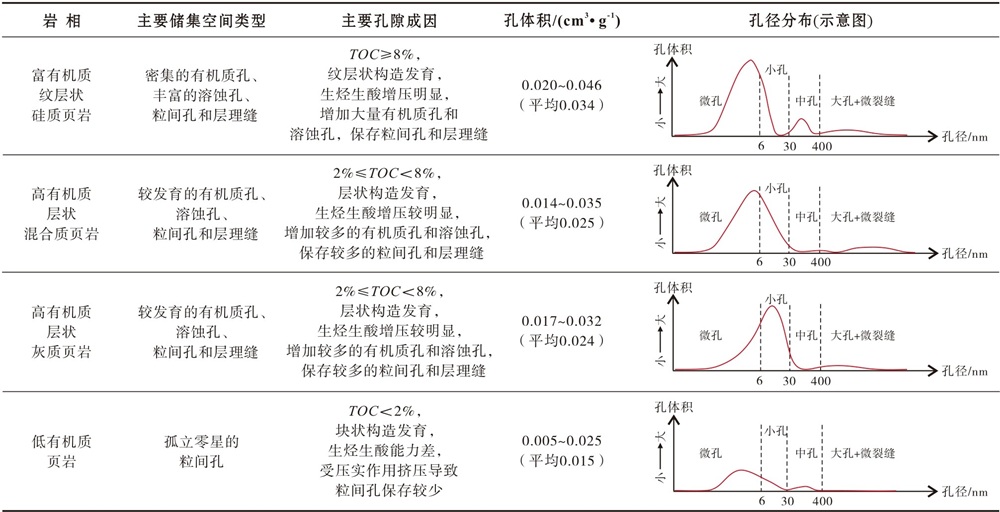
Exploratory breakthroughs have been achieved in ultra-deep shale gas from the Permian Dalong Formation in Puguang area of Sichuan Basin. However, due to variable sedimentary environments, diverse lithofacies types, and great burial depths, the pore structure characteristics of different lithofacies remain unclear, which severely constrains subsequent shale gas development. Through experiments on geochemistry, petrology, and pore structure characterization, the reservoir space characteristics and controlling factors of different lithofacies of the Dalong Formation in Puguang area are systematically analyzed. The results indicate: (1) The Dalong Formation mainly develops organic-rich laminated siliceous shale, organic-bearing layered mixed shale, organic-bearing layered calcareous shale, and organic-lean shale. (2) Eight types of reservoir spaces are identified: pores within organic matter, organic matter-matrix pores, intergranular pores between rigid particles, pyrite intercrystalline pores, dissolution pores, intraparticle clay pores, tectonic fractures, and organic matter shrinkage fractures. Compared with other lithofacies, the organic-rich laminated siliceous shale develops larger-scale and more numerous organic pores, dissolution pores, and microfractures, exhibiting higher porosity, pore volume, and proportion of medium-large pores and microfractures. In contrast, organic-lean shale has poorly developed organic pores and microfractures, and inorganic pores are mostly isolated. (3) During the high-maturity thermal evolution stage, most organic matter degrades and is consumed, generating large volumes of oil and gas along with organic pores. Meanwhile, high contents of rigid siliceous minerals (such as feldspar and quartz) can not only provide relatively simple and open large-scale intergranular pores but also release more reservoir space through organic acid dissolution. Therefore, as TOC and siliceous content increase, the corresponding porosity, pore volume, and proportion of medium-large pores and microfractures show an increasing trend.
Key words

ultra-deep shale / shale lithofacies / reservoir space characteristics / Dalong Formation / Pugang area / Sichuan Basin

Cite this article

Download Citations
WANG Xin , LI Zhongchao , ZHOU Kai , et al . Reservoir space characteristics and controlling factors of different lithofacies for ultra-deep shale gas of the Permian Dalong Formation in Puguang area, Sichuan Basin[J]. Marine Origin Petroleum Geology. 2026, 31(3): 236-250 https://doi.org/10.3969/j.issn.1672-9854.2026.03.003

References

[1]
郭旭升, 王濡岳, 申宝剑, 等. 中国页岩气地质特征、资源潜力与发展方向[J]. 石油勘探与开发, 2025, 52(1): 15-28.
GUO Xusheng, WANG Ruyue, SHEN Baojian, et al. Geological characteristics, resource potential, and development direction of shale gas in China[J]. Petroleum exploration and development, 2025, 52(1): 15-28.
[2]
段金宝, 徐田武, 彭君, 等. 四川盆地东北部铁北1侧HF井二叠系超深层页岩气勘探突破及启示[J]. 中国石油勘探, 2025, 30(4): 44-58.
DUAN Jinbao, XU Tianwu, PENG Jun, et al. Exploration breakthroughs and implications of the Permian ultra-deep shale gas in Well Tiebei 1 L-HF, northeastern Sichuan Basin[J]. China petroleum exploration, 2025, 30(4): 44-58.
[3]
李敏, 刘雅利, 冯动军, 等. 中国海相页岩气资源潜力及未来勘探方向[J]. 石油实验地质, 2023, 45(6): 1097-1108.
LI Min, LIU Yali, FENG Dongjun, et al. Potential and future exploration direction of marine shale gas resources in China[J]. Petroleum geology and experiment, 2023, 45(6): 1097-1108.
[4]
聂海宽, 党伟, 张珂, 等. 中国页岩气研究与发展20年: 回顾与展望[J]. 天然气工业, 2024, 44(3): 20-52.
NIE Haikuan, DANG Wei, ZHANG Ke, et al. Two decades of shale gas research & development in China: review and prospects[J]. Natural gas industry, 2024, 44(3): 20-52.
[5]
包书景, 葛明娜, 赵培荣, 等. 中国页岩气勘探开发现状、潜力与发展建议[J]. 石油与天然气地质, 2025, 46(2): 348-364.
BAO Shujing, GE Mingna, ZHAO Peirong, et al. Status-quo, potential, and recommendations on shale gas exploration and exploitation in China[J]. Oil & gas geology, 2025, 46(2): 348-364.
[6]
杨雨, 汪华, 谢继容, 等. 页岩气勘探新领域: 四川盆地开江—梁平海槽二叠系海相页岩气勘探突破及展望[J]. 天然气工业, 2023, 43(11): 19-27.
YANG Yu, WANG Hua, XIE Jirong, et al. Exploration breakthrough and prospect of Permian marine shale gas in the Kaijiang-Liangping Trough, Sichuan Basin[J]. Natural gas industry, 2023, 43(11): 19-27.
[7]
胡东风, 魏志红, 王威, 等. 四川盆地东北部雷页1井上二叠统大隆组页岩气勘探突破及其启示[J]. 天然气工业, 2023, 43(11): 28-39.
HU Dongfeng, WEI Zhihong, WANG Wei, et al. Breakthrough of shale gas exploration in Dalong Formation of Upper Permian by Well Leiye 1 in the northeastern Sichuan Basin and its implications[J]. Natural gas industry, 2023, 43(11): 28-39.
[8]
HAO Fang, ZHANG Xuefeng, WANG Cunwu, et al. The fate of CO2 derived from thermochemical sulfate reduction (TSR) and effect of TSR on carbonate porosity and permeability, Sichuan Basin, China[J]. Earth-science reviews, 2015, 141: 154-177.
[9]
雍锐, 杨洪志, 吴伟, 等. 四川盆地北部二叠系大隆组页岩气富集高产主控因素及勘探潜力[J]. 石油勘探与开发, 2025, 52(2): 253-266.
YONG Rui, YANG Hongzhi, WU Wei, et al. Controlling factors and exploration potential of shale gas enrichment and high yield in the Permian Dalong Formation, Sichuan Basin, SW China[J]. Petroleum exploration and development, 2025, 52(2): 253-266.
[10]
李启锐, 谭秀成, 陈雷, 等. 沉积期水下地貌对海相页岩岩相的差异控制:以川南长宁龙马溪组为例[J]. 古地理学报, 2026, 28(1): 158-172.
LI Qirui, TAN Xiucheng, CHEN Lei, et al. Differential control of underwater palaeogeomorphology on lithofacies of shale: a case study of the Longmaxi Formation in Changning area, southern Sichan Basin[J]. Journal of palaeogeography, 2026, 28(1): 158-172.
[11]
LOUCKS R G, RUPPEL S C. Mississippian Barnett shale: lithofacies and depositional setting of a deep-water shale-gas succession in the Fort Worth Basin, Texas[J]. AAPG bulletin, 2017, 91(4): 579-601.
[12]
JIANG Zaixing, GUO Ling, LIANG Chao, et al. Lithofacies and sedimentary characteristics of the Silurian Longmaxi shale in the southeastern Sichuan Basin, China[J]. Journal of palaeogeography, 2013, 2(3): 238-251.
[13]
LIU Shugen, MA Wenxin, JANSA L, et al. Characteristics of the shale gas reservoir rocks in the Lower Silurian Longmaxi Formation, east Sichuan Basin, China[J]. Energy exploration & exploitation, 2013, 31(2): 187-219.
[14]
卢双舫, 黄文彪, 陈方文, 等. 页岩油气资源分级评价标准探讨[J]. 石油勘探与开发, 2012, 39(2): 249-256.
LU Shuangfang, HUANG Wenbiao, CHEN Fangwen, et al. Classification and evaluation criteria of shale oil and gas resources: discussion and application[J]. Petroleum exploration and development, 2012, 39(2): 249-256.
[15]
李新景, 吕宗刚, 董大忠, 等. 北美页岩气资源形成的地质条件[J]. 天然气工业, 2009, 29(5): 27-32.
LI Xinjing, Zonggang, DONG Dazhong, et al. Geologic controls on accumulation of shale gas in North America[J]. Natural gas industry, 2009, 29(5): 27-32.
[16]
SHI Juye, JIN Zhijun, LIU Quanyou, et al. Lithofacies classification and origin of the Eocene lacustrine fine-grained sedimentary rocks in the Jiyang Depression, Bohai Bay Basin, Eastern China[J]. Journal of Asian earth sciences, 2020, 194: 104002.
[17]
康家豪, 王兴志, 谢圣阳, 等. 川中地区侏罗系大安寨段页岩岩相类型及储层特征[J]. 岩性油气藏, 2022, 34(4): 53-65.
KANG Jiahao, WANG Xingzhi, XIE Shengyang, et al. Lithofacies types and reservoir characteristics of shales of Jurassic Da'anzhai member in central Sichuan Basin[J]. Lithologic reservoirs, 2022, 34(4): 53-65.
[18]
LAZAR O R, BOHACS K M, MACQUAKER J H S, et al. Capturing key attributes of fine-grained sedimentary rocks in outcrops, cores, and thin sections: nomenclature and description guidelines[J]. Journal of sedimentary research, 2015, 85(3): 230-246.
[19]
姚艳斌, 刘大锰, 黄文辉, 等. 两淮煤田煤储层孔-裂隙系统与煤层气产出性能研究[J]. 煤炭学报, 2006, 31(2): 163-168.
YAO Yanbin, LIU Dameng, HUANG Wenhui, et al. Research on the pore-fractures system properties of coalbed methane reservoirs and recovery in Huainan and Huaibei coal-fields[J]. Journal of China Coal Society, 2006, 31(2): 163-168.
[20]
IUPAC. Manual of symbols and terminology[J]. Pure and applied chemistry, 1972, 31: 578.
[21]
卢双舫, 李俊乾, 张鹏飞, 等. 页岩油储集层微观孔喉分类与分级评价[J]. 石油勘探与开发, 2018, 45(3): 436-444.
LU Shuangfang, LI Junqian, ZHANG Pengfei, et al. Classification of microscopic pore-throats and the grading evaluation on shale oil reservoirs[J]. Petroleum exploration and development, 2018, 45(3): 436-444.
[22]
WANG Xin, WANG Min, ZHAO Chen, et al. Reservoir characteristics and controlling factors of the middle-high maturity multiple lithofacies reservoirs of the Lianggaoshan Formation shale strata in the northeastern Sichuan Basin, China[J]. Marine and petroleum geology, 2024, 161: 106692.
[23]
ZHANG Pengfei, LU Shuangfang, LI Junqian. Characterization of pore size distributions of shale oil reservoirs: a case study from Dongying Sag, Bohai Bay Basin, China[J]. Marine and petroleum geology, 2019, 100: 297-308.
[24]
LOUCKS R G, REED R M, RUPPEL S C, et al. Spectrum of pore types and networks in mudrocks and a descriptive classification for matrix-related mudrock pores[J]. AAPG bulletin, 2012, 96(6): 1071-1098.
[25]
XU Liangwei, YANG Keji, WEI Hao, et al. Diagenetic evolution sequence and pore evolution model of Mesoproterozoic Xiamaling organic-rich shale in Zhangjiakou, Hebei, based on pyrolysis simulation experiments[J]. Marine and petroleum geology, 2021, 132: 105233.
[26]
CURTIS M E, SONDERGELD C H, AMBROSE R J, et al. Microstructural investigation of gas shales in two and three dimensions using nanometer-scale resolution imaging[J]. AAPG bulletin, 2012, 96(4): 665-677.
[27]
WANG Feiteng, GUO Shaobin. Influential factors and model of shale pore evolution: a case study of a continental shale from the Ordos Basin[J]. Marine and petroleum geology, 2019, 102: 271-282.
[28]
孙龙德, 刘合, 何文渊, 等. 大庆古龙页岩油重大科学问题与研究路径探析[J]. 石油勘探与开发, 2021, 48(3): 453-463.
SUN Longde, LIU He, HE Wenyuan, et al. An analysis of major scientific problems and research paths of Gulong shale oil in Daqing Oilfield, NE China[J]. Petroleum exploration and development, 2021, 48(3): 453-463.
[29]
YUAN Yujie, REZAEE R, YU Hongyan, et al. Compositional controls on nanopore structure in different shale lithofacies: a comparison with pure clays and isolated kerogens[J]. Fuel, 2021, 303: 121079.
[30]
KATTI D R, THAPA K B, KATTI K S. Modeling molecular interactions of sodium montmorillonite clay with 3D kerogen models[J]. Fuel, 2017, 199: 641-652.
[31]
CHANG Jiaqi, FAN Xiaodong, JIANG Zhenxue, et al. Differential impact of clay minerals and organic matter on pore structure and its fractal characteristics of marine and continental shales in China[J]. Applied clay science, 2022, 216: 106334.
[32]
REDDY C R, BHAT Y S, NAGENDRAPPA G, et al. Brønsted and Lewis acidity of modified montmorillonite clay catalysts determined by FT-IR spectroscopy[J]. Catalysis today, 2009, 141(1/2): 157-160.
[33]
WANG Guanping, JIN Zhijun, LIU Guangxiang, et al. Pore system of the multiple lithofacies reservoirs in unconventional lacustrine shale oil formation[J]. International journal of coal geology, 2023, 273: 104270.
[34]
METWALLY Y M, CHESNOKOV E M. Clay mineral transformation as a major source for authigenic quartz in thermo-mature gas shale[J]. Applied clay science, 2012, 55: 138-150.
[35]
MILLIKEN K L, RUDNICKI M, AWWILLER D N, et al. Organic matter-hosted pore system, Marcellus Formation (Devonian), Pennsylvania[J]. AAPG bulletin, 2013, 97(2): 177-200.
[36]
ALDEGA L, CARMINATI E, SCHARF A, et al. Thermal maturity of the Hawasina units and origin of the Batinah Mélange (Oman Mountains): insights from clay minerals[J]. Marine and petroleum geology, 2021, 133: 105316.
[37]
杨雨然, 徐亮, 马维泽, 等. 川东北深层页岩储层成岩作用及对孔隙发育的影响: 以DY1H井吴家坪组—大隆组为例[J]. 海相油气地质, 2024, 29(4): 385-400.
YANG Yuran, XU Liang, MA Weize, et al. Diagenesis and its influence on pore development of deep shale reservoirs in northeastern Sichuan Basin: a case study of Wujiaping Formation and Dalong Formation in Well DY1H[J]. Marine origin petroleum geology, 2024, 29(4): 385-400.
[38]
ZHANG Qin, WU Xinsong, RADWAN A E, et al. Diagenesis of continental tight sandstone and its control on reservoir quality: a case study of the Quan 3 member of the Cretaceous Quantou Formation, Fuxin uplift, Songliao Basin[J]. Marine and petroleum geology, 2022, 145: 105883.
PDF(14809 KB)

Accesses

Citation

Detail

Sections
Recommended

/