PDF(3656 KB)

Recent advances in global deepwater oil and gas exploration and development, and insights into deepwater operation capability building
Wang Hongping, Si Chunsong, Fan Guozhang, Zuo Guoping, Ding Liangbo, Xu Xiaoyong, Li Weiqiang, Wang Xiao, Wu Jianan, Wang Siwen, Zhang Qianwen, Wang Zeyu, Su Yiqing
Marine Origin Petroleum Geology ›› 2026, Vol. 31 ›› Issue (4) : 524-540.
PDF(3656 KB)
PDF(3656 KB)
Recent advances in global deepwater oil and gas exploration and development, and insights into deepwater operation capability building
Deepwater regions, as strategic successors to global onshore and shallow-water oil and gas resources, have an exploration maturity of merely 16.8%, with immense remaining resource potential, positioning them as core domains for global reserve and production growth and strategic energy competition. Since the 1970s, global deepwater oil and gas exploration and development has progressed through five major stages: initial exploration, early breakthroughs, rapid development, vigorous expansion, and steady development under complex circumstances. In recent years, a series of breakthroughs have been achieved in deepwater petroleum geology and development engineering technologies, yielding theoretical innovations in deepwater submarine fan lithologic reservoirs, deepwater pre-salt lacustrine carbonate reservoirs, deepwater biogas accumulations, and ultra-deepwater ultra-shallow gas accumulations. Key technological systems have also been established, including deepwater OBN seismic exploration, fine characterization of complex reservoirs in deepwater oil and gas fields, safe and efficient deepwater drilling and completion, and all-sea mode deepwater development engineering, which have strongly supported major exploration discoveries and efficient development in deepwater basins worldwide. To address major strategic national demands in deepwater operations, domestic oil companies must take scientific and technological innovation as the core driver, continuously advancing research on global deepwater hydrocarbon enrichment theories, efficient deepwater field development technologies, and all-sea mode engineering techniques, and establishing an integrated technical system covering the entire business chain of deepwater exploration, development, engineering, and operations management. This will facilitate the transition of deepwater oil and gas operations from follower-style development to independent innovation and leading operations, providing theoretical support and technical reserves for the efficient exploration and development of China's deepwater resources and national energy security.
deepwater oil and gas / exploration theory / development technology / engineering technology / deepwater operation capability
| [1] |
|
| [2] |
王陆新, 潘继平, 杨丽丽. 全球深水油气勘探开发现状与前景展望[J]. 石油科技论坛, 2020, 39(2): 31-37.
|
| [3] |
穆龙新, 陈亚强, 许安著, 等. 中国石油海外油气田开发技术进展与发展方向[J]. 石油勘探与开发, 2020, 47(1): 120-128.
通过系统回顾中国石油海外油气田开发技术的发展历程,总结已形成的特色开发技术,并针对海外油气开发面临的挑战,提出未来海外业务的发展目标与技术发展方向。中国石油经历海外20多年的油气田开发实践,将国内成熟油气田开发技术与海外油气藏特征相结合,形成了以海外砂岩油田高速开发及稳油控水技术、大型碳酸盐岩油气藏高效开发和超重油油藏整体水平井泡沫油冷采开发技术为代表的海外特色开发技术。在深入分析海外油气开发面临的挑战和技术需求的基础上,结合国内外油气开发技术发展趋势,提出未来海外油气开发技术需重点研发人工智能储集层预测与三维地质建模、海外砂岩油田高速开发后二次开发及提高采收率、海外碳酸盐岩油气藏注水注气提高采收率、海外非常规油气经济有效开发、海域深水油气藏高效开发配套技术等,实现海外高含水砂岩油田提高采收率技术继续保持国际领先,碳酸盐岩油气藏开发技术达到国际先进,非常规和海域深水油气开发技术逐步缩小差距,实现快速追赶等目标。图3表4参40
|
| [4] |
窦立荣, 温志新, 王建君, 等. 2021年世界油气勘探形势分析与思考[J]. 石油勘探与开发, 2022, 49(5): 1033-1044.
基于埃士信能源咨询公司(IHS)等商业数据库及油公司公开信息,对2021年全球勘探投资、油气新发现、油公司勘探业务调整策略、未来有利勘探领域等方面进行了系统分析。结果表明:2021年世界油气勘探形势依然延续新冠疫情以来的低迷态势,投资及钻井工作量同比小幅下降,但探井成功率特别是深水探井成功率明显提升,油气新发现储量同比略有增加;海域被动陆缘盆地深水仍为常规大中型油气田发现的主战场,陆上富油气盆地深层常规油气精细勘探依然延续良好态势,沙特、俄罗斯等多个国家致密油气及页岩油气勘探有新的发现;国际、国家及独立石油公司均在加大本土资源勘探开发力度的同时,利用自身优势持续聚焦境外深水、天然气等核心领域;全球海域深水、陆上深层和非常规油气3大领域是未来有利油气勘探方向。建议中国油公司跨国勘探业务:①通过投标超前低成本进入全球深水前沿盆地,发现规模油气后采用“双勘探模式”经营;②通过参股等多种方式进入全球新兴热点盆地未钻区块,快速发现规模油气田;③以联合研究形式与资源国国家石油公司合作,积极进入陆上富油气盆地深层;④重点关注沙特、俄罗斯等国家致密油气及页岩油气勘探合作机会,利用国内成熟理论技术优势择机进入。
|
| [5] |
温志新, 王建君, 王兆明, 等. 世界深水油气勘探形势分析与思考[J]. 石油勘探与开发, 2023, 50(5): 924-936.
利用标普全球、睿咨得等商业数据及各油公司的公开信息,对全球深水油气勘探趋势、深水油气发现特点、七大国际油公司深水油气勘探业务布局进行系统分析。结果表明:深水领域是当前全球油气勘探发现最重要的领域,被动大陆边缘盆地深水大发现油气田个数及储量均最多,深水油气大发现对海域新发现油气总储量的贡献最大。岩性油气藏发现越来越多,且油气发现主要分布于中—新生界;七大国际油公司广泛活跃在深水油气勘探和开发各个环节,并发挥着全球引领作用。结合多年对全球油气地质与资源评价形成的理论认识,提出未来有利的深水勘探领域主要集中在大西洋两岸、印度洋周缘、北冰洋周缘等3大领域。提出了开拓海外深水油气勘探业务的6点建议:拓宽多用户地震资料获取渠道,提高深水勘探科学选区水平;加大重点领域深水勘探项目获取力度;灵活进退勘探区块;以大权益获取区块,采用“双勘探模式”经营;加强与深水技术领先国际油公司的合作;提升商务运作能力,逐步实现“非作业者”向“作业者”转变。
|
| [6] |
|
| [7] |
张功成, 屈红军, 赵冲, 等. 全球深水油气勘探40年大发现及未来勘探前景[J]. 天然气地球科学, 2017, 28(10): 1447-1477.
深水勘探自1975年至今已发展40余年,其勘探发现历程总体可划分为起步阶段(1975—1984年)、早期阶段(1985—1995年)和快速发展阶段(1996年至今)。目前深水区已成为全球油气勘探的热点和油气增储上产的重要领域之一。40年来全球深水油气大发现主要沿“三竖两横”五大深水盆地群分布:①大西洋深水盆地群的石油重大发现主要集中在南段的巴西、西非和墨西哥湾,天然气主要在北部的挪威西海岸;②东非陆缘深水盆地群则在鲁武马盆地、坦桑尼亚盆地等发现一批巨型天然气田;③西太平洋深水盆地群油气大发现主要集中在中国南海和东南亚海域;④新特提斯深水盆地群总体富气,天然气重大发现主要集中在澳大利亚西北陆架和东地中海;⑤环北极深水盆地群目前仅在巴伦支海获深水油气大发现。全球深水石油资源主要集中在大西洋中、南段;天然气资源分布相对广泛,主要在大西洋深水盆地群北段、东非深水盆地群、新特提斯深水盆地群、环北极深水盆地群。未来全球深水盆地勘探存在“两老四新”六大领域,“两老”领域为大西洋深水盆地群和东西走向的新特提斯构造域深水富气盆地群,二者勘探程度相对较高,但潜力仍然很大;“四新”领域包括盐下和超深水区等深层新领域,以及环北极深水盆地群和滨西太平洋深水盆地群,新领域将是今后深水油气勘探的主要领域。
<p>Deepwater exploration has been developed for more than 40 years since 1975,generally,its exploration history can be divided into the beginning stage (1975-1984),the early stage(1985-1995)and the rapid development stage(1996-now).Currently,deepwater areas have become the hotspot of global oil and gas exploration,and they are also one of the most important fields of oil and gas increase in reserves and production all over the world.In 40 years,global deepwater oil and gas discoveries are mainly distributed along five deepwater basin groups which are characterized by “three vertical and two horizontal”:(1)In deepwater basins of Atlantic Ocean,giant discoveries of oil are mainly concentrated in the Brazil,West Africa and the Gulf of Mexico of the southern part of Atlantic Ocean,and the significant discoveries of natural gas are mainly in the west coast of Norway of the northern part of Atlantic Ocean;(2)In deepwater basins of East African continental margin,a group of giant gas fields have been found in Rovuma Basin and Tanzania Basin;(3)In deepwater basins of Western Pacific Ocean,giant discoveries of oil and gas are mainly concentrated in the South China Sea and Southeast Asian waters;(4)The deepwater basins of Neo-Tethys Region are rich in gas,and the most important gas discoveries are mainly distributed in the northwest shelf of Australia and the eastern Mediterranean;(5)In deepwater basins around the Arctic Pole,major discoveries of oil and gas have been only found in deepwater area of Barents sea currently.Global deepwater oil resources are mainly concentrated in the middle and south sections of Atlantic Ocean.Deepwater gas resources are relatively widely spread,mainly distribute in northern part of Atlantic Ocean deepwater basins,the deepwater basins of East African,the deepwater basins of Neo-Tethys region and the deepwater basins around the Arctic Pole.There will be six domains for future oil-gas exploration of global deepwater basins which are characterized by “two old and four new”,specifically,“wo old” domains refer to the Atlantic offshore deepwater basins and offshore deepwater basins of the Neotethys structural domain,where exploration degree is relatively high,but the potential is still great;While the “four new” domains stand for presalt and ultra deepwater basins formations,offshore deepwater basins in the circum-North Pole area and West Pacific offshore deepwater basins,and the new fields will be the main fields of deepwater oil and gas exploration in the future.</p>
|
| [8] |
蒋德鑫, 张厚和, 李春荣, 等. 全球深水-超深水油气勘探历程与发展趋势[J]. 海洋地质前沿, 2022, 38(10): 1-12.
|
| [9] |
常毓文, 李宏伟, 郜峰, 等. 全球海域油气开发形势与展望[J]. 国际石油经济, 2022, 30(3): 1-11.
|
| [10] |
Offshore oil and gas reservoirs comprise a significant portion of the world's reserve base, and their development is expected to help close a potential gap in the supply of hydrocarbons in the near future. Continuous advances in technology have helped the oil and gas industry to extend the exploration and production activities to deep and ultra-deep waters in harsher environments. Field development in the offshore environment is associated with numerous significant challenges in different phases including exploration, reservoir description and characterization, development planning, drilling, production, improved oil recovery (IOR) and enhanced oil recovery (EOR), transportation, and decommissioning. These challenges are further complicated by economic restrictions, especially in periods when low or unstable oil prices weaken the incentives of investments due to the high risks and uncertainties involved. Environmental concerns including the adverse effects of seismic surveys, drilling activities, discharge of waste material and produced water, and accidental spills and blowouts add another level of complexity to the design and implementation of offshore projects. Safe, reliable, and efficient development of offshore hydrocarbon reservoirs can be achieved through the proper identification of the challenges and use of modern technologies and innovative methods. This work is an effort to provide a comprehensive review of the history, global distribution, production share, classification, characteristics, and characterization methods of offshore reservoirs, and some of the main aspects and challenges of the experimental and modeling works as well as IOR/EOR planning and implementations from the reservoir engineering and production standpoint. These challenges are categorized based on their area of impact, i.e., characterization and recovery (production) phases. Furthermore, economic and environmental challenges are reviewed. After the recent downturn that caused a decline in offshore investments, current investment trends and the forecasts show that the offshore industry is booming again with more focus on cost saving and operational efficiency. The key technologies that can expedite the growth of the offshore petroleum industry have also been discussed.
|
| [11] |
张功成, 屈红军, 冯杨伟. 深水油气地质学概论[M]. 北京: 科学出版社, 2015.
|
| [12] |
穆龙新, 计智锋. 中国石油海外油气勘探理论和技术进展与发展方向[J]. 石油勘探与开发, 2019, 46(6): 1027-1036.
通过对中国石油20多年来海外油气勘探工作的全面回顾,系统总结海外油气勘探理论与技术的发展历程、发展现状与应用成效。中国石油海外油气勘探经历了探索勘探、滚动勘探、风险勘探和效益勘探4个发展阶段,油气勘探理论技术也经历了从最初的将国内成熟技术的直接应用、到集成应用、再到与海外特点相结合的研发创新之发展道路,形成了以被动裂谷盆地、含盐盆地、前陆盆地斜坡带、全球油气地质与资源评价等为代表的海外油气勘探理论与技术系列。在深入分析未来海外勘探业务发展对科技需求的基础上,结合国内外理论技术发展趋势,系统论述未来海外勘探面临的难点、理论技术需求和重点发展方向与目标:①海外勘探要持续发展陆上常规油气勘探技术,保持该领域处于国际先进水平;②创新发展全球油气资源与资产一体化优化评价技术及其信息系统建设工程,实现由并跑到领跑的跨越、达到国际领先水平;③集成应用发展深水勘探技术、逐步缩小与世界先进水平的差距。图6表3参26
|
| [13] |
陆如泉. 扬帆出海30年: 从“走出去”到“全球化”——中国石油参与共建“一带一路”10周年、“走出去”30周年概述[J]. 中国石油企业, 2024(2): 21-29, 135.
|
| [14] |
刘合年, 史卜庆, 薛良清, 等. 中国石油海外“十三五”油气勘探重大成果与前景展望[J]. 中国石油勘探, 2020, 25(4): 1-10.
“十三五”以来,国际油价持续低迷、外部投资环境日益复杂,如何尽快适应复杂的内外部环境、实现 精准部署与效益勘探是中国石油天然气集团有限公司(简称中国石油)海外油气勘探面临的重大问题。中国石油海外 油气勘探提出了以效益为中心,积极寻求规模优质可快速动用储量,大力实施风险勘探和精细勘探的部署策略。创新 实施“产学研用”一体化科研攻关组织模式、优化总部决策流程、坚持勘探开发工程一体化、加强深水勘探领域国际 合作、立足全球大盆地积极开拓勘探新项目,逐步积累形成了一系列行之有效的勘探管理措施。2016—2019 年,通 过上述部署和措施的实施,中国石油海外油气勘探取得12 项重大突破与战略新发现,成熟探区精细勘探多点开花, 累计探明油气地质储量超10×108t 油当量,桶油发现成本低于2 美元/bbl,平均探井成功率为76%。当前中国石油 海外油气勘探虽然面临国际油价持续低位、勘探项目急剧减少、新区块获取竞争日益激烈、常规油气资源品质劣质化、 勘探对象愈加复杂、深水油气独立勘探开发能力弱等挑战,但全球待发现油气资源依然丰富,高新技术跨界融合必将 推动勘探理念的转变和技术的革新,海外油气勘探前景广阔。
During the period of the 13th Five-Year Plan, oil prices have remained continuously low and the global investment environment has become increasingly complicated. This has raised major issues for CNPC overseas oil and gas exploration, including the issue of how to adapt to complex internal and external environments as quickly as possible and how to achieve accurate deployment and benefit exploration. The company has proposed a robust deployment strategy of focusing on benefits, seeking large-scale, high-quality, rapidly-recoverable reserves, and carrying out risk exploration and fine exploration. A series of effective exploration management measures have gradually been developed. These include: innovating and implementing an integrated research organization mode of “industry-college-institute-application cooperation”, optimizing decision-making processes at headquarters level, integrating exploration-development-engineering, strengthening international cooperation in deep-water exploration, and screening large basins globally to identify new exploration projects. Between 2016 and 2019, CNPC overseas oil and gas exploration made 12 major breakthroughs and strategic discoveries as a result of implementation of these measures. Discoveries have been made in several fields in mature exploration areas through fine exploration. Cumulative proven oil and gas geological reserves are more than 10×108 t oil equivalent, the discovery cost per barrel oil is less than $2/bbl, and the average success rate of exploration wells is 76%. At present, CNPC overseas oil and gas exploration still faces challenges such as continuously low international oil prices, a sharp decrease in exploration projects, increasingly fierce competition for new blocks, the inferior quality of conventional oil and gas resources, and increasingly complex exploration objects. The company also has comparatively weak capacity for independent exploration and development of deep-water oil and gas. However, There are still rich undiscovered oil and gas resources around the world. Cross-border integration of advanced technologies will transform exploration concepts and technological innovations, so the prospects for overseas oil and gas exploration are broad and promising.
|
| [15] |
|
| [16] |
|
| [17] |
吴佳男, 李祥权, 丁梁波, 等. 东非鲁伍马盆地上始新统海底扇发育演化特征[J]. 海相油气地质, 2025, 30(3): 217-227.
|
| [18] |
孔令武, 赵红岩, 梁建设, 等. 转换大陆边缘盆地深水浊积砂岩油气成藏差异性研究: 以西非北段科特迪瓦盆地为例[J]. 沉积学报, 2022, 40(1): 244-254.
|
| [19] |
杨永才, 孙玉梅, 李友川, 等. 南大西洋被动陆缘共轭盆地烃源岩分布与油气富集规律: 以巴西桑托斯盆地和西非纳米贝盆地为例[J]. 海洋地质与第四纪地质, 2015, 35(2): 157-167.
|
| [20] |
刘小兵, 窦立荣. 国际大油公司深水油气勘探实践及启示: 以圭亚那斯塔布鲁克区块为例[J]. 中国石油勘探, 2023, 28(3): 78-89.
近年来,国际大油公司持续在深水领域取得勘探突破。其中埃克森美孚公司领导的勘探联合体在圭亚那的斯塔布鲁克区块获得31个深水油气田发现,使圭亚那成为南美地区石油行业的重要国家之一,同时也带动了周边海域的勘探热潮。圭亚那盆地横跨圭亚那和苏里南海域,埃克森美孚公司在圭亚那盆地的油气勘探主要经历了3个阶段,分别是1957—1982年超前布局圭亚那盆地苏里南海域1999—2015年再进圭亚那盆地并长期坚守圭亚那海域;2015年至今地质认识和地震技术助推获得一系列勘探发现。国际大油公司,尤其是埃克森美孚公司领导的勘探联合体在圭亚那的勘探实践表明,开展区域地质综合研究并结合新资料坚定勘探信心,通过引进合作伙伴共担风险、共享收益,是风险勘探的典型做法,可为中国油公司实现从“走出去”迈向“走上去”开展海外油气勘探业务提供借鉴和参考。
In recent years, exploration breakthroughs have continuously been obtained in deepwater fields by major international oil companies. Among them, the joint venture company led by ExxonMobil has discovered 31 deepwater oil and gas fields in Stabroek block in Guyana, making it a rising star in the petroleum industry in South America and driving the exploration boom in the peripheral offshore areas. Guyana Basin spans Guyana and Suriname offshore areas. ExxonMobil’s petroleum exploration in Guyana Basin mainly experienced three stages, namely, the advanced layout in Suriname offshore area during the 1957-1982, re-exploration in Guyana Basin and long-term research in Guyana offshore area during the 1999-2015, and a series of discoveries by applying new geological understanding and seismic technologies since 2015. The exploration practice of major international oil companies in Guyana, especially the joint venture company led by ExxonMobil, shows that it is a feasible and typical way to implement risk exploration by conducting comprehensive regional geological study and applying new data to strengthen exploration confidence and introducing partners to share risks and benefits, which provides reference for Chinese oil companies in promoting overseas petroleum exploration business from “going global” to “going better”.
|
| [21] |
张光亚, 刘小兵, 赵健, 等. 东非被动大陆边缘盆地演化及大气田形成主控因素: 以鲁武马盆地为例[J]. 地学前缘, 2018, 25(2): 24-32.
东非被动大陆边缘盆地近年来发现了一系列大气田,主要分布于鲁武马盆地,其可采储量达3.8×10¹² m3。盆地经历了卡鲁裂谷期、马达加斯加裂谷期和马达加斯加漂移期等3期构造演化。其中,马达加斯加裂谷期形成下侏罗统—中侏罗统湖相滨浅海相烃源岩,于早白垩世进入生油门限,晚白垩世达到生油高峰,渐新世进入生气窗。受马达加斯加漂移期东非陆上断裂系统活动影响,大量富砂沉积物以块体搬运和深海滑塌方式向深水区堆积,形成了盆地内面积广、厚度大、岩性相对均一且物性良好的超大型深水重力流沉积砂体;漂移期海相泥页岩则为良好的区域性盖层。东非陆上早期隆升和三角洲进积作用使鲁武马盆地形成重力滑动和盐底辟构造,渐新统—上新统内形成东非被动陆缘正断层带(EANFZ)和逆冲断层带(EATFZ),下伏中—下侏罗统烃源岩生成油气沿正断层和深水区逆冲断层向上运移,聚集于构造岩性地层、构造圈闭中,形成大气田。
Many giant gas fields, concentrated in the Rovuma Basin of the East Africa passive margin basins, were discovered in recent years with a total recoverable reserves up to 3.8 trillion cubic meters. The Rovuma Basin has gone through three stages of tectonic evolution, i.e. the Karoo rift, Madagascar rift and Madagascar drift. The LowerMiddle Jurassic lacustrine and shallow sea source rocks formed in the Madagascar rift period, and came to the oil window, the peak of oil generation and the gas window, in the Early Cretaceous, the Late Cretaceous and the Oligocene, respectively. Affected by the East Africa onshore faults during the Madagascar drift period, massive sandrich sediments accumulated towards the deep water region by way of block transport and deep water sliding. It formed a super giant deepwatergravityflow sandbody, wide and thick, with relatively uniform lithology and favorable physical property within the basin. The marine mudstone during the Madagascar drift period provided a good regional overlying strata. The early uplift onshore East Africa and delta progradation led to the formation of gravity sliding and salt diapir within the Rovuma Basin, and subsequently the East Africa normal fault zone (EANFZ) and the East Africa thrust fault zone (EATFZ), between the Oligocene and Pliocene. As a result, hydrocarbons from the underlying LowerMiddle Jurassic source rocks migrated upward along the normal and deep water thrust faults, accumulating in the structurallithologicalstratigraphy and structural traps to form the giant gas fields.<br>
|
| [22] |
张光亚, 余朝华, 黄彤飞, 等. 非洲地区裂谷盆地类型及油气成藏特征[J]. 中国石油勘探, 2020, 25(4): 43-51.
非洲地区发育多期多类裂谷盆地,油气资源丰富。为指导非洲地区油气勘探与战略选区,对非洲地区裂 谷盆地形成期次、类型及重点裂谷盆地的油气成藏特征进行了分析和研究。研究结果表明:①非洲地区主要发育古生 代、中生代和新生代3 期裂谷盆地,形成卡鲁裂谷系、中西非陆内裂谷系、北非陆缘裂谷系及红海—亚丁湾—东非裂 谷系;按原型盆地成因,可划分为与热隆拉张有关的主动裂谷盆地以及与走滑或区域伸展应力场有关的被动裂谷盆地; 根据盆地所处构造位置及基底特征,可划分为陆内裂谷盆地、陆间裂谷盆地、拗拉谷裂谷盆地和陆缘裂谷盆地。②因 盆地构造演化、沉积充填和结构的不同,导致油气地质特征及油气富集规律存在差异。北非陆缘裂谷盆地发育海相优 质烃源岩,以中—新生界含油气系统为主,油气主要富集在差异沉降形成的断垒区;中西非陆内裂谷盆地多期裂谷叠 置,主力成藏组合存在较大差异,油气主要分布在古近系、上白垩统、下白垩统不同层系中;东非陆内裂谷盆地形成 晚,以新生界含油气系统为主。
Rift basins in Africa are of many types, are in many stages of geological development, and often possess rich oil and gas resources. In order to guide oil and gas exploration and strategic selection of favorable areas, this study analyzes the types and formation stages of rift basins in Africa. The hydrocarbon accumulation characteristics of a number of key rift basins are also described. The results show that: (1) there are three principal stages of rift basins in Africa: Paleozoic, Mesozoic, and Cenozoic. A number of rift systems are formed: the Karoo rift system, the intracontinental rift system in West and Central Africa, the continental margin rift system in North Africa, and the Red Sea-Gulf of Aden-East African rift system. Prototype basins can be divided into active rift basins and passive rift basins according to genesis type. Active basins are related to thermal-uplift and tension and passive basins are related to strike slip or regional extensional stress fields. Basins can be divided into intracontinental rift basins, intercontinental rift basins, aulacogen rift basins, and continental margin rift basins according to structural position and basement characteristics. (2) The basins have different petroleum geological characteristics and hydrocarbon enrichment laws as a result of variations in tectonic evolution, sedimentary filling, and structure. In North Africa, high-quality marine source rocks are developed in continental margin rift basins. The dominant petroleum system is a Mesozoic-Cenozoic system. Oil and gas are primarily accumulated in faulted horst areas formed by differential subsidence. In Central and West Africa, multi-stage superimposed rifts are developed in intracontinental rift basins with a variety of major plays. Oil and gas are distributed in Paleogene, Upper Cretaceous, and Lower Cretaceous formations. In East Africa, intracontinental rift basins formed late and are dominated by a Cenozoic petroleum system.
|
| [23] |
何文渊, 史卜庆, 范国章, 等. 巴西桑托斯盆地深水大油田勘探实践与理论技术进展[J]. 石油勘探与开发, 2023, 50(2): 227-237.
分析研究巴西桑托斯盆地油气勘探历程及勘探实践成果,利用地震、重磁、钻井等资料,系统研究总结了巴西桑托斯盆地油气富集规律理论认识和勘探关键技术进展。提出盆地“两隆三坳”构造格局及阿—乌隆起带控藏的认识,认为裂谷期主烃源灶控制油气富集区带、古构造控制湖相碳酸盐岩储集层规模和质量、连续厚层盐岩控制油气聚集与保存,揭示了CO<sub>2</sub>充注改造油气藏过程和机理。研发了层控、相控盐下构造变速成图、湖相碳酸盐岩储集层预测、侵入岩和喷发岩分布预测、湖相碳酸盐岩烃类检测以及超临界状态CO<sub>2</sub>流体测井识别等5项勘探关键技术。上述理论认识与技术方法为中国石油巴西深水项目超大型油田的发现和探明提供重要支撑,对桑托斯盆地及相似领域的深水大型油田勘探具有启示意义。
|
| [24] |
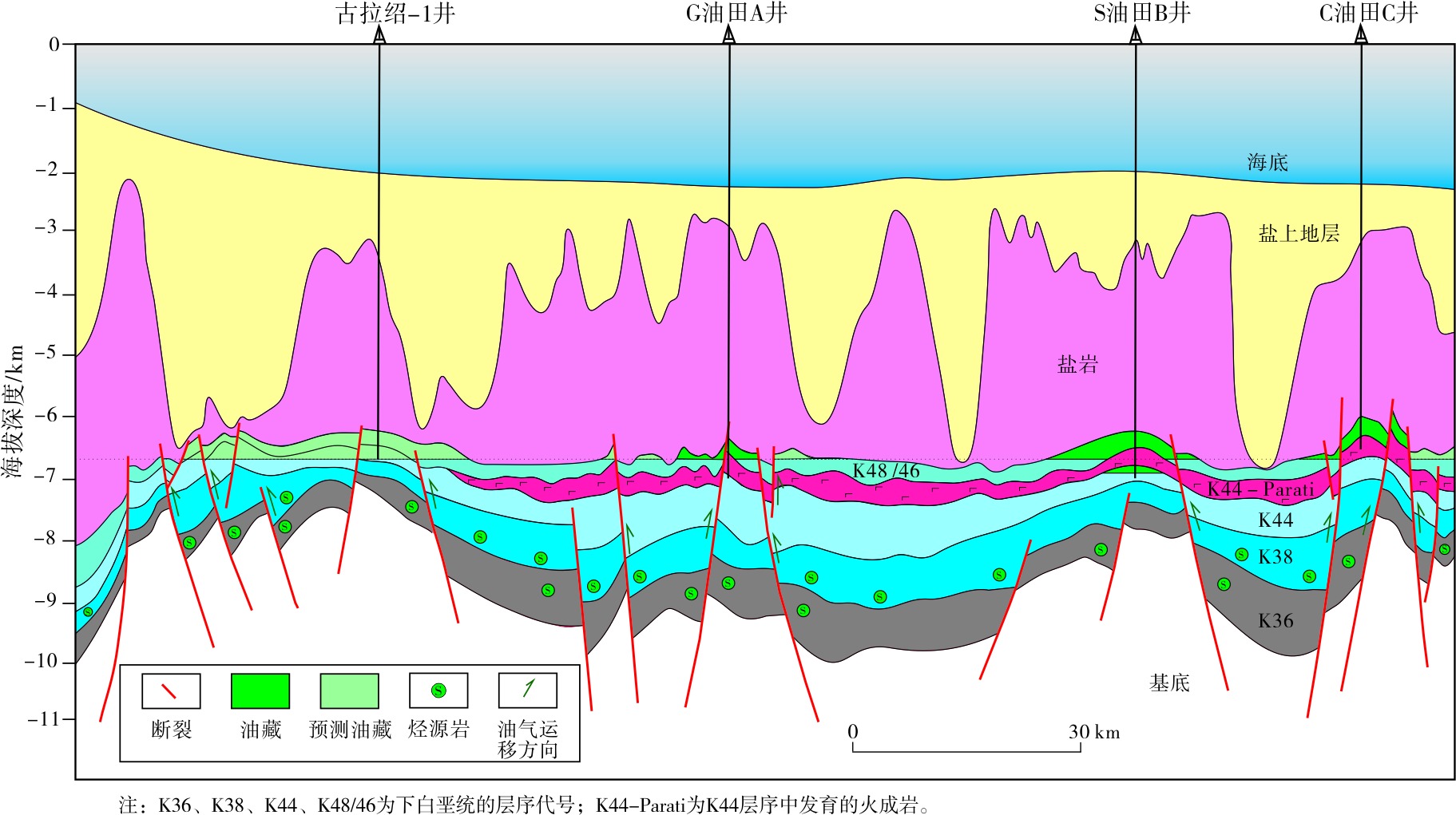
何文渊, 黄先雄, 王红平, 等. 南美桑托斯盆地深水区古拉绍-1井油气勘探发现及意义[J]. 石油学报, 2024, 45(2): 339-347.
2021年,南美桑托斯盆地深水区风险探井古拉绍-1井获得重大原油发现,地层测试获得日产千吨高产油流,确定了巴西阿拉姆区块超大型油藏的勘探潜力,证实其具有规模商业开发前景。为了更好认识这一重大突破,在区域地质背景分析的基础上,结合油气勘探历程,对古拉绍-1井的构造-沉积背景、油气成藏条件以及油藏特点进行了详细分析。研究结果表明:①阿拉姆区块位于桑托斯盆地阿拉姆—乌拉普鲁(阿—乌)隆起带,与卢拉—苏格(卢—苏)隆起带的卢拉油田隔"湖"相望,具有相似的构造沉积背景;盆地中央大型古隆起为碳酸盐岩沉积提供了有利条件。②阿拉姆区块邻近主力生烃凹陷,油源充足。③继承性古隆起控制了湖相碳酸盐岩储层连片分布。④盐岩、盐上灰泥岩和泥岩对油藏形成了多重有效封盖。⑤盐下背斜圈闭规模大,为有利油气指向区。⑥古拉绍-1井油藏属于低CO<sub>2</sub>、低H<sub>2</sub>S中质油超压油藏。古拉绍-1井的成功钻探是巴西桑托斯盆地盐下核心区向外围区拓展取得的重大突破,是中国石油天然气集团有限公司(中国石油)坚持海外风险勘探的重大成功,是中国石油海外深水油气合作发展的又一成功实践,对巴西桑托斯盆地盐下油气勘探工作以及中国石油深水油气业务发展战略具有指导意义。
In 2021, a great breakthrough has been made in discovery of crude oil in the risk exploration well, i.e., Well Gulashou-1, in deep water area of Santos Basin in South America; a daily production of thousands of tons of high-yield oil flows was obtained in the drill stem testing, thus determining a super large oil reservoir in the Alam block in Brazil and confirming its potential for large-scale commercial development. To better understand this major breakthrough, the tectonic-sedimentary environment, accumulation conditions and reservoir characteristics of Well Gulashao-1 were analyzed in detail based on the analysis of regional geological background, in combination with the exploration history. The results show as follows. (1) Alam block is located in the Alam-Uirapuru uplift belt of Santos Basin, facing with Lula oilfield in the Lula-Sugar uplift belt across a lake, and the both has a similar tectonic-sedimentary background. The large paleo-uplift in the center of the basin provides favorable conditions for carbonate sedimentation. (2) Alam block is adjacent to the main hydrocarbon generating sag with abundant oil sources. (3) The inherited paleo-uplift controls the contiguous distribution of lacustrine carbonate reservoirs. (4) Salt rocks, post-salt calcilutites and mudstones have formed multiple effective seals on the oil reservoir. (5) The pre-salt anticlinal trap is developed on a large scale, demonstrating a favorable migration direction of oil and gas. (6) The pool in Well Gulashao-1 is an overpressure reservoir, which produces medium crude oil with low CO<sub>2</sub> and H<sub>2</sub>S contents. The successful drilling of Well Gulashao-1 is a major breakthrough of oil exploration expanding from the pre-salt core area to the periphery in Santos Basin of Brazil. It is a major success achieved by PetroChina Company Limited (PetroChina) in adhering to overseas risk exploration and also a successful practice of overseas cooperation for deepwater oil and gas exploration in PetroChina. It is of guiding significance to the pre-salt oil and gas exploration in Santos Basin of Brazil and the development strategy of deepwater oil and gas business in PetroChina.
|
| [25] |
范国章, 杨柳, 王红平, 等. 巴西桑托斯盆地油气勘探历程与大型油气田群发现启示[J]. 海相油气地质, 2025, 30(6): 537-549.
|
| [26] |
王红平, 于兴河, 杨柳, 等. 巴西桑托斯盆地油气田形成的关键条件与勘探方向[J]. 矿产勘查, 2020, 11(2): 369-377.
|
| [27] |
范国章, 史卜庆, 杨柳, 等. 巴西桑托斯盆地盐下油气分布特征与富集规律[J]. 海相油气地质, 2022, 27(4): 337-347.
The Santos Basin is the richest hydrocarbon continental marginal basins in the world so far. This paper studied the discovery history and discussed the characteristics and distribution of the pre-salt oil-gas fields in the basin. According to the exploration strategy, the discovery history could be divided into three stages. The first stage is concerned with the exploration at the core of outer high (2005-2009) while the second stage at the surrounding of outer high (2009-2013). The third stage is characterized by the commercial mode of PSC given its increasing exploration risks. The hydrocarbon mainly lies under the thick salt in the deep water ocean. The discoveries are primarily oil reservoir with few gas reservoir and condensate oil reservoir. The oil reservoirs are characterized by medium-high density, high gas/oil ratio, existence of CO2 and normal / super-high pressure. The reservoir type is mainly structural reservoir whose source (lacustrine shale) - reservoir (lacustrine carbonate) - cap (continuous salt rock) developed in the rift and sag stage. The super-giant oilfields are located in the structural traps of Lula-Sugar Loaf uplift and Aram-Uirapuru uplift. The large and medium-small oilfields are located in the structural traps of secondary uplifts in western depression and central depression. From the viewpoint of basin evolution and hydrocarbon accumulation, the formation and distribution of hydrocarbon reservoirs are decided by the tectonic framework of rift stage. The hydrocarbon accumulation directions and favorable enrichment belts are decided by the tectonic activity of passive continental margin stage. There are five geological factors controlling the pre-salt hydrocarbon enrichment. The paleo-structure controls the reservoir type and quality. The current structure controls the accumulation direction. The salt rock controls the accumulation efficiency. The source kitchen controls the oil enrichment belt. The CO2 charging influences the fluid property. The study shared a comprehensive understanding about the exploration of Santos Basin and may provide some references of the exploration for other deep-water passive margin basins.
|
| [28] |
田继先, 邵泽宇, 李剑, 等. 柴达木盆地第四系泥岩生物气成藏地质特征及有利勘探方向[J]. 天然气地球科学, 2024, 35(12): 2155-2167.
第四系生物气是柴达木盆地天然气主产区,储层以砂岩为主,近年来储量增长困难,泥岩生物气作为全新勘探领域,勘探程度低,成藏特征及勘探潜力不明。以研究区2口新钻井的泥岩段取心资料为对象,在系统实验分析基础上,开展泥岩生物气成藏特征综合研究,预测泥岩生物气有利勘探区。结果表明:①第四系泥岩以滨浅湖—半深湖相深灰色泥岩沉积为主,受咸水—半咸水缺氧环境影响,发育块状、条带状和纹层状构造,砂岩、碳酸盐岩、泥岩互层特征明显,泥岩纵向上主要集中在Ⅲ、Ⅵ、Ⅷ层组3个层段,厚度大,连续性好;②第四系泥岩有机质丰度低,但可供微生物改造的有机质丰富,并且第四系发现了大量烃类、藻类等不同类型有机质,提高了生物气的生气能力;③第四系泥岩发育原生粒间孔、溶蚀孔、裂缝、晶间孔及少量有机孔等多种类型孔隙,高孔高渗,孔喉半径以宏孔为主,介孔和微孔较少;④现场解析表明:泥岩地层普遍含气,以游离气为主,脆性矿物发育段及构造高部位含气量高;⑤第四系高孔渗疏松泥岩受含水性、上覆地层压力及泥岩厚度等多因素控制,具有自封闭能力。第四系泥岩生物气具有“源储一体、脆性矿物含量控富集、泥岩厚度控封盖及构造控方向”的成藏模式,三大气田及北斜坡区是泥岩生物气有利富集区。
Quaternary biogas is the main producing natural gas in the Qaidam Basin. The reservoir is mainly sandstone. Reserve growth has been difficult in recent years. Mudstone gas, as a brand new exploration field, has a low exploration level, and the formation and reservoir characteristics as well as the exploration potential are unknown. In this study, we take the core data of the mudstone section of two newly drilled wells in the study area as the object, and carry out a comprehensive study of the formation and reservoir characteristics of mudstone biogas based on systematic experimental analysis, on the basis of which we predict the favorable exploration area for mudstone biogas. The results of the study show that: (1) The Quaternary mudstone is mainly deposited by dark grey mudstone in shallow lake and semi-deep lake, and influenced by the anoxic environment of brackish water and semi-brine water, and develops blocky, striped and laminar structure, with obvious characteristics of sand, carbonate rock and mud interlayer, and the mudstone is mainly concentrated in Ⅲ, Ⅵ and Ⅷ layer groups, with large thickness and good continuity. (2) The low abundance of organic matter in the Quaternary mudstone, but the high abundance of organic matter available for microbial modification, and the large amount of different types of organic matter, such as hydrocarbons and algae, found in the Quaternary system, improve the biogas production capacity. (3) The Quaternary mudstone develops primary intergranular pores, dissolution pores, cracks, intergranular pores and a small number of organic pores and other types of pores, high porosity and high permeability, the pore radius of macropores, mesopores and micropores are relatively small. (4) On-site analysis shows that the mudstone layers are generally gas-bearing, with free gas as the main gas, and the development section of brittle minerals and the tectonic high part of the gas-bearing parts of the high. (5) The Quaternary loose mudstone with high porosity and permeability is controlled by many factors such as water content, overburden pressure and mudstone thickness, and has the ability of self-containment. Mudstone is controlled by water content, overlying stratigraphic pressure and mudstone thickness and has the ability to self-seal. It is concluded that the Quaternary mudstone gas has a reservoir formation mode of "integrated source and storage, accumulation controlled by brittle mineral content, direction controlled by mudstone thickness, pore sealing and tectonic", and the three major fields and the north slope area are favorable areas for mudstone gas accumulation. |
| [29] |
史卜庆, 王兆明, 万仑坤, 等. 2020年全球油气勘探形势及2021年展望[J]. 国际石油经济, 2021, 29(3): 39-44.
|
| [30] |
|
| [31] |
杨松岭, 张科, 陈景阳, 等. 全球生物气藏分布特征及成藏条件[J]. 天然气工业, 2019, 39(8): 10-24.
|
| [32] |
林春明, 李艳丽, 漆滨汶. 生物气研究现状与勘探前景[J]. 古地理学报, 2006, 8(3): 317-330.
|
| [33] |
|
| [34] |
田琨, 王大鹏, 殷进垠, 等. 东地中海深水油气富集条件与勘探方向[J]. 中国石油勘探, 2021, 26(3): 107-116.
The eastern Mediterranean has become one of the global hot spots of deep-water oil and gas exploration in recent years owing to its abundant oil and gas resources and low degree of exploration. The study of deep-water hydrocarbon enrichment conditions in the Eastern Mediterranean is of guiding significance to the selection of exploration zones and plays in this area. This paper analyzes the tectonic sedimentary evolution, petroleum geological conditions, reservoir-caprock assemblages, and hydrocarbon accumulation characteristics of the Eastern Mediterranean and discusses the deep-water hydrocarbon enrichment conditions and exploration targets by comprehensive petroleum geological study on the international oil and gas commercial database and geological and geophysical data. The results show that there are two main reservoir-caprock assemblages of Miocene reef limestone + salt rock and Miocene turbidite sandstone + salt rock, and two inferred reservoir-caprock assemblages of Cretaceous turbidite sandstone + shale and Jurassic reef limestone + marl in the Eastern Mediterranean. The deep-water hydrocarbon enrichment in the Eastern Mediterranean is controlled by thick Oligocene-Miocene marine source rocks, high-quality Miocene basin floor fan turbidite sandstone and reef limestone reservoirs, regional salt caprocks and large structural traps developed during the tectonic inversion period. In the future, favorable plays of Miocene turbidite sandstone in the deep-water area in the Levant Basin and Miocene reef limestone around the Erotosthenes platform should be focused on, and new fields of Miocene turbidite sandstone in deep-water area in theHerodotus Basin and deep Mesozoic in the Levant Basin be further explored.
|
| [35] |
徐长贵, 吴克强, 裴健翔, 等. 超深水超浅层天然气富集机理与成藏模式: 以琼东南盆地陵水36-1气田为例[J]. 石油勘探与开发, 2025, 52(1): 44-56.
基于琼东南盆地油气勘探实践与油气地质研究新进展,综合地震、测井、钻井、岩心、井壁取心及地球化学等新资料,以陵水36-1气田为例,对超深水超浅层天然气田的气源、储-盖条件、圈闭类型、运聚特征、富集机理与成藏模式开展系统研究。研究表明:①琼东南盆地超深水超浅层天然气成因类型包括热成因气和生物气,以热成因气为主;②储层主要为第四系深水海底扇砂岩;③盖层类型有深海泥岩、块体流泥岩及含水合物地层;④圈闭类型以岩性圈闭为主,也发育构造-岩性圈闭;⑤运移通道包括断层、气烟囱、裂隙带等垂向输导通道及大型砂体、不整合面等侧向输导层,构成单一或者复合输导格架。提出超深水超浅层天然气“深浅双源供烃、气烟囱-海底扇复合输导、深海泥岩-块体流泥岩-含水合物地层三元封盖、晚期动态成藏、脊线规模富集”的天然气成藏新模式。研究取得的新认识对下步深水超浅层及相关领域或地区的油气勘探具有借鉴和启示意义。
|
| [36] |
吴克强, 裴健翔, 胡林, 等. 莺歌海-琼东南盆地油气勘探新进展与思考[J]. 中国海上油气, 2024, 36(5): 1-13.
|
| [37] |
宋鹏, 李芳, 孙万元, 等. 南海深水少井区浅层气储层地震预测技术及应用[J]. 世界地质, 2024, 43(4): 526-540.
|
| [38] |
黄时卓, 李芳, 宋鹏, 等. 琼东南盆地超深水浅部气藏地球物理识别技术[J]. 地球科学, 2024, 49(1): 313-323.
|
| [39] |
|
| [40] |
|
| [41] |
|
| [42] |
裘怿楠, 陈子琪. 油藏描述[M]. 北京: 石油工业出版社, 1996.
|
| [43] |
穆龙新. 油藏描述的阶段性及特点[J]. 石油学报, 2000, 21(5): 103-108.
在油田开发过程中,由于每个开发阶段的任务不同,所拥有的资料基础不同,加之我国陆相储层的复杂性,造成了不同开发阶段油藏描述所要描述的重点内容和精度的不同,从而形成了油藏描述的阶段性.总体来看油藏描述可划分为开发准备阶段的早期油藏描述、主体开发阶段的(中期)油藏描述和挖潜、提供采收率阶段的精细油藏描述三大阶段.每个阶段在构造、地层、沉积相、储层、地质模型等方面所描述的重点内容和精度要求等都有明显差别.本文给出了每个阶段油藏描述应重点描述的对象和内容,所需要的主要技术和方法以及达到的精度要求等.
During the development of oilfield,the different emphasis and different information in different stages,as well as the complexities of continental reservoirs result in the different stress and precision of description in different stages.Reservoir description can be divided into three stages:the early description in preparative stage,fine description in mature stage and precision description in EOR stages.Each stage differs obviously in the description of structure,formation,sedimentary facies,reservoir and geological model.The paper summarizes main stages of reservoir description.
|
| [44] |
万广峰, 刘成彬, 张洁, 等. 中油国际巴西深水油气项目提质增效创新与实践[J]. 国际石油经济, 2021, 29(3): 96-101.
|
| [45] |
贾爱林, 郭智, 郭建林, 等. 中国储层地质模型30年[J]. 石油学报, 2021, 42(11): 1506-1515.
储层地质模型是表征地质体规模、储层建筑结构与流体分布特征的综合体,是地质研究的最终成果和数值模拟的基础数据体。回顾并总结了中国储层地质建模30年来的发展历程与阶段、地质模型的类型划分与主要特点以及中国储层地质建模技术的主要进展。前20年,在引进、吸收国外建模理念和技术的基础上,形成了中国储层地质模型的基本框架、流程和步骤;建立了扇三角洲、辫状河等储层原型地质知识库,开展了河流相储层分级构型研究,推动了定量地质学的发展;分构造背景和储层类型建立模型,在随机模拟方法和技术上取得突破。近10年来,建模手段日趋丰富,方法不断进步,同时随着开发阶段和开发对象的深刻变革产生了3个方面的重大变化:①非常规储层开发逐渐受到重视,针对非常规储层的地质建模技术得到了大力发展与广泛应用;②许多油田进入中-高含水期或开发后期,针对老油田的储层表征与建模技术不断深化;③随着天然气工业的快速发展,形成了一套针对天然气开发需求的油藏描述与地质建模技术。
Reservoir geological model is a comprehensive body that characterizes the scale of geological body, reservoir structure and fluid distribution characteristics. It is also the final result of geological research and the basic data system for numerical simulation. This paper reviews the development process and stages of geological modeling in China in the past three decades, and summarizes the classification and main characteristics of geological models and the major progress in geological modeling technology.In the first stage of 20 years, based on introducing and studying the foreign modeling concepts and technologies, the basic framework, processes and steps of geological modeling have been established in China; a prototype geological knowledge database for reservoirs such as fan delta and braided rivers has been built, and relevant studies have been carried out on the hierarchical configuration of fluvial facies reservoir, thus promoting the development of quantitative geology; a series of geological models have been established according to the different structural background and reservoir types, and breakthroughs have been made in stochastic simulation methods and technologies. In the nearly 10 years, the methods of reservoir geological modeling has been developed, and continuously improved. Meanwhile, with the profound revolution in the development stage and development object, three major changes occurred:first, unconventional reservoirs, as a exploitation target, have been gradually attracting attention, and thus the geological modeling technology for unconventional reservoirs has been vigorously developed and widely used; second, a large number of oilfields have entered the middle-high water cut period or late development period, and the reservoir characterization and modeling technologies for old oilfields have been continuously improved; third, the rapid development of natural gas industry has resulted in the appearance of a set of reservoir characterization and geological modeling technologies for meeting the needs of natural gas development.
|
| [46] |
计秉玉, 张文彪, 何应付, 等. 油藏地质建模与数值模拟一体化内涵及发展趋势[J]. 石油学报, 2024, 45(7): 1152-1162.
地质建模与油藏数值模拟是现代油藏研究与管理的重要工具,推动建模—数值模拟一体化技术发展与应用对油气藏高效开发具有重要意义。通过阐述建模—数值模拟学科的形成、发展及深度融合的历程,剖析了建模—数值模拟一体化在理念、流程、算法和应用上的内涵,分析了建模—数值模拟一体化关键技术发展趋势。地质建模技术要向地震多信息驱动、多点统计学新算法、地质过程模拟、人工智能技术等方面继续探索;数值模拟技术要更加注重多相多组分多场耦合、物理化学渗流、全油藏一体化模拟、人工智能自动历史拟合等方向的深化研究。提出了实现建模—数值模拟一体化的主要做法,包括搭建一体化软件平台、建立规范流程标准、发挥示范引领作用以及大力培养复合型人才;并认为多维多尺度数据同化、构建油气藏开发大模型以及数字孪生是建模—数值模拟一体化的未来发展趋势。
Geological modeling and numerical reservoir simulation are considered as important tools for modern reservoir research and management, and it is of great significance to promote the development and application of modeling and numerical simulation integration technique for efficient exploitation of oil and gas reservoirs. This paper briefly elaborates the formation, development and deep integration of the modeling and numerical simulation disciplines, and also analyzes the connotations of modeling and numerical simulation integration in terms of concept, process, algorithm and application, as well the development trends for key techniques of modeling and numerical simulation integration. At present, geological modeling technique needs to be further explored in terms of seismic multi-information drive, multi-point new statistical algorithm, geological process simulation and artificial intelligence technology; numerical simulation technique should focus more on in-depth studies of multi-phase, multi-component and multi-field coupling, physicochemical porous flow, whole-reservoir integration simulation and AI-based automatic history matching. Main methods for achieving modeling and numerical simulation integration are proposed, including building an integrated software platform, establishing standard procedures and standards, giving play to demonstrative and leading roles and fostering versatile talents. Moreover, it is considered that multi-dimensional and multi-scale data assimilation, construction of big reservoir development model and digital twin will be the future development trends for integrated modeling and numerical simulation.
|
| [47] |
左国平, 范国章, 孙辉, 等. 深水油气勘探关键评价技术及其在东非海域的应用[J]. 海相油气地质, 2021, 26(3): 211-223.
In recent years, several giant gas reservoirs have been found in the deep-water area of offshore Mozambique in East Africa, making this area the focus of gas exploration in the world. However, the exploration degree in this area is low, and the research on deep-water sedimentary system is at a low level, which restricts the fine petroleum exploration in this area. Based on core, logging, and 3D seismic data, the sequence stratigraphic framework of Mozambique sea area is established by integrating the key technologies of deep-water oil and gas exploration, such as deep-water sedimentary sequence stratigraphic identification and division method, deep-water sedimentary structural unit comprehensive description technology, deep-water sedimentary reservoir prediction and fluid identification technology, and deep-water sedimentary reservoir 3D geological modeling technology. A comprehensive description chart of deep-water sedimentary structural elements was formed, which was used for effectively predicting the distribution of deep-water sedimentary reservoirs and fluid distribution. The research results provide technical support for reserve evaluation and well deployment, boost the development of trillions of cubic meters of giant gas fields in Mozambique, and achieve good application results.
|
| [48] |
刘文岭, 韩大匡. 数字孪生油气藏: 智慧油气田建设的新方向[J]. 石油学报, 2022, 43(10): 1450-1461.
对地下储层和流体的认识程度严重制约油气田开发的生产举措,而油气藏描述在油气田开发中占有重要地位,构建油气藏系统的数字孪生体是油气藏描述的最高境界。在对油气田开发研究现状与发展趋势和数字化转型生产需求分析的基础上,提出了数字孪生油气藏理论,将数字孪生油气藏定义为"构建油气藏的数字孪生仿真模型,最大限度地量化逼近真实油气藏,及时准确地表征油气藏全生命周期动态变化,模拟物理世界油气藏实体在真实环境下的开发行为",为油气藏描述与油气藏工程一体化研究指明了方向。论述了基于数字孪生油气藏的智慧油气田建设重点方向与建设内容,指出通过建立油气藏开发系统的数字化副本——油气藏数字孪生体,以此为基础在云端优化开发与科学管理油气田,将带来油气田开发领域的一场新的技术革命,数字孪生油气藏将为智慧油气田建设赋予新的内涵。
The production measures of oil and gas field development is severely restricted by the degree of understanding of subsurface reservoirs and fluids; reservoir description plays an important role in oil and gas field development business, and the main goal of reservoir description is to construct the digital twin system of reservoirs. Based on analyzing the current research status and development trend of oil and gas field development and the demands for digital transformation-based production, the paper proposes the digital twin theory of oil and gas reservoir, which defines the reservoir digital twin as "building a digital twin simulation model of oil and gas reservoirs to maximize the quantitative approximation of the real reservoir, characterizing the dynamic changes of the whole life cycle of reservoirs in a timely and accurate manner, and simulating the development behavior of reservoir entities from the physical world in a real environment". This points out the direction for the integrated research of reservoir description and reservoir engineering. Further, the paper presents the key directions and contents of smart oil and gas field construction based on the digital twin system of oil and gas reservoirs, and it is pointed out that by establishing a digital copy of oil and gas reservoir development system, i.e., the digital twin system of oil and gas reservoirs, as a basis for optimal development and scientific management of oil and gas fields in the cloud, a new technological revolution in the field of oil and gas field development will emerge, and the digital twin system of oil and gas reservoirs will give new connotation to the construction of smart oil and gas fields.
|
| [49] |
张文彪, 段太忠, 刘彦锋, 等. 综合沉积正演与多点地质统计模拟碳酸盐岩台地: 以巴西Jupiter油田为例[J]. 石油学报, 2017, 38(8): 925-934.
为有效提高碳酸盐岩沉积相(岩相)模拟的精度,以巴西Jupiter油田为例,在岩心、测井及地震资料综合分析的基础上,通过多条件约束建立该地区碳酸盐岩台地沉积正演模型,以此作为多点地质统计模拟的三维训练图像,并利用成熟的Snesim算法对实际油田数据进行模拟。研究结果表明:沉积正演模拟初始控制条件对碳酸盐岩台地沉积分布影响较大,主要包括水深、风向、波浪能量、碳酸盐岩产率等,其中水深(主要影响温度和光照)对碳酸盐岩产率影响最大;波浪能量大小控制不同类型碳酸盐岩分布特征,高能环境沉积物主要为生物礁及颗粒灰岩,低能环境沉积物主要为泥晶灰岩;碳酸盐岩沉积正演模型体现了高能生物礁与低能泥晶灰岩的渐变接触关系,符合碳酸盐岩生长规律,将其转化为三维训练图像,多点模拟结果既满足所有钻井认识又体现了训练图像反映的相结构关系。本研究总结了碳酸盐岩台地沉积正演模拟的分析方法,提出三维训练图像获取较新的思路,综合了沉积正演模拟与多点统计模拟的优势,并在实际油田应用中取得一定效果,对类似孔隙性碳酸盐岩油藏地质建模具有借鉴意义。
To effectively improve the accuracy of carbonate sedimentary facies (lithofacies)simulation, based on integrated analysis of core data, logging data and seismic data of Jupiter oilfield in Brazil, multi-condition constraint is used to create the sedimentary forward model of regional carbonate platform as the 3D training image of multipoint geological statistical simulation. Meanwhile, the mature Snesim algorithm is applied to simulate actual oilfield data. Research results demonstrate that the sedimentary forward modeling of initial control conditions make great impacts on the sedimentary distribution of carbonate platform, mainly including water depth, wind direction, wave energy and carbonate production. Among them, water depth (mainly affecting temperature and light)has the most influence on carbonate production. The distribution characteristics of different carbonate types were controlled by wave energy magnitude. High-energy environmental sediments mainly include reefs and grain stones, while low-energy environmental sediments are dominated by micrite. The sedimentary forward model of carbonate also reveals the changing contact relationship between high-energy reefs and low-energy micrite, consistent with carbonate growth rules. Then, it is converted to 3D training image, and multipoint simulation results are not only coincident with drilling understanding but also reflect the facies structure relation reflected by training image. Through summarizing the sedimentary forward simulation analysis method of carbonate platform, a new approach of acquiring 3D training image is proposed in this study; as integrating the advantages of sedimentary forward modeling and multipoint statistical simulation, it has a good application in oilfield and provides a reference for the geological modeling of porous carbonate reservoir. |
| [50] |
|
| [51] |
万广峰. 巴西深水油气勘探开发实践[M]. 北京: 石油工业出版社, 2020.
|
| [52] |
|
| [53] |
|
| [54] |
|
| [55] |
|
| [56] |
|
| [57] |
|
| [58] |
马英文, 曹砚锋, 邱浩, 等. 中国海油中深层油气田完井技术现状及展望[J]. 中国海上油气, 2024, 36(5): 146-156.
|
| [59] |
|
| [60] |
杨进, 傅超, 刘书杰, 等. 中国深水钻井关键技术与装备现状及展望[J]. 世界石油工业, 2024, 31(4): 69-80.
|
| [61] |
王宇, 张俊斌, 陈斌, 等. 水下采油树应用技术发展现状[J]. 石油机械, 2016, 44(12): 59-64.
|
| [62] |
范白涛, 吴旭东, 罗鸣, 等. 中国超深水钻完井核心装备国产化进展与展望[J]. 钻采工艺, 2026, 49(3): 171-182.
|
| [63] |
黄吉, 姜晓翔, 甘霏斐. FPSO国内外发展及市场展望[J]. 船舶工程, 2021, 43(12): 29-36.
|
| [64] |
魏跃峰, 单铁兵, 张太佶. 中国海洋油气开发装备研发史[M]. 上海: 上海交通大学出版社, 2022.
|
| [65] |
谢彬, 喻西崇, 韩旭亮, 等. FLNG研究现状及在中国南海深远海气田开发中的应用前景[J]. 中国海上油气, 2017, 29(2): 127-134.
|
| [66] |
温志新, 窦立荣, 王兆明, 等. 近20年全球油气勘探趋势分析与思考[J]. 石油学报, 2026, 47(5): 974-992.
基于标普全球(S&P Global)、睿咨得能源(Rystad Energy)等商业数据库及全球油公司的公开信息,对2004—2024年全球油气的勘探投资、勘探区块授予、勘探钻井、油气新发现等进行系统分析。研究结果表明:勘探投资随着原油价格上涨先是经历了10年的上升期,随后进入低位稳定期,常规油气勘探以海域为主,非常规油气勘探聚焦页岩油气;常规油气探井数量在近年呈低位态势,探井的地质成功率总体稳定,高影响探井主要聚焦在非洲和拉美地区东部海域的深水—超深水领域;深水前沿盆地、深层—超深层和非常规成为全球油气增储的主要领域。基于近20年全球油气勘探的总体趋势,建议中国油公司发展跨国油气勘探业务:①持续强化海外上游业务,聚焦优质油气资产获取;②积极拓展全球深水—超深水勘探,抢占前沿有利领域;③依托技术优势,超前布局陆上深层—超深层富油气区;④积极评价陆上富油气盆地,坚持常规和非常规油气并举与立体勘探;⑤持续提前购买多用户地震数据,开展超前选区研究。
Based on commercial databases such as S&P Global and Rystad Energy, alongside public disclosures from international oil companies, this study provides a systematic analysis of global hydrocarbon exploration investment, block licensing, exploratory drilling, and new discoveries from 2004 to 2024. The results indicate that exploration investment underwent a decade of expansion driven by rising crude oil prices, followed by a period of low-level stabilization. Conventional exploration is currently dominated by offshore areas, whereas unconventional exploration is concentrated in shale oil and gas. While the number of conventional exploration wells has remained low in recent years, geological success rates have exhibited overall stability. High-impact wells are primarily located in deepwater to ultra-deepwater plays in Africa and the eastern offshore regions of Latin America. Furthermore, deepwater frontier basins, deep to ultra-deep reservoirs, and unconventional resources have emerged as the primary source for global reserve growth. Based on the overarching trends in global hydrocarbon exploration over the past two decades, several strategic recommendations are proposed for Chinese oil companies to advance their international exploration business: (1) continuously strengthening overseas upstream operations with a focus on acquiring premium oil and gas assets; (2) actively expanding into global deepwater and ultra-deepwater exploration to secure early-mover advantages in frontier domains; (3) leveraging technological competitive edges to strategically position within onshore deep and ultra-deep hydrocarbon-rich zones; (4) comprehensively evaluating onshore petroliferous basins, and maintaining a dual emphasis on conventional and unconventional resources through integrated multi-dimensional exploration; (5) consistently pre-purchase multi-client seismic data to facilitate proactive play-entry and site-selection research.
|
| [67] |
韩鑫, 杨波, 唐慧敏, 等. 海上深水气田群高效稳产开发技术研究[J]. 海洋石油, 2024, 44(4): 41-45.
|
| [68] |
范白涛, 吴怡, 袁俊亮, 等. 中国海油“十四五”石油工程技术进展与发展建议[J]. 石油钻探技术, 2025, 53(6): 28-36.
|
| [69] |
孙福街. 中国海上油气开发技术进展与展望[J]. 世界石油工业, 2026, 33(1): 222-232.
|
| [70] |
陈旭光, 寇海磊, 牛小东, 等. 深海水下技术装备发展研究[J]. 中国工程科学, 2024, 26(2): 1-14.
深海水下技术装备是认知深海、开发深海资源以及保护海洋生态的关键,拓展深海新空间面临复杂多变的环境挑战,亟需高水平的深海水下技术装备作支撑。本文立足我国海洋强国建设的发展实际,分析了深海水下技术装备的体系构成和发展需求,从深海观测 / 探测与感知系统、水下施工作业装备、深海水下油气生产系统、深海矿产资源开发装备4个方面出发,梳理了国外深海水下技术装备的发展现状和趋势。在此基础上,总结了我国深海水下技术装备研制的发展现状,分析了发展面临的工程挑战,剖析了相关关键技术装备体系和关键物理 – 力学机制,概括了深海水下技术装备的典型装备代表和装备图谱,凝练了我国深海水下技术装备的共性关键技术,涵盖智能化与自动化技术、精密元器件加工制造技术、高精度定位导航、高速率通信技术、大系统力学计算与分析和跨尺度工程设计方法与技术等方面。为实现我国深海水下技术装备的高质量发展,研究建议:加强深海水下工程技术发展的顶层设计,推动构建共性关键技术协作体系;增强我国深海水下技术规范和标准的行业影响力,大力开拓国际市场;高质量推进兼容通用的平台建设;注重培养深海水下工程科技创新人才,为加速实现海洋科技产业高水平发展提供支撑。
Deep-sea underwater technology and equipment are crucial aspects to cognize the deep sea, exploit deep-sea resources, and protect the marine ecosystem. Expanding the deep-sea space faces complex environmental challenges and urgently requires support of high-level deep-sea underwater technologies and equipment. This study analyzes the components and demands for the deep-sea underwater technology and equipment and reviews the current status and development trends of the technology and equipment from four aspects: deep-sea observation/detection and perception, underwater construction, deep-sea oil and gas production, and deep-sea mineral resource collection. Moreover, this study analyzes the development status and engineering challenges in China, explores the key technology and equipment systems and key physical–mechanical mechanisms behind them, and summarizes the typical equipment and corresponding diagram. Additionally, the common key technologies of the deep-sea underwater equipment in China are summarized, including the intelligent and automation technology, precision component processing and manufacturing technology, high-precision positioning and navigation technology, high-speed communication technology, computational and analytical mechanics of large systems, and multiscale engineering design methods and technologies. Furthermore, countermeasures and suggestions are proposed aiming at achieving high-quality development of the deep-sea underwater technology and equipment in China: strengthening the top-level design of deep-sea underwater engineering to promote the establishment of a coordinating system for common key technologies, enhancing the industry influence of Chinese deep-sea underwater technical standards to explore the international market, promoting the construction of compatible and universal platforms with high quality, and training innovation professionals to provide support for the high-level development of the marine science and technology industry. |
| [71] |
秦雁群, 肖坤叶, 陈忠民, 等. 埃尼集团“双勘探模式”执行情况、实施要领与启示[J]. 中国石油勘探, 2025, 30(6): 58-69.
在全球能源转型与低油价周期的双重压力下,国内外大油气公司均面临勘探投资萎缩、现金流紧张等生存挑战。意大利埃尼集团通过创新" 双勘探模式",结合深水技术优势在勘探发现后通过权益出售实现早期价值变现,成功构建了“发现- 货币化- 再发现”的闭环体系。本文系统梳理该模式的内涵、执行情况及实施要领,结合莫桑比克、埃及和科特迪瓦典型案例分析,揭示其通过技术驱动、资本优化和战略协同实现低成本发现与高效开发的路径。研究表明,“双勘探模式”具有:低成本、大发现是基础,高权益、快变现是精髓,保留作业者身份和分散风险是保障等特点;主体实施过程包括区块购入、自主勘探和自循环三大阶段10个细分步骤;适用于低油价时期且需同时满足特定的资源、管输、政策、资本和技术条件;现阶段仍面临资源稀缺、外部市场环境和内部技术能力等诸多挑战。基于中国石油海外油气资产经营现状,提出现有项目应构建全生命周期评估体系和权益管理矩阵、新项目获取应形成“能否持续变现”的新经营观等建议。
Under the dual pressures of global energy transition and low oil price cycles, major oil and gas companies worldwide face survival challenges including shrinking exploration investments and tight cash flows. Italy’s Eni Group has innovatively developed the “Dual Exploration Model,” leveraging its deepwater technical advantages to achieve early value realization through equity sales after exploration discoveries,successfully establishing a closed-loop system of “discovery-monetization-rediscovery.” This paper systematically reviews the model’s connotation,execution status, and implementation essentials, analyzing case studies from Mozambique, Egypt, and C?te d’Ivoire to reveal its path of achieving low-cost discoveries and efficient development through technology-driven approaches, capital optimization, and strategic synergy.Research shows that the “Dual Exploration Model” features: low cost and major discoveries as the foundation, high equity and fast monetization as the essence, and retaining operator status and risk diversification as safeguards. The main implementation process consists of three stages (block acquisition, independent exploration, and self-recycling) with 10 detailed steps. It is suitable for low oil price periods but requires specific resource, pipeline, policy, capital, and technical conditions. Currently, it still faces numerous challenges including resource scarcity, external market environment, and internal technical capabilities. Based on the current status of PetroChina’s overseas oil and gas assets, this paper proposes recommendations such as establishing full-lifecycle assessment systems and equity management matrices for existing projects and forming a new business philosophy of “sustainable monetization” for new project acquisitions.
|

/
| 〈 |
|
〉 |