

0 前言
碳酸盐岩油气藏因其储层物性好、储量规模大、采收率高及勘探开发成本低而备受关注,来自碳酸盐岩储层的油气产量约占全球油气总产量的60%。中新世以来南海发育着众多以生物礁为基础构成的碳酸盐台地,是寻找大油气田的重要领域[1]。根据IHS数据库统计,截至2025年,南海已发现油气藏与含油气构造共775个,其中碳酸盐岩生物礁岩性油气藏144个,占油气藏发现总个数的19%;累计发现探明可采储量油当量92.23×10⁸ t,其中碳酸盐岩油气藏探明可采储量34.80×10⁸ t,占比为38%[2]。这些油气藏主要分布于北部的东沙台地、南部的南康台地及东南部礼乐巴拉望台地。前人对以上台地发育的碳酸盐岩油气藏及勘探潜力进行了相关研究:孙启良等[3]对南海北部生物礁碳酸盐岩差异性及控制因素进行了研究;马玉波等[4]论述了西沙海区碳酸盐台地地震反射特征及沉积模式;王龙等[5]探讨了南海中南部区域碳酸盐岩储层的分布规律。这些研究主要集中在对碳酸盐岩储层特征的描述以及碳酸盐台地的识别方法等方面,对碳酸盐岩油气藏的形成条件、主控因素及成藏模式的总结与对比研究相对较少。本文通过系统解剖南海已发现的典型碳酸盐岩油气藏,分析总结成藏条件与主控因素,建立成藏模式,以期为南海及相同地质条件地区的碳酸盐岩油气藏有利区带优选和目标评价提供一定的借鉴和参考。
1 区域地质背景
始新世至早渐新世,随着印澳板块北东向俯冲及太平洋板块北西向俯冲,地幔物质向东南方向蠕动,华南大陆边缘发育一系列地堑-半地堑,以湖相沉积为主,该时期是南海各盆地烃源岩的主要发育时期。早渐新世晚期,随着张裂作用的持续进行,西北次海盆与中央海盆相继裂开,早期稳定的微地块(如东沙、西沙、礼乐、中沙等地块)开始裂离于华南大陆。基于其刚性基底性质(如西沙地块的花岗片麻岩),这些微地块抗变形能力强、沉降均一,造成地块内裂陷欠发育。
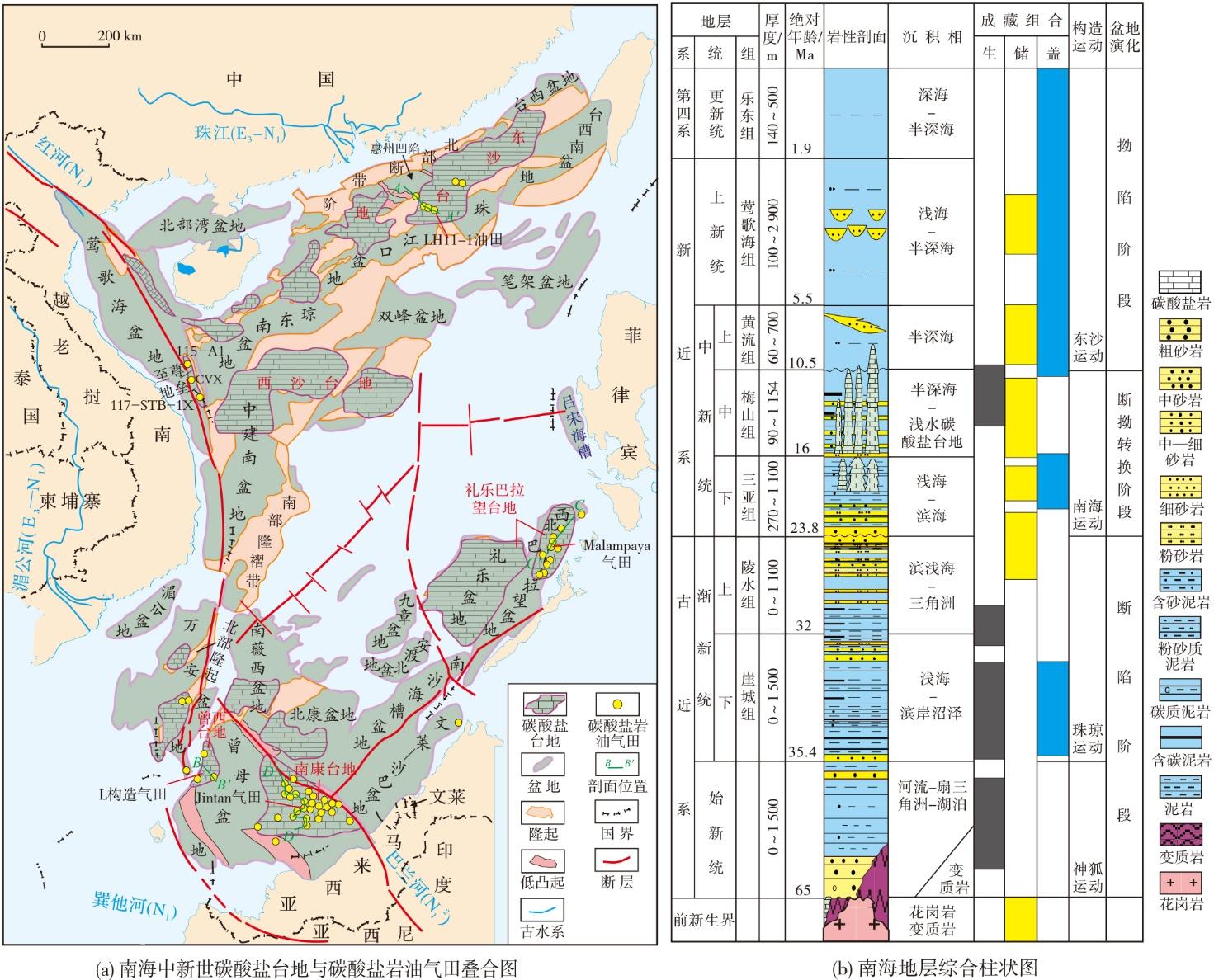
晚渐新世至中中新世,随着中央海盆与西南海盆的持续裂开,礼乐地块向东南方向漂移。该时期南海沉降速率减缓,海水大规模入侵,前期一些稳定的微地块开始被海水覆盖。由于远离物源,在这些地块边缘普遍发育生物礁,地块内发育碳酸盐滩,形成稳定型碳酸盐台地(如东沙台地、西沙台地)(图1a)[8]。同时在远离物源的盆地,其断块的地垒部位(如莺歌海盆地至尊地垒、中建南盆地中南部地垒、万安盆地中南部地垒、礼乐—巴拉望地垒)普遍发育断块型碳酸盐台地(图1a,1b)。早中新世晚期开始,随着南沙地块与婆罗洲地块逆时针碰撞,造成地块内早期发育的凹陷发生反转,加之远离物源,在这些反转高部位发育反转型碳酸盐台地,如曾母盆地、北康盆地、南薇西盆地反转形成的反转型碳酸盐台地(图1a)。该时期大规模发育的碳酸盐岩为油气藏形成提供了良好的储层。晚中新世,南海进入加速沉降期,前期发育的生物礁大部分被快速淹没而停止发育,此时巨厚的海相泥岩覆盖于前期碳酸盐岩之上形成良好的区域盖层。
2 南海典型碳酸盐岩油气藏特征
根据南海地质背景与基底结构,将南海碳酸盐台地分为稳定型台地、断块型台地与反转型台地。稳定型台地以东沙台地为代表,目前发现各类碳酸盐岩油气田与含油气构造11个,累计探明油气可采储量油当量0.52×10⁸ t,其中最大也是最典型的油田为LH11-1油田(图1a);断块型台地以曾西台地和礼乐巴拉望台地为代表,目前南海已发现最大的气田L构造气田就位于曾西台地,其探明地质储量达6.29×10¹² m3,后者目前已发现各类碳酸盐岩油气藏与含油气构造20个,累计探明油气可采储量油当量3.90×10⁸ t,其中最典型也是最大的油气田为Malampaya油气田(图1a);反转型台地最典型的代表是曾母盆地的南康台地,目前已发现各类碳酸盐岩油气藏与含油气构造共计95个,累计探明油气可采储量油当量20.47×10⁸ t,台地上油气田具有成群成带分布、一礁一藏的特征,都有相似的油气成藏条件,目前掌握资料较多的气田为Jintan气田(图1a)。
台地类型、发育部位与形成过程不同,造成其内发育的油气藏具有不同的成藏模式。为明确不同类型台地碳酸盐岩油气藏的异同点,下文对稳定型台地内发育的LH11-1油田、断块型台地内发育的L构造气田与Malampaya油气田、反转型台地内发育的Jintan气田等油气田的典型油气藏进行解剖分析。
2.1 LH11-1油田
2.1.1 油田概况
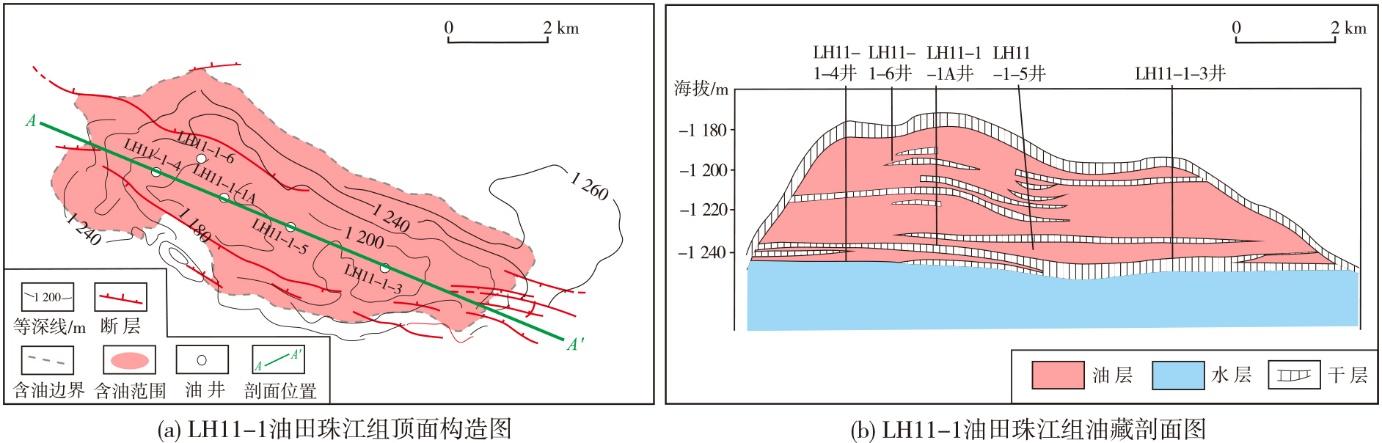
LH11-1油田位于南海北部珠江口盆地东部,1987年LH11-1-1A井于下中新统珠江组生物礁地层中钻遇油层,用2.22 mm油嘴DST测试产油356.7 m3/d,从而发现该大型生物礁油田。油田自1996年开始开采,截至2021年累计产油1 921×104 t。油田构造上位于珠一坳陷的惠州凹陷和珠二坳陷的白云凹陷之间的东沙隆起西北端,是在基底古隆起上形成的中新世大型披覆背斜油藏(图2a),形态完整,构造简单。油田地处大陆边缘,水深300~332 m,主体位置跨越坡折带与上陆坡。圈闭面积为53.6 km2,含油面积为36.3 km2,探明地质储量为1.54×10⁸ t,为一块状底水油藏(图2b),油水界面海拔为为-1247 m。地面原油相对密度为0.92~0.97,地层原油黏度为50~162 mPa•s,低含蜡(0.43%~6.21%),低含硫(0.28%~0.41%)。原油遭受不同程度的生物降解作用,纵向上距油水界面越远,地面原油比重和地层原油黏度越低,油水界面附近存在一个氧化程度更高的稠油带。
2.1.2 石油地质特征
油田烃源灶位于北面的惠州凹陷,主力烃源岩为始新统文昌组湖相暗色泥岩,下渐新统恩平组的湖沼相煤系泥岩是次要烃源岩。暗色泥岩和湖沼含煤系泥岩地层厚度为800~1 000 m,分布面积达6 000 km2。作为主力烃源岩的文昌组暗色泥岩有机质丰度高,有机碳含量在2.24%~3.03%之间,有机质类型主要为Ⅱ1型和Ⅱ2型。由于地温梯度高达4.0 ℃/100 m,故具有良好的成熟条件,烃源岩生油门限的Ro为0.55%、埋深为2 400 m,生烃高峰的Ro介于0.8%~1.03%、埋深在3 200~3 500 m之间。这套烃源岩主要发育在大陆架台地内部均衡沉降拗陷的半封闭-封闭性水域中,产烃率高[9-10]。
油田的主要储层为远离生烃凹陷的中新统生物礁滩灰岩。盆地构造史和沉降史研究表明,LH11-1油田所在的东沙隆起是珠江口盆地中央隆起带的组成部分,是一个长期发育的古隆起,直至晚渐新世以后才沉降,沦为水下高地。进入早中新世以来,在东沙隆起形成了碳酸盐台地相沉积,并有块礁、边缘礁形成。主要的成礁期在早中新世末,直至发生东沙运动。这套礁灰岩厚度为400~600 m,主体厚度达470 m;礁体面积为300 km2,平面分布长达100 km。这套规模较大的碳酸盐沉积建造,经后期淋滤、溶蚀、次生扩大等后期成岩作用的改造,发育晶洞、晶孔、粒间孔、粒内孔等各种类型的孔隙,其孔隙度平均为15%~21%,渗透率一般为(39~458)×10-3 μm2、最高达6 150×10-3 μm2[11],储集物性极佳。
油田盖层是一套在横向上厚度稳定且连续的下中新统上部—中中新统海相泥岩,厚达200 m。这套海相泥岩致密低渗,具有较好的均质性、可塑性,既是区域盖层,又是直接盖层,对生物礁滩灰岩中的油气形成有效的封闭而聚集成藏。
2.1.3 成藏模式
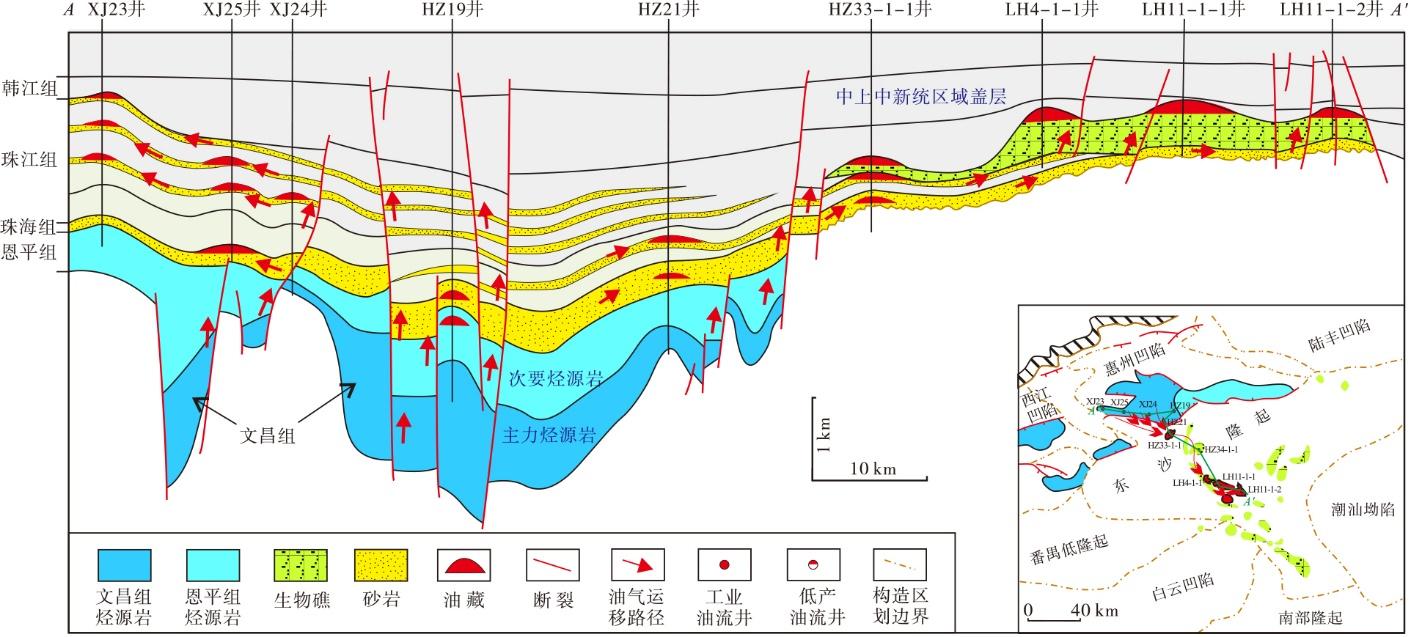
LH11-1油田勘探的成功,对南海生物礁型油气勘探具有重要启示。勘探之前认为LH11-1圈闭距离生烃凹陷远(60 km),油气难以长距离运移至圈闭成藏,但勘探证实,断裂、断拗转换不整合面和断拗转换期发育的滨海砂岩是优质高效的输导通道,为油气长距离运移创造了条件,使得远离生烃凹陷的台地区生物礁成藏成为可能。台地边缘带的生物礁储集物性好,资源规模大,是南海油气勘探的重要方向。
2.2 L构造气田
2.2.1 气田概况
2.2.2 石油地质特征
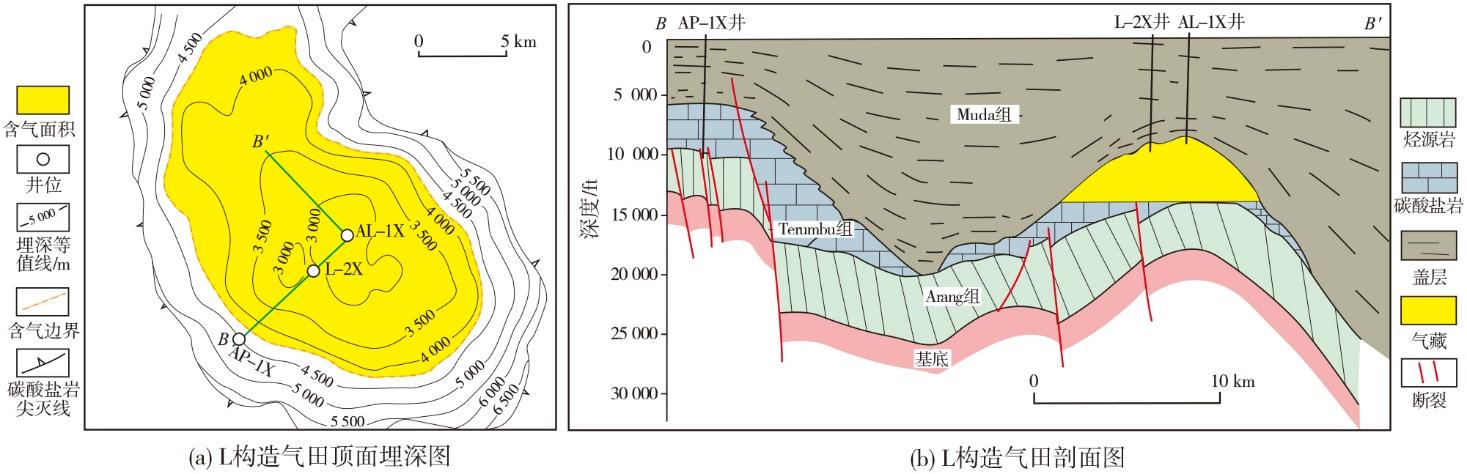
纳土纳D-Alpha区块前新生界为侏罗系—白垩系褶皱基底,L构造是在浅水孤立碳酸盐台地上沉积形成的一个礁-隆复合圈闭,圈闭幅度达3 900 m,面积320 km2(图4a)。圈闭形成于晚中新世。L构造的盖层为上新统横向稳定且区域性分布的Muda组深海相页岩。
2.2.3 成藏模式
曾母盆地古近系厚度大于9 000 m,渐新统烃源岩-中—上新统碳酸盐岩-上中新统及以上海相页岩构成良好生储盖组合。在渐新统沉积末期,随着南海西南次海盆的裂开,断裂向外扩展,形成了断块型的垒-堑构造,地堑部位发育的煤系沼泽形成良好的烃源岩。到了晚中新世,厚约1 500 m的中新统碳酸盐岩覆盖了断块的地垒部位,这些地层成为纳土纳L构造气田的主要储层。上新世早期区域沉降导致海平面快速上升,沉积了厚达2 500 m的深水相页岩,巨厚的页岩可作为良好的封盖盖层,同时促使深埋的煤系烃源岩成熟生烃。油气顺着断层垂向输导进入碳酸盐岩储层成藏(图4b)。
2.3 Malampaya油气田
2.3.1 油气田概况
Malampaya油气田位于西北巴拉望盆地中北部(图1),于1992年被发现,油气田所处水深介于750~1 200 m,平均水深830 m。油气田含油气面积为27.3 km2,顶面埋深约2 000 m,探明油气可采储量油当量约为8 300×104 t,其中石油可采储量为1 400×104 t,天然气可采储量为830×108 m3。
2.3.2 石油地质特征
目前没有探井直接钻遇西北巴拉望盆地烃源岩,对所采油样的研究表明,原油高含硫,同时含有藻类及陆上高等植物的生物标志物,指示生油母质既含有海源有机质,也含有陆相有机质。盆地北部上渐新统泥岩总有机碳可达7.5%,结合区域地质分析,认为上渐新统泥岩是该盆地一套重要的烃源岩。
2.3.3 成藏模式
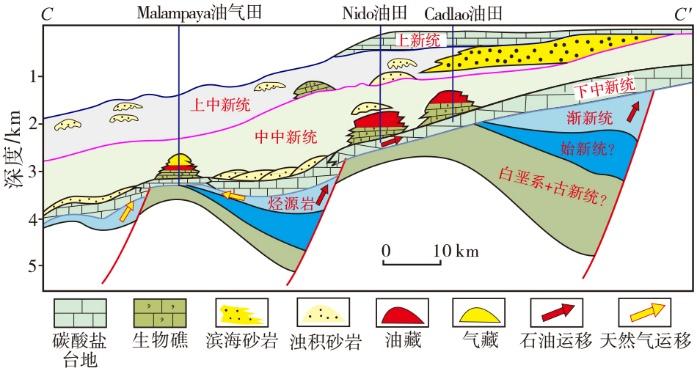
如果Malampaya油气田的烃源岩发育在古近纪同生裂谷序列中,那么油气生成高峰可能为中新世或更早;如果烃源岩发育在早渐新世的后裂谷序列中,则油气生成高峰可能为中中新世,此时烃源岩的埋深为2 000~2 300 m。所以,在晚中新世—早上新世,盆地向陆方向的边缘发生与碰撞有关的反转和抬升时,全盆地可能已停止生烃。
把同裂谷期及早期裂谷后基于沉积等厚线确定的主要地堑看作是生烃灶,那么这个生烃灶内烃类生成的主要时期大约在中中新世。现今该半地堑的地震几何特征指示烃源岩层底部的高过成熟油气主要向西运移至Malampaya构造,而烃源岩层顶部的低成熟到成熟的石油则主要向东南方向运移至Nido地区(图5)。
2.4 Jintan气田
2.4.1 气田概况
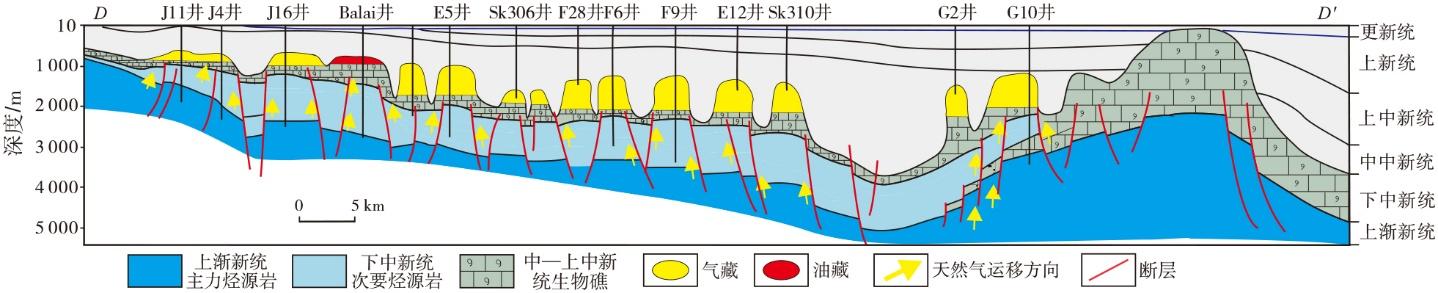
1992年在沙捞越岸外约290 km处发现了Jintan中—上中新统气田,期间相继钻探Jintan-1号发现井和Jintan-2号评价井,单井的天然气及凝析油产量颇丰。Jintan气田位于曾母盆地南康台地东部,水深约140 m,为曾母盆地典型的生物礁气田(图1)。该气田探明含气面积为40.1 km2,累计探明天然气储量为849.51×10⁸ m3,总可采储量油当量约为7 808×104 t。
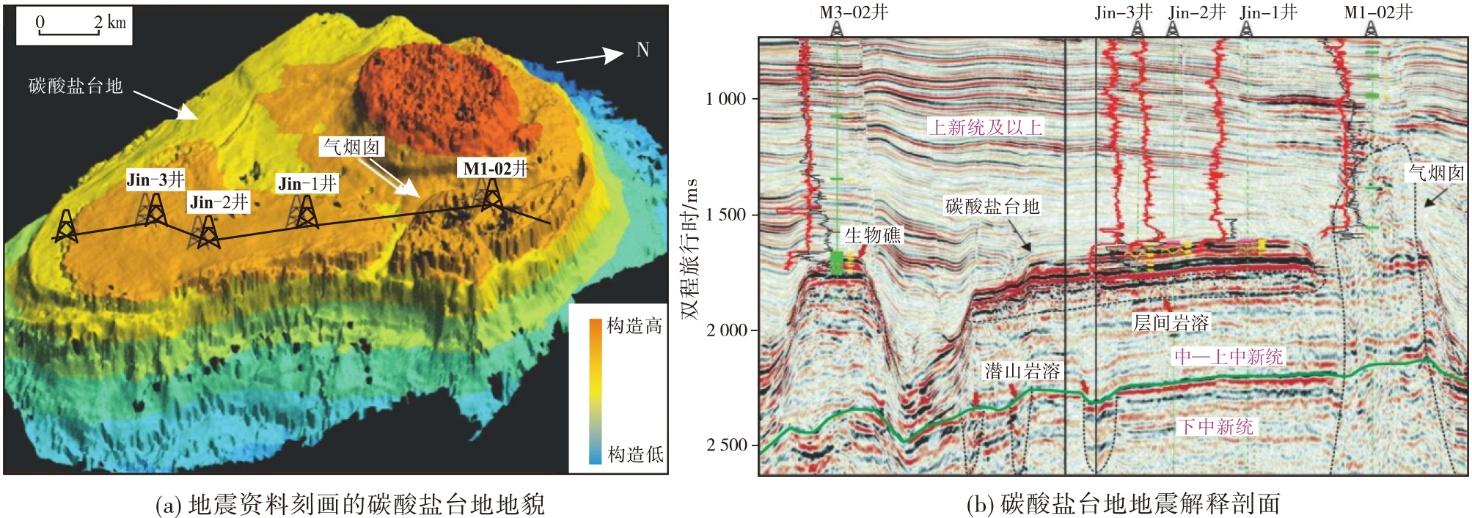
勘探表明,Jintan气田位于一个起伏很小但很宽阔的碳酸盐台地上,是一个巨大的碳酸盐岩隆[17],属于断裂活动引起的水上高地形成的碳酸盐岩分布区(图6)[18],有利相区为岩隆和礁相;Jintan气田底部为几个孤立的碳酸盐堆积体相互融合的巨型台地,受到构造隆起及断裂的影响,台地类型为NE走向为主的孤立台地,发育NE—SW走向的小断层,断层落差不大。除此之外,构造运动对生物礁和台地的发育演化具有重要作用,碳酸盐台地和生物礁多发育在构造隆起上,水体环境相对比较浅,有利于造礁生物的繁育以及碳酸盐沉积物的形成;另一方面,构造隆起部位水动力能量较强,高能的环境有利于礁滩的发育,在隆起上沉积的礁滩间歇性暴露,受到溶蚀作用,容易形成一些次生孔隙并能作为好的储层。
2.4.2 石油地质特征
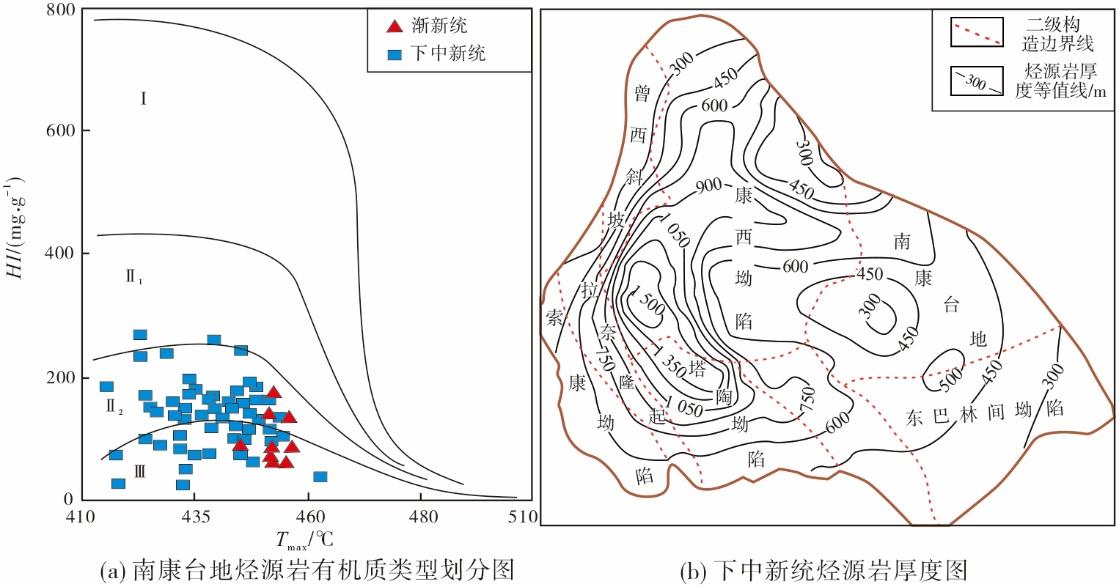
Jintan气田的主力烃源岩为渐新统—下中新统崖城组—三亚组的泥岩和煤岩。其中渐新统烃源岩属于下海岸平原煤系泥岩沉积,最大厚度可达1 650 m,TOC均值为0.5%~2.3%,有机质类型为Ⅱ-Ⅲ型(图7a),Tmax介于431~454 ℃,处于高成熟—过成熟阶段。下中新统烃源岩属于海岸平原、滨海相泥岩和煤层沉积,最大厚度可达550 m(图7b),TOC均值为0.63%~1.50%,有机质类型为Ⅱ-Ⅲ型,Tmax介于403~451 ℃,处于低熟—成熟阶段。Jintan气田内的流体以天然气、凝析油、地层水为主,其中凝析油具有较高密度、低双杜松烷和奥利烷、高C29藿烷/C30藿烷值,Pr/Ph(向东降低)值低—中等,Tm/Ts值小于2.0,含硫量大于2.0,C27甾烷超过C28和C29,为典型海相烃源岩来源的原油[19]。
2.4.3 成藏模式
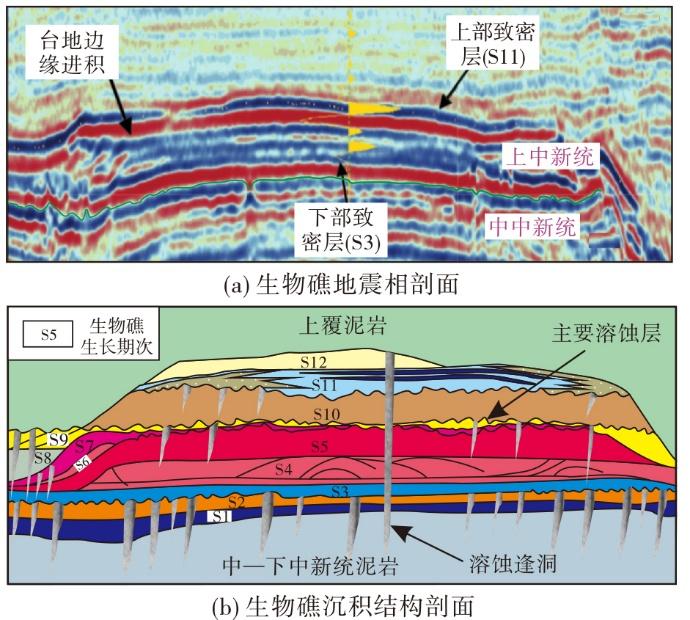
曾母盆地崖城组—三亚组发育陆源海相泥岩,有机质丰度较低,但厚度大,为Jintan气田提供充足的气源。黄流组、梅山组的生物礁为储层,岩性以石灰岩、白云质灰岩及白云岩为主,物性条件好,提供了有利的储集空间。晚中新世—上新世时期,深部塑性流体和气体在高温压条件下上侵形成各种类型的流体活动系统,产生的断裂、微裂隙是天然气运移的有效通道。黄流组及以上地层的海相泥岩突破压力高、封盖能力强,为异常高压气藏的形成提供了重要保障。烃源岩、储层及盖层相互配置形成下生中储上盖的组合。
3 不同台地碳酸盐岩油气成藏特征
通过对南海多个地区典型碳酸盐岩油气藏的解剖,分析此类油气藏形成的地质条件,总结了不同类型台地发育的碳酸盐岩油气藏的异同点。
主要共同点:①除了LH11-1油田烃源岩沉积时期略早,为古近系始新统文昌组外,其余碳酸盐岩油气藏的烃源岩多来自渐新统及中新统的煤岩和煤系泥岩,烃源岩厚度一般大于500 m,局部地区可达1 000 m以上;有机质丰度为中等—优,TOC一般高于1%,有机质类型以Ⅱ2-Ⅲ型为主,多处于成熟阶段。②储层时代以中—晚中新世为主,在Malampaya地区可见少量晚渐新世储层;储层岩性多为浅海环境下的生物礁灰岩、砂屑灰岩,单层厚度变化大,储层孔隙度主要介于20%~25%,渗透率主体介于(100~200)×10-3 μm2。③盖层均以拗陷期沉积的海相泥岩为主。
主要不同点:①输导通道。稳定型台地上发育的碳酸盐岩油气藏往往位于台地内部,因此横向展布的稳定砂体或者区域性不整合面是此类台地上油气横向输导的最主要通道;断块型台地与反转型台地上发育的油气藏往往直接位于台地上,因此直接沟通油源的断层是此类台地上油气垂向运移的最主要通道。②成藏模式。对于稳定型台地的碳酸盐岩油气藏,其成藏模式为“下生侧储”远距离输导成藏模式;断块型台地的碳酸盐岩油气藏的成藏模式为“下生侧储”近距离输导成藏;反转型台地的碳酸盐岩油气藏的成藏模式为“下生上储”近距离成藏。③主控因素。对于稳定型台地的碳酸盐岩油气藏,油气需要从烃源灶经横向稳定的输导系统长距离运移至圈闭中聚集成藏,因此输导体系是稳定型台地上油气成藏的关键因素。例如位于东沙隆起的LH11-1油田,油气从惠州凹陷经60 km的长距离运移至圈闭中聚集成藏,而不在输导通道上的圈闭则都没有成藏。对于断块型台地与反转型台地,由于生物礁生长速度明显高于同时代碎屑岩沉积速度,且储层发育于台地高部位,造成上覆岩层往往较薄,因此盖层的有效性是这两类台地上油气成藏的关键因素。例如南康反转型台地,台地上发育130余个碳酸盐岩建隆,但不是所有的建隆都形成有效圈闭而聚集了油气,主要原因就是在于建隆顶部海相泥岩太薄而不能有效对储层中的天然气进行封堵。
4 勘探启示
稳定型台地发育于前新生界稳定地块之上,往往规模大、连续性好,储集空间类型以原生孔隙为主,但由于所处的刚性基底早期裂谷欠发育,台地内部往往缺乏烃源岩,需台地周边烃源岩灶为台地内圈闭长距离输导提供油源,因此运移路径的有效性是油气成藏的关键因素之一。同时台地顶部常暴露遭受风化剥蚀,缺乏区域性泥岩盖层,有效的盖层可能是台地淹没时期形成的泥灰岩或致密碳酸盐岩层,因此盖层的有效性是油气成藏的另一个关键因素。因此,在勘探过程中要寻找位于油气运移路径上的构造-地层复合圈闭或大型岩性体圈闭;同时,紧邻生烃凹陷,台地边缘有大规模生物礁发育的区域,也是有利勘探区域。
断块型台地由于发育于盆地内相邻凹陷的凸起部位,地垒隆起直接与两侧的箕状断陷(深洼带)相邻,这些深洼带是优质烃源岩发育区,断裂本身可作为油气垂向运移的高速通道,因此油源条件极其优越。地垒高部位是碳酸盐岩生长的最有利场所,易形成高能环境的礁滩复合体。但是,断裂活动往往导致台地结构复杂,相变快,储层横向连续性较差。而且断裂是运移通道,同时也可能是油气逸散的通道,若后期断裂再次活动,可能导致油气藏被破坏,因此盖层的完整性和保存条件的有效性是油气成藏的关键。在勘探过程中应寻找近源高产的中小型油气田群,可能获得高产工业油气流。
反转型台地发育于早期凹陷后期反转的高部位,形成的台地往往规模大,连续性好,且台地暴露期间遭受大气淡水淋滤和溶蚀,岩溶作用非常普遍,可形成极其优质的孔、洞、缝等网络储集体,部分石灰岩白云石化,也极大地改善了深层储层的性能,如南康台地。但是构造抬升和断裂活动也可能导致早期形成的油气藏被调整甚至破坏。由于该类优质储层直接位于生烃凹陷之上,且与油源断层沟通,因此往往是碳酸盐岩油气藏形成的最有利勘探领域。勘探过程中应寻找受岩溶和构造反转共同控制的大型、特大型裂缝-溶洞型油气藏,一旦突破,单井产量可能极高。
3类台地油气藏中,反转型台地上发育的碳酸盐岩建隆,其下直接与烃源岩接触,其上为区域性海相泥岩盖层,反转过程中发育的断层可作为良好的油气运移通道,碳酸盐岩建隆往往成群成带发育。因此,认为反转型台地的“下生上储”成藏模式是南海最有利的成藏类型,其上发育的碳酸盐岩建隆是最有利的勘探领域,往往一点突破,即可带动整个区域的勘探突破。
5 结论
(1)根据构造背景与基底结构,将南海碳酸盐台地分为稳定型台地、断块型台地与反转型台地,并对每类台地的典型油气田进行解剖,分析其成藏条件及主控因素,并建立成藏模式。
(2)南海碳酸盐岩油气田的烃源岩主要为渐新统及中新统的煤岩和煤系泥岩,储层发育时代多为中—晚中新世,盖层以拗陷期沉积的海相泥岩为主,多通过断裂进行横向、垂向运移。稳定型台地油气藏为 “下生侧储”远距离输导成藏模式;断块型台地油气藏为“下生侧储”近距离输导成藏模式;反转型台地油气藏为“下生上储”近距离成藏模式。
(3)稳定型台地的有利勘探领域为台地边缘与生烃凹陷相邻的生物礁及台地内部有不整合面沟通的碳酸盐岩建隆;断块型台地的有利勘探领域为断垒上有油源断裂沟通的碳酸盐岩建隆;反转型台地的有利勘探领域为直接位于烃源灶上且有油源断裂沟通的碳酸盐岩建隆。其中反转型台地上发育的碳酸盐岩建隆是南海最重要的碳酸盐岩勘探领域。