
0 前言
围绕长兴组沉积相、台地演化模式与储层发育规律,前人已开展大量研究并取得重要成果。姚鑫阳等[11]在开江—梁平海槽东侧长兴组中识别出一个局部暴露不整合面,由此将长兴组划分为2个三级层序和5个四级层序,进而提出该区在早期主要发育碳酸盐缓坡沉积体系,中—晚期发育碳酸盐台地沉积体系;董庆民等[12]认为蓬溪—武胜台凹南部长兴组发育碳酸盐缓坡相和开阔台地相,礁滩储层具有多期旋回性且优势储层分布明显的特征;文龙等[13]基于岩心和薄片观察、储层地球化学特征分析、井震联合的储层识别和追踪,认为川中地区长兴组发育孔隙型礁滩复合体灰岩储层,形成于沉积和早表生环境,并揭示了四川盆地深层长兴组孔隙型礁滩灰岩储层的发育不是个别现象,而是普遍发育。然而,这些研究多集中于开江—梁平海槽边缘、蓬溪—武胜台凹边缘等沉积-构造单元。随着勘探程度加深,蜀南东部斜坡—向斜区长兴组见多处气测显示与钻测证实的高含气段[14],显示该区开阔台地内的石灰岩储层具有重要的潜在资源潜力,但是关于此类储层的层序地层格架、沉积特征及分布有利区带仍缺乏系统的认识,制约了勘探部署与目标优选。
基于此,以四川盆地蜀南地区东部长兴组为研究对象,综合应用野外剖面、薄片、测井及地震等多种资料,对研究区关键层序界面进行识别并建立层序地层格架,明确长兴组沉积相类型及特征,分析蜀南地区东部长兴组储层特征及主控因素,进而对有利储层分布进行了预测,以期为蜀南地区东部长兴组气藏的勘探与目标优选提供可靠的地质依据。
1 区域地质概况
四川盆地构造上属于扬子板块,是一个在前震旦系变质岩基底上沉积了巨厚的震旦纪—中三叠世海相碳酸盐岩和晚三叠世—始新世陆相碎屑岩的大型叠合盆地。晚二叠世长兴期,四川盆地整体仍处于克拉通内陆盆地环境中。在峨眉地裂构造运动和扬子地块西缘深大基底断裂活动的共同控制下,四川盆地地台内部的差异性沉降和构造分异作用显著增强,台地内部逐步形成了“三隆三凹”的古地理格局[15]。研究区位于四川盆地东南部(图1a),大地构造上主体处于川南低陡构造带,横跨川西南低陡构造带东北部、川东高陡构造带西南部和川中平缓构造带南部,与泸州古隆起大部分重叠[16-17]。长兴期研究区西部受康滇古陆、北部受蓬溪—武胜台洼及古隆起边缘构造抬升的影响,形成了有利于生物生长的富氧、高水动力的沉积环境,为滩体发育奠定了沉积基础[18-20]。
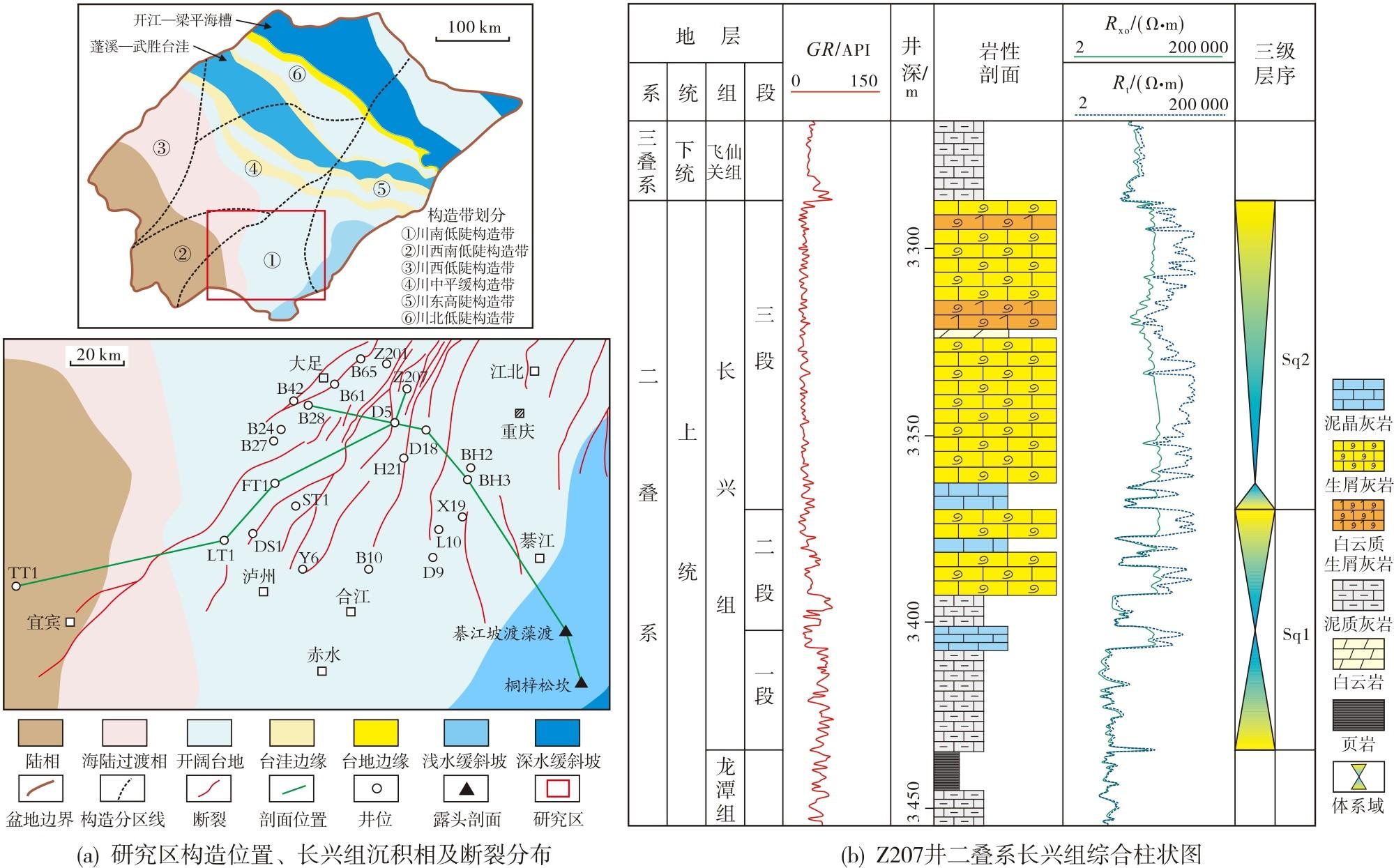
蜀南地区东部长兴组地层厚80~350 m,整体上呈西薄东厚的趋势。长兴组从下到上被划分为三段。长一段以泥质灰岩为主,自然伽马值整体偏高。长二段下部沉积泥质灰岩,中部以及上部为生屑灰岩夹薄—中层状泥晶灰岩,自然伽马为中—高值,幅度变化较大。长三段主要发育生屑灰岩,中—上部伴有中层状白云质生屑灰岩夹薄层白云岩,自然伽马值整体表现为低值(图1b)。
综合应用测井和地震资料,通过层序地层学综合分析对关键层序界面进行识别,在长兴组识别出三个层序界面(自下而上分为SB1、SB2和SB3),进一步将长兴组划分为两个三级层序(Sq1和Sq2)。两个三级层序均发育海侵体系域(TST)和高位体系域(HST),Sq1大致对应长一段和长二段,Sq2大致对应长三段。
2 沉积相识别标志及类型
2.1 沉积相识别标志
2.1.1 岩相标志
蜀南地区长兴组主要发育泥晶灰岩、颗粒灰岩、泥晶白云岩及碎屑岩-碳酸盐混积岩等岩石类型,各类岩石在垂向分布和沉积相带上均表现出明显的区域特征,其岩相组合能够较好反映台内构造背景与沉积水动力变化。
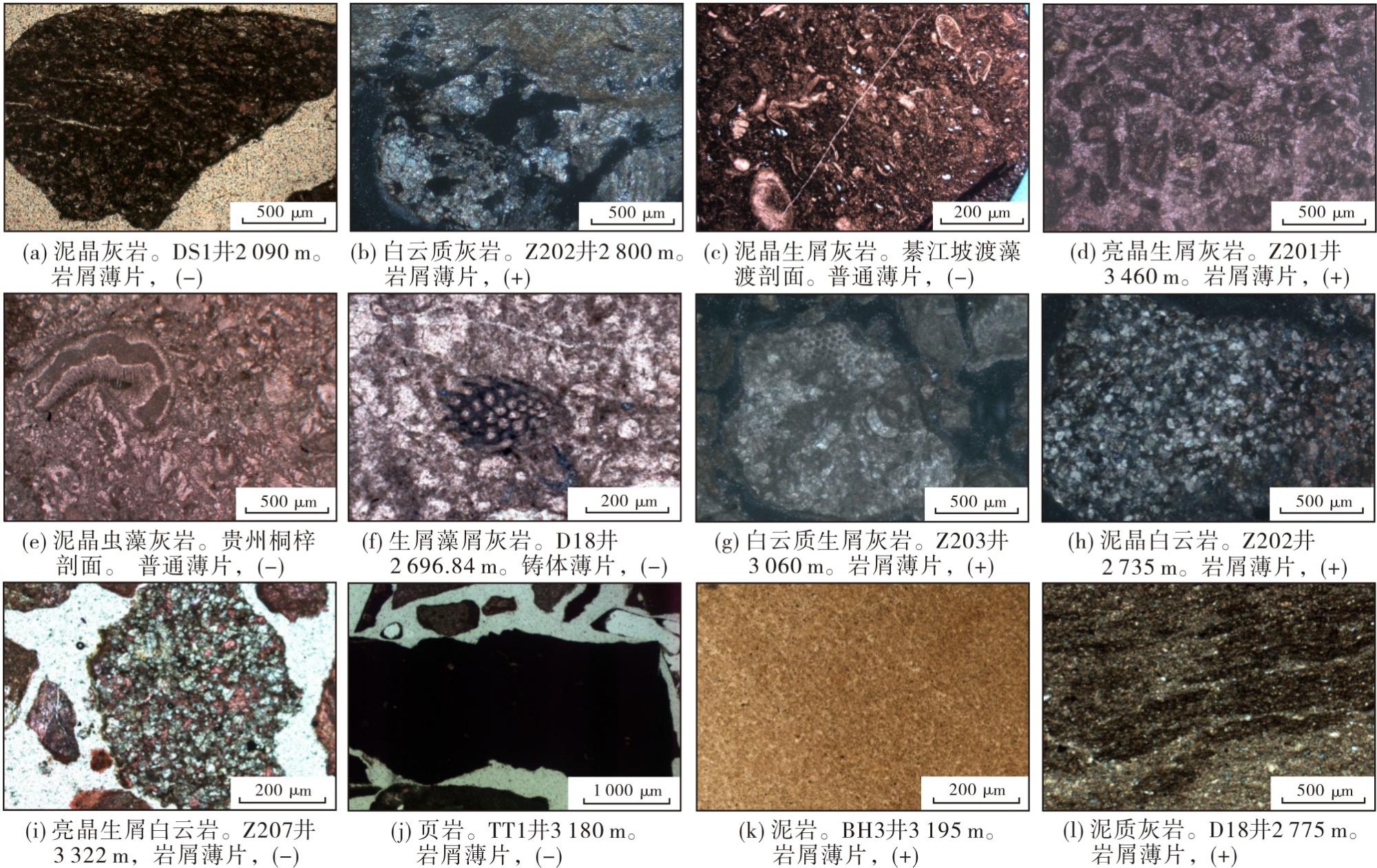
颗粒灰岩主要发育于长二段上部与长三段,多为颗粒支撑、亮晶胶结,局部孔隙被方解石充填,是研究区台内滩相发育的重要标志性岩相。颗粒灰岩主要有含生屑泥晶灰岩、泥晶生屑灰岩(图2c)、亮晶生屑灰岩(图2d)、泥晶虫藻灰岩(图2e)、生屑藻屑灰岩(图2f)以及泥晶藻屑灰岩。其中泥晶生屑灰岩分布最广、厚度最大。研究区东南部野外剖面及井下岩心显示亮晶颗粒灰岩的颗粒磨圆度高,具有清晰亮晶胶结的结构特征,指示台内滩高能带;而泥晶颗粒灰岩则颗粒间泥质充填较多,多见于滩间海亚相及相对低能环境。研究区东北部部分井段的颗粒灰岩在长三段上部局部受到白云石化改造,形成白云质生屑灰岩(图2g),白云石晶体多呈细晶—粉晶状,常沿生屑骨架内部的原生孔隙、腔体及微裂缝呈选择性分布,形成较为显著的云斑状—斑块状白云石化结构。
2.1.2 测井相标志
利用研究区内多口井自然伽马(GR)曲线的参数特征,从波动幅度、曲线形态平滑程度及与顶底的接触关系等方面进行分析,结合薄片照片进行综合解释,实现伽马曲线形态特征与沉积微相类型的相互标定(图3)。
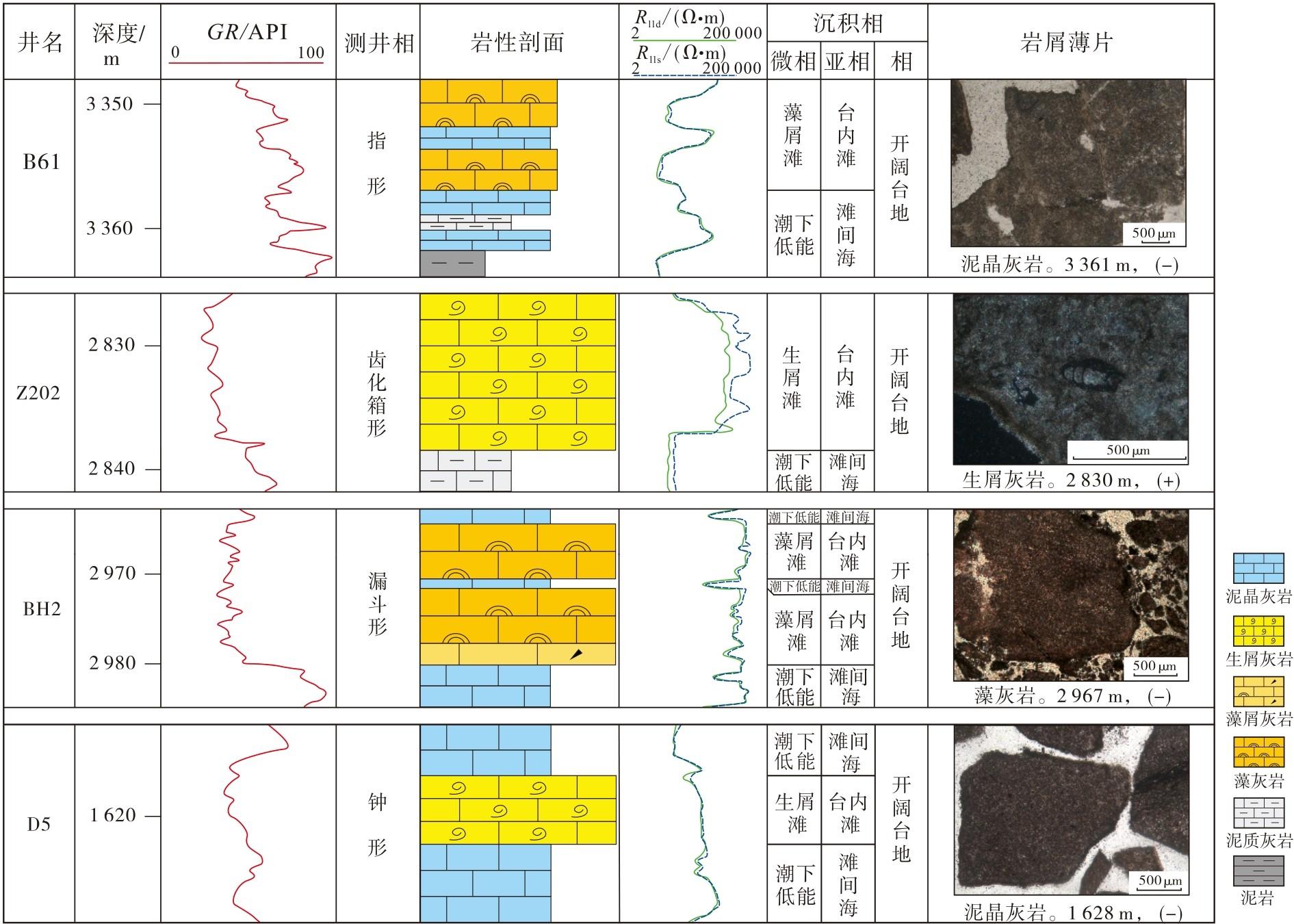
B61井3 350~3 360 m井段中可见典型指形GR曲线,该类曲线幅度变化最大,相对数值最高,范围在90~100 API之间,表现为边界清晰、光滑的指形,与顶部和底部均呈突变式接触。此类曲线对应泥质灰岩和泥晶灰岩,代表水动力条件相对较弱的开阔台地滩间海潮下低能沉积。
Z202井2 826~2 838 m井段中可见典型齿化箱形GR曲线,该类曲线幅度变化不大,相对数值最低,范围在20~30 API之间,与顶部和底部均呈突变式接触。曲线对应生屑灰岩、含生屑灰岩和白云质生屑灰岩,代表水动力条件强且稳定的开阔台地台内滩亚相,具体又可划分为藻屑滩、生屑滩等高能微相。
BH2井2 966~2 968 m、2 977~2 983 m井段中可见典型漏斗形GR曲线,该类曲线幅度变化较大,相对数值自下而上逐渐减小,表明水动力条件从早期到晚期由弱变强,在顶部呈加速渐变式接触,底部呈突变式接触。对应的岩性由泥晶藻屑灰岩、泥晶生屑灰岩和泥质灰岩渐变为亮晶藻屑灰岩、亮晶生屑灰岩和泥晶灰岩,通常代表开阔台地潮下低能带微相向藻屑滩、生屑滩等高能带微相的转变。
D5井1 612~1 614 m、1 627~1 630 m井段中可见典型钟形GR曲线,该类曲线与漏斗形GR曲线相反,相对数值自下而上逐渐增大,表明水动力条件从早期到晚期由强变弱。对应的岩性由生屑灰岩、藻屑灰岩渐变为泥晶灰岩,通常代表开阔台地台内生屑滩高能微相向滩间海潮下低能微相的转变。
2.1.3 地震相标志
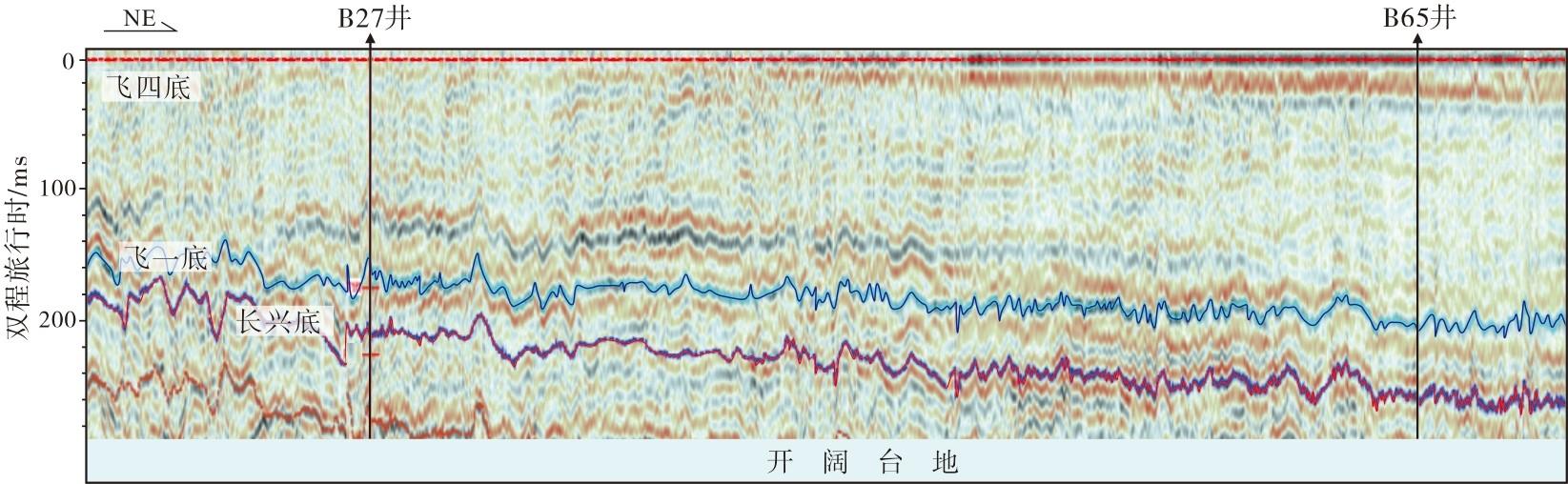
通过对四川盆地青杠坪—王家场地区长兴组地震资料进行分析,认为研究区长兴期发育典型的开阔台地相。开阔台地相在地震剖面中总体表现为层状-席状,中等振幅,指示台内沉积;内部反射呈平行-次平行特征,连续性较好,显示出稳定的沉积环境。B27井—B65井之间中部表现为中—较强振幅,可见层状亮带和轻微波形加厚,层状亮带横向延伸稳定,反射连续性好(图4),表明该区在沉积期内具备较均一的沉积条件与较弱的水动力扰动。
2.2 沉积相类型
晚二叠世长兴期,蜀南地区东部的沉积受到峨眉地裂运动和泸州—开江古隆起的共同影响。通过对野外露头剖面、薄片、测井资料及地震资料的综合分析,并结合区域沉积背景,系统分析了研究区长兴组沉积体系特征及演化规律。长兴组沉积初期,全球海平面上升,蜀南地区东部以碳酸盐缓坡沉积体系为主,中—晚期海平面下降,演化为缓坡型碳酸盐台地沉积体系,整体发育开阔台地相和台地前缘缓斜坡相,主体以开阔台地相为主[25-26]。研究区西侧受康滇古陆影响,在长兴期发育陆相和海陆过渡相。根据台地内的地形的几何形态及水体能量大小可将开阔台地相进一步划分为台内滩和滩间海两个亚相,其中台内滩亚相又可细分为生屑滩、藻屑滩和潮下低能3个微相。
2.2.1 碳酸盐缓坡相
长兴组沉积早期继承了龙潭期的沉积格局,古地貌及沉积环境均不利于生物的生长,沉积分异作用尚不明显,生物礁滩体系尚未开始大规模成型。据此认为蜀南地区东部该时期发育缓坡沉积。该沉积相带主要发育在长一段,岩性以泥晶灰岩、硅质灰岩、泥质灰岩以及泥质含量较高的含生屑灰岩和生屑灰岩为主,沉积水体较深,水动力条件弱。在地震剖面上,该相带表现为振幅较弱、连续性较好的反射特征;在测井曲线上,GR呈中—高值,电阻率呈低—中值。该缓坡沉积相可进一步细分为浅水缓坡亚相和深水缓坡亚相。
浅水缓坡亚相岩性以泥晶灰岩为主,沉积水体相较于深水缓坡亚相略浅,水动力条件弱。测井曲线上GR表现为高—中值,伴有中度齿化现象,电阻率表现为低—中值。
深水缓坡亚相岩性以页岩、硅质灰岩和泥质灰岩为主,沉积水体最深,水动力条件最弱。测井曲线上表现为最高的GR值和最低的电阻率值。
2.2.2 开阔台地相
长兴组沉积中—晚期,受海平面变化、构造抬升作用以及蓬溪—武胜台洼格局演变的影响,研究区发育碳酸盐台地沉积,整体发育开阔台地相,受局部古地貌高低控制,地层厚度为80~130 m。该沉积相主要发育于长二段和长三段,岩性以泥晶灰岩、生屑灰岩和藻屑灰岩为主。根据沉积物特征及沉积时水动力条件差异,可将开阔台地相进一步细分为台内滩亚相和滩间海亚相。
台内滩亚相的岩性以生屑灰岩和藻屑灰岩为主,部分粒间充填泥晶方解石或亮晶方解石。生屑灰岩发育普遍,相对能量较弱,为低能滩相沉积;藻屑灰岩局部发育,水动力条件较强,为高能滩相沉积。部分井在长三段顶部局部发育白云质灰岩与灰质白云岩。该亚相中生屑普遍发育,含量大于50%,可见有孔虫、䗴类、海百合茎、藻类等生屑,滩体裂缝-孔隙较为发育,为良好的储层。开阔台地台内滩亚相位于台地平缓区,厚度多在3~10 m之间。在地震剖面上,表现为较强振幅,连续性较差,其内部局部反射紊乱[27];在测井曲线上,通常表现为较低的GR值和较高的电阻率,GR值伴有轻微齿化现象。台内滩亚相进一步可细分为生屑滩和藻屑滩两个微相,其中生屑滩又可根据水动力条件以及测井曲线特征细分为高能生屑滩和低能生屑滩。
滩间海亚相是开阔台地内浅滩之间水体相对较深的区域,与台内滩亚相交替出现,为低能沉积环境,主要在高位体系域海侵—海退旋回早期发育,在长二段与长三段中均有发育。岩性以泥晶灰岩和含生屑泥晶灰岩为主,泥质含量相对较高。在地震剖面上表现为中等振幅、连续性较好的平行-微波状反射;在测井曲线上GR表现为中—高值,电阻率表现为中—低值,GR值伴有中度齿化现象。
2.2.3 台地前缘缓斜坡相
通过对区域沉积背景及现有资料的综合分析,认为在研究区东南部的碳酸盐台地前缘向海一侧发育台地前缘缓斜坡相。该相带生物碎屑普遍发育,以有孔虫、藻屑为主(如綦江坡渡藻渡低能生屑滩),岩性以泥晶生屑灰岩为主(图2c)。根据水体深浅,可进一步将其细分为浅水缓斜坡和深水缓斜坡亚相。
浅水缓斜坡亚相的岩性以生屑灰岩、砂屑生屑灰岩和虫藻灰岩为主,岩石颗粒间多为泥晶或灰泥充填,局部含泥质夹层,发育低能生屑滩。整体水体较为动荡,可见由重力流搬运形成的砾屑灰岩。
深水缓斜坡亚相的岩性以灰色、深灰色泥晶灰岩、燧石结核灰岩为主,局部见造礁生物海绵,镜下可见灰黑色硅质放射虫泥岩及含硅质泥岩,岩石颗粒间多为泥晶或灰泥填充,发育低能生屑。整体水动力条件较浅水缓斜坡亚相弱,沉积厚度薄。
2.2.4 陆相与海陆过渡相
晚二叠世期间,四川盆地及其邻区构造-沉积背景深受张裂作用和同期正断裂活动控制。西南方向的康滇古陆是整个盆地的主要陆源区,为盆地提供大量陆源碎屑沉积物[28]。研究区西侧邻近康滇古陆,沉积物供给充分,多沉积碎屑物质,由西向东逐渐由陆相向海陆过渡相及开阔台地相过渡。陆相主要发育页岩、粉砂岩、铝土质泥岩等碎屑岩类或灰质泥岩、泥岩等泥质含量较高的低能沉积物;海陆过渡相受多动力组合影响,发育泥质灰岩、泥岩等混合岩类。
3 沉积相分布及演化
3.1 连井沉积相展布特征
在沉积相识别的基础上,选择了2条具有代表性的连井剖面开展层序格架内沉积环境的分布格局和演化过程分析。
南西—北东向剖面(TT1井—LT1井—FT1井—D5井—Z207井)与北西—南东向剖面(B28井—D18井—BH3井—綦江坡渡藻渡露头—桐梓松坎露头)对比结果表明(图5),长兴组不同沉积时期相带分异及滩体迁移特征明显。南西—北东向剖面长兴组厚度为80~150 m,由南西向北东逐渐增厚;北西—南东向剖面厚度为50~100 m,中部较厚、两侧较薄。两条剖面沉积演化均经历了由早期碳酸盐缓坡沉积向碳酸盐台地沉积的转变。
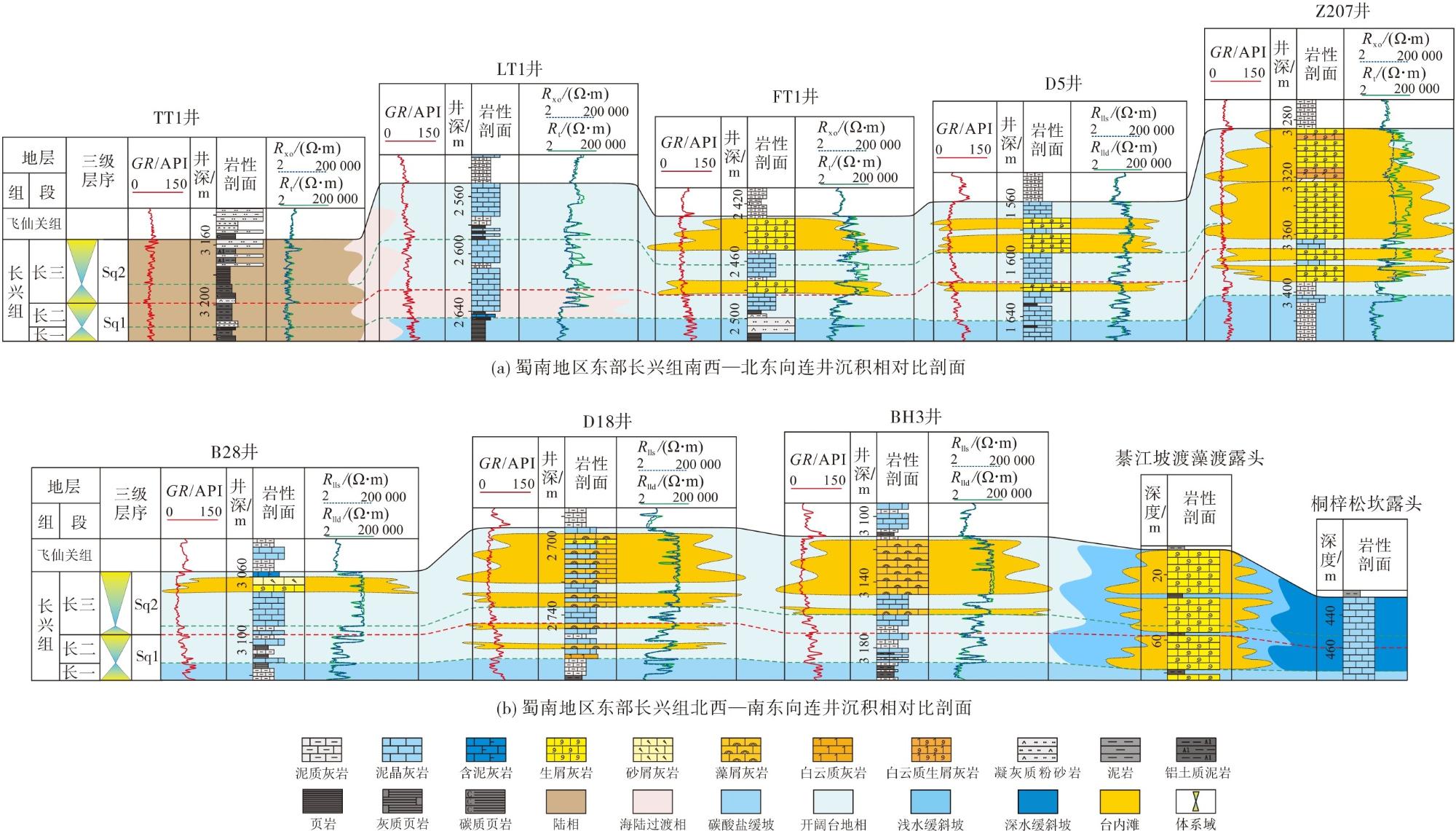
Sq1-TST时期,受区域海侵影响,研究区整体发育碳酸盐缓坡相,以低能细粒沉积为主,无滩、礁发育。南西—北东向剖面中,TT1井以陆相—海陆过渡相沉积为主,LT1—Z207井均发育碳酸盐缓坡沉积,岩性以泥岩、泥质灰岩、页岩、泥晶灰岩为主;北西—南东向剖面各井及露头岩性主要为泥岩、泥灰岩、灰质页岩等低能沉积。
Sq1-HST时期,受构造活动及海平面变化共同控制,沉积格局由碳酸盐缓坡逐渐向台地过渡,滩体开始局部小规模发育。南西—北东向剖面TT1井—Z207井依次发育陆相—海陆过渡相—开阔台地相,其中D5、Z207井见薄层生屑滩;北西—南东向剖面D18井、綦江坡渡藻渡发育低能生屑滩,B28、BH3井以开阔台地—碳酸盐缓坡相沉积为主。
Sq2-TST时期,小规模海侵使滩体发育受限,滩体规模明显萎缩。南西—北东向剖面中,TT1井及其附近仍为陆相—海陆过渡相及低能沉积为主,向北东逐渐过渡为开阔台地相,仅在FT1井、Z207井附近发育薄层生屑滩;北西—南东向剖面,B28井至BH3井发育开阔台地相,向南东依次过渡为浅水缓斜坡、深水缓斜坡相,綦江坡渡藻渡可见少量低能生屑滩,未见礁体发育。
Sq2-HST时期,海平面持续下降,区域水动力增强,研究区进入滩体发育高峰期。南西—北东向剖面上,D5井率先发育薄—中层生屑滩,FT1井在中晚期发育厚层生屑滩并持续加积,Z207井因处于台内高部位,全期发育厚层生屑滩;北西—南东向剖面中,D18井、BH3井发育藻屑滩,B28井顶部发育高能生屑滩,滩体集中分布于中段及局部高地势区。
整体而言,长兴组沉积早期以碳酸盐缓坡相低能细粒沉积为主,Sq1-HST时期台内局部高部位开始发育小型滩体,Sq2-TST时期滩体大幅萎缩,Sq2-HST时期达最发育阶段。两条剖面均显示,研究区长兴组滩体主要发育于台内相对高部位,沿连井剖面方向具有明显迁移和局部叠置特征。
3.2 沉积相平面展布特征
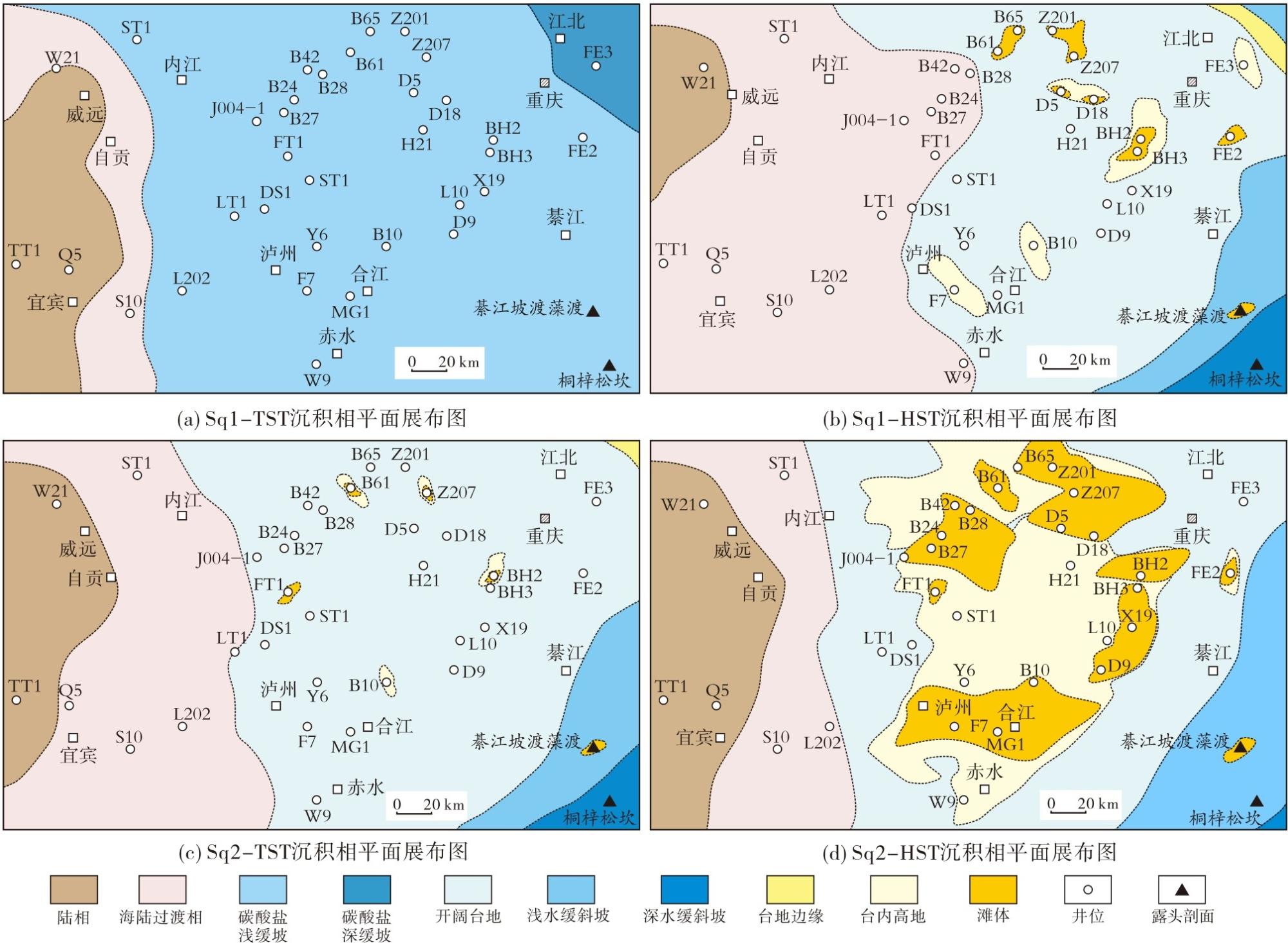
Sq1-TST沉积时期,全球海平面上升,扬子台地及周缘区域进入海侵控制下的碳酸盐缓坡沉积阶段(图6a)。受泸州古隆起和川中古隆起的影响,除陆相和海陆过渡相外,研究区南西—北东由浅水逐渐向深水演变,西南部发育浅水缓坡沉积,向东北过渡为深水缓坡沉积。该时期研究区内未见滩体发育,岩性以泥岩、泥质灰岩等低能沉积为主。
Sq1-HST沉积时期,海平面相对下降,沉积地层明显增厚。研究区内进入碳酸盐台地沉积阶段,平面上自北西向南东呈“陆相—海陆过渡相—开阔台地—浅水缓斜坡—深水缓斜坡”的沉积格局(图6b)。该时期由于沉积环境稳定,水体能量较强,台地内部和浅水缓斜坡开始发育断续小规模片状生屑滩体,台地内部局部发育相对低能的藻屑滩,而浅水缓斜坡发育低能生屑滩。
Sq2-TST沉积时期,海平面再次上升,相带展布继承了Sq1-HST沉积格局,研究区东北角的斜坡相因蓬溪—武胜台洼向东扩展而进一步向东扩。由于水体加深,大部分生物礁滩体因生长速度慢于海平面上升速度而被淹没,滩体沉积中断,因此仅构造高点发育小规模生屑滩(图6c)。
Sq2-HST沉积时期,海平面下降,研究区进入浅水高能环境,滩体再次发育。台内高地成为生屑滩发育的主要区域,形成了局部的高能滩体沉积区,呈较大规模片状分布(图6d)。
3.3 沉积相演化模式
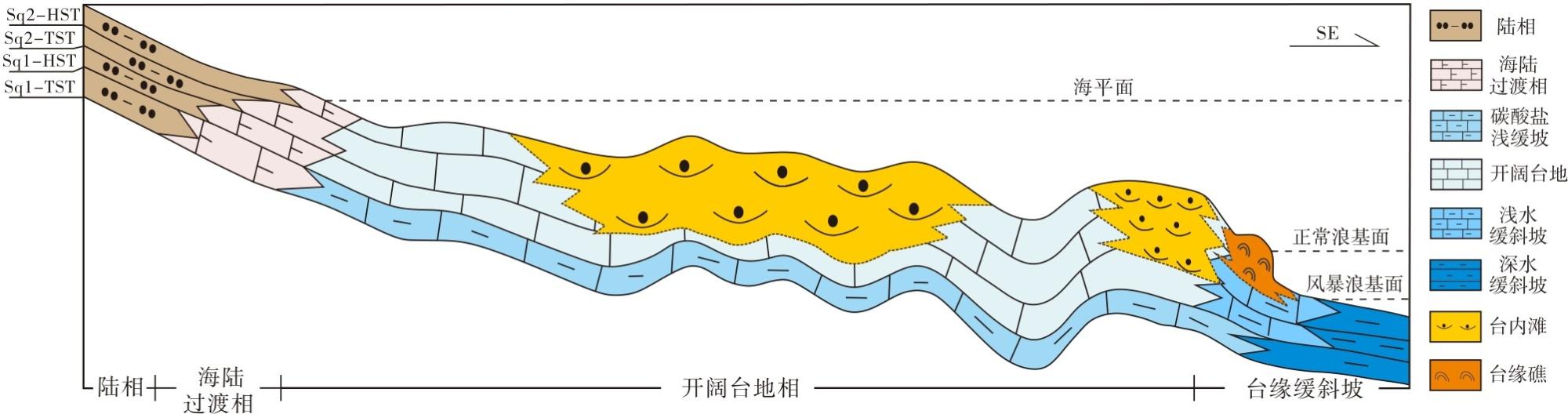
根据上述分析,建立了蜀南地区沉积相演化模式图(图7)。蜀南地区东部在晚二叠世龙潭期经历了一次较大规模的海侵,导致海平面上升,在研究区内主要发育泥质沉积。Sq1-TST期,海平面持续上升,研究区整体继承龙潭期的碳酸盐缓坡沉积,能量较低,未有滩体发育。Sq1-HST期,研究区处于海退环境,在峨眉地裂拉张运动和泸州古隆起的影响下,开始从碳酸盐缓坡沉积过渡为缓坡型碳酸盐台地沉积。此时,由于海平面不断下降,水动力条件变强,开阔台地局部高地以及台缘浅水缓斜坡开始接受藻屑灰岩与生屑灰岩沉积,形成生屑滩,但滩体规模不大。在此阶段发生的构造运动和海退背景均有利于储层的发育。Sq2-TST期,海水快速涌入,研究区再次发生小规模海侵,海水上升速度远大于生物生长速度,使得大部分滩体被迫停止发育,滩体规模变小,仅构造高点可见薄层生屑滩沉积。Sq2-HST期,此时为研究区滩体发育全盛时期,海水再次退出研究区,滩体再次开始发育,开阔台地内开始发育大规模的藻屑滩沉积以及高能虫屑滩沉积。除此之外,由于海平面不断下降,台缘浅水缓斜坡相对高能处也有小范围礁体分布。
4 有利储集区带预测
4.1 储集空间类型及特征
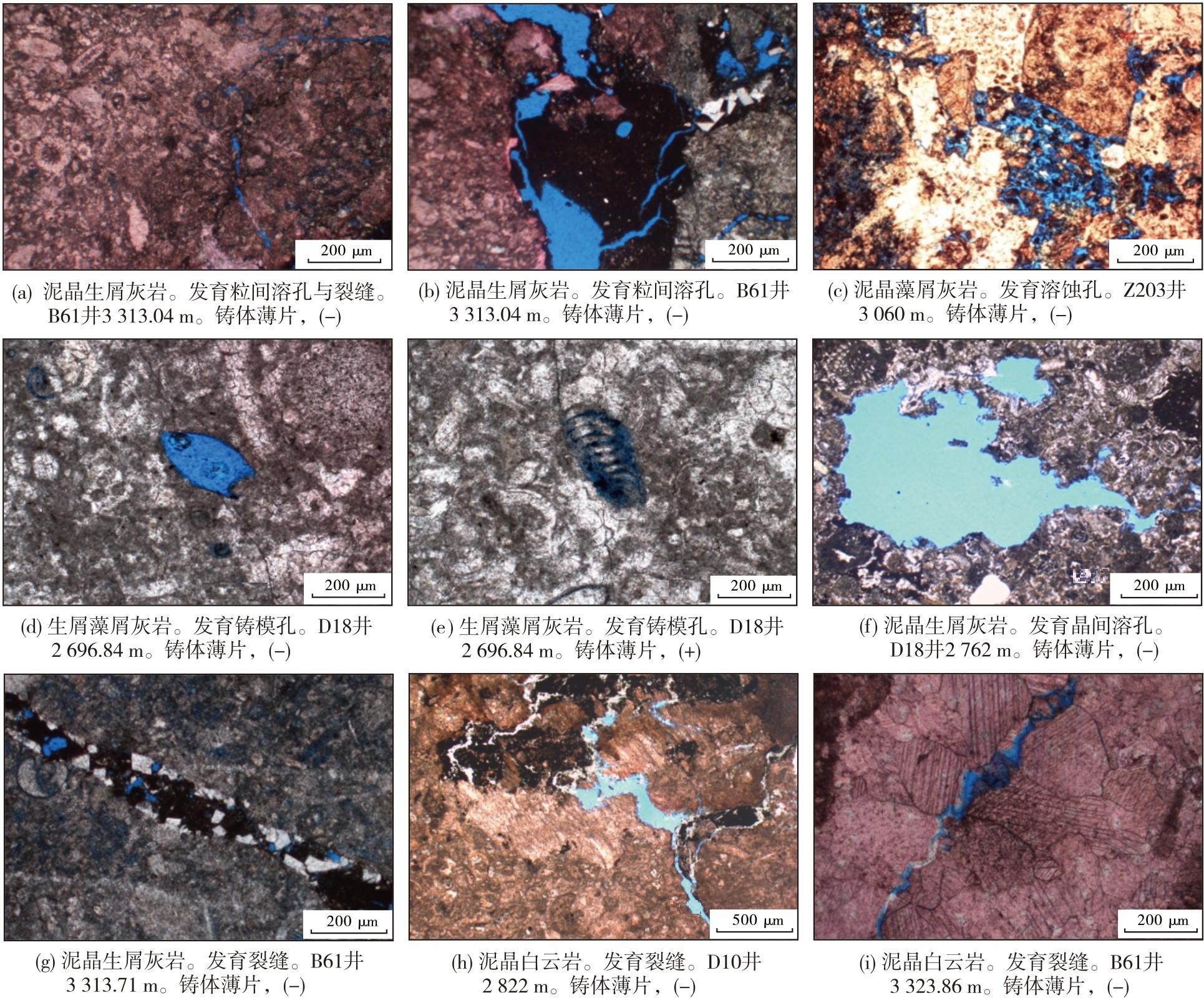
4.2 储层发育主控因素
研究区长兴组储层的形成主要受到沉积相及溶蚀作用的控制,深水缓斜坡亚相的发育范围控制了有利储层发育的边界。
4.2.1 沉积相
研究区发育陆相、海陆过渡相、碳酸盐缓坡相、开阔台地相和台地前缘缓斜坡相等沉积相,其中开阔台地相中的台内滩亚相是储层发育的主要亚相类型。同时研究区主要发育缓坡型碳酸盐台地,台地前缘缓斜坡相带与开阔台地相带间古地貌差异相对较小,受海平面升降及同沉积断裂活动影响更为明显,局部亦可见生屑颗粒沉积。研究区东南缘处于台地前缘深水缓斜坡亚相,沉积水体较深,滩体发育受限,储层基本不发育;而研究区东北部处于开阔台地台内高地上,沉积水体较浅,同时受盆地东部蓬溪—武胜台洼控制,沉积环境相对有利,台内滩体与储层发育程度较高。台内滩亚相通常沉积于Sq1-HST与Sq2-HST时期,该时期海平面下降,水体变浅、水动力条件增强,有利于滩体的再生长与加积,促使生屑灰岩、砂屑灰岩、白云质灰岩等优质储层的形成。强水动力条件可有效冲刷颗粒间的泥质成分,使颗粒间保持大量原生粒间孔。粒间孔隙将会为后期溶蚀作用提供渗流通道,使得孔渗得到提高,储层物性得到改善[31],更有利于优质储层的形成。相反,在Sq1-TST与Sq2-TST沉积时期,由于海平面上升,水动力条件减弱,滩体生长受限,海水中泥质含量增加,填充颗粒间及粒内空间,降低了孔隙度与储层有效性。
4.2.2 溶蚀作用
研究区溶蚀作用主要表现为两种形式:埋藏期溶蚀作用和同生期大气淡水溶蚀作用。埋藏期溶蚀作用主要对储层规模扩大及储层质量的改善起到一定作用。埋藏期间,酸性流体对原有储层进行溶蚀再改造,使得储层质量得到极大的提高。同生期大气淡水溶蚀作用在研究区内也较为常见,与海平面变化高度耦合,分为早期选择性溶蚀和晚期非选择性溶蚀[32]。Sq2-HST晚期海平面降至最低点,滩体顶部暴露在地表,受到大气淡水的淋滤作用,发生选择性溶蚀。这种选择性溶蚀进一步提高了滩体内部的孔隙度并促进优质储层的形成。早期选择性溶蚀主要是对生物碎屑、颗粒内部或不稳定成分进行溶解,在研究区内常表现为铸模孔;而晚期非选择性溶蚀常发生于滩体长时间暴露在地表的情况下,其发生过程与海平面变化密切相关,在研究区常表现为粒间(溶)孔、晶间(溶)孔和溶蚀孔。溶蚀作用的发生是形成优质储层的关键。
除上述主控因素之外,研究区内构造运动也影响着储层发育。由于华蓥山以东地区发育多组不同走向的断裂,对长兴组储层起到改善作用,因此,蜀南地区东部长兴组发育相控孔隙型储层和构造控制的裂缝-孔洞型储层。
4.3 有利储层分布
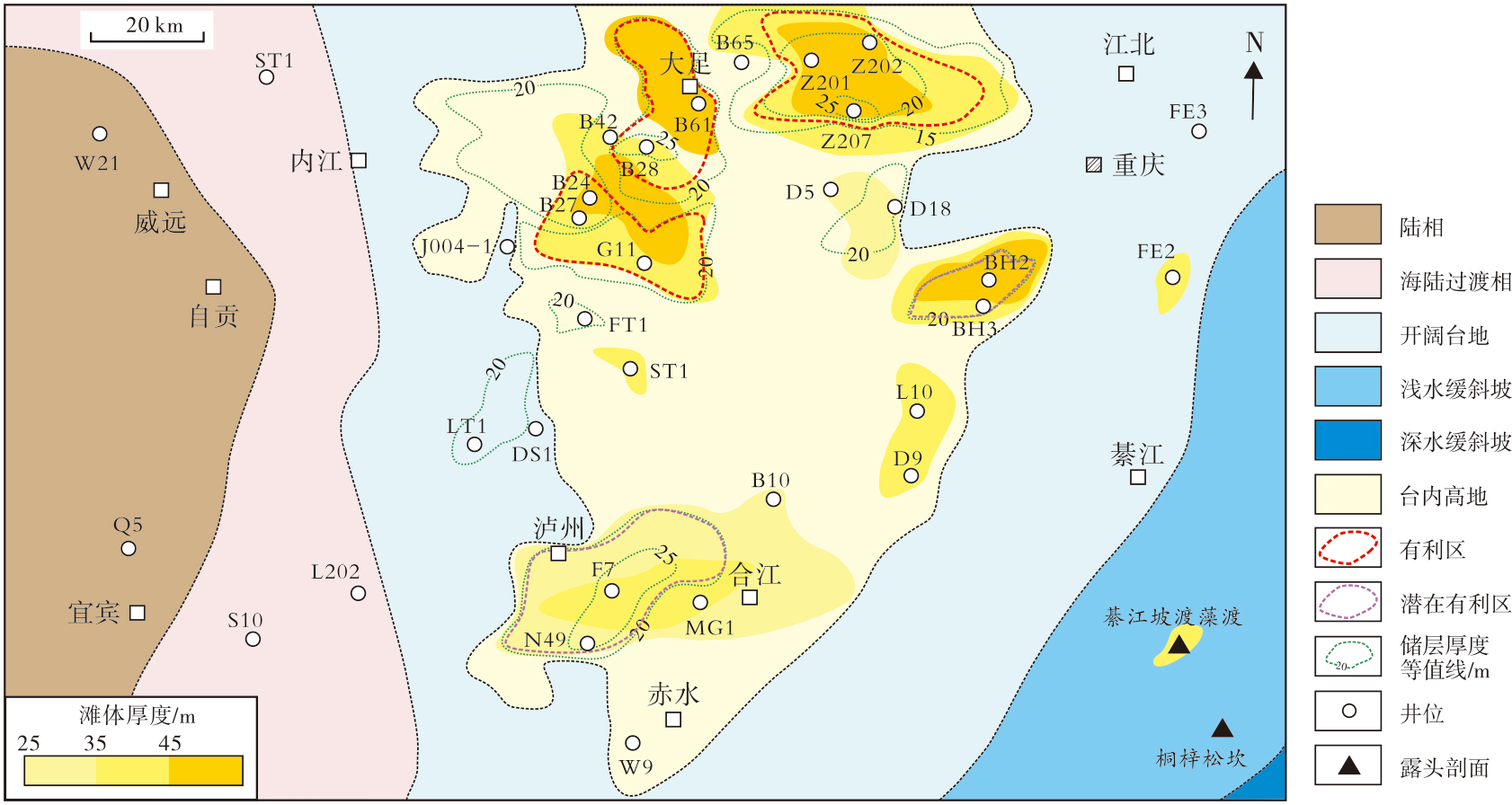
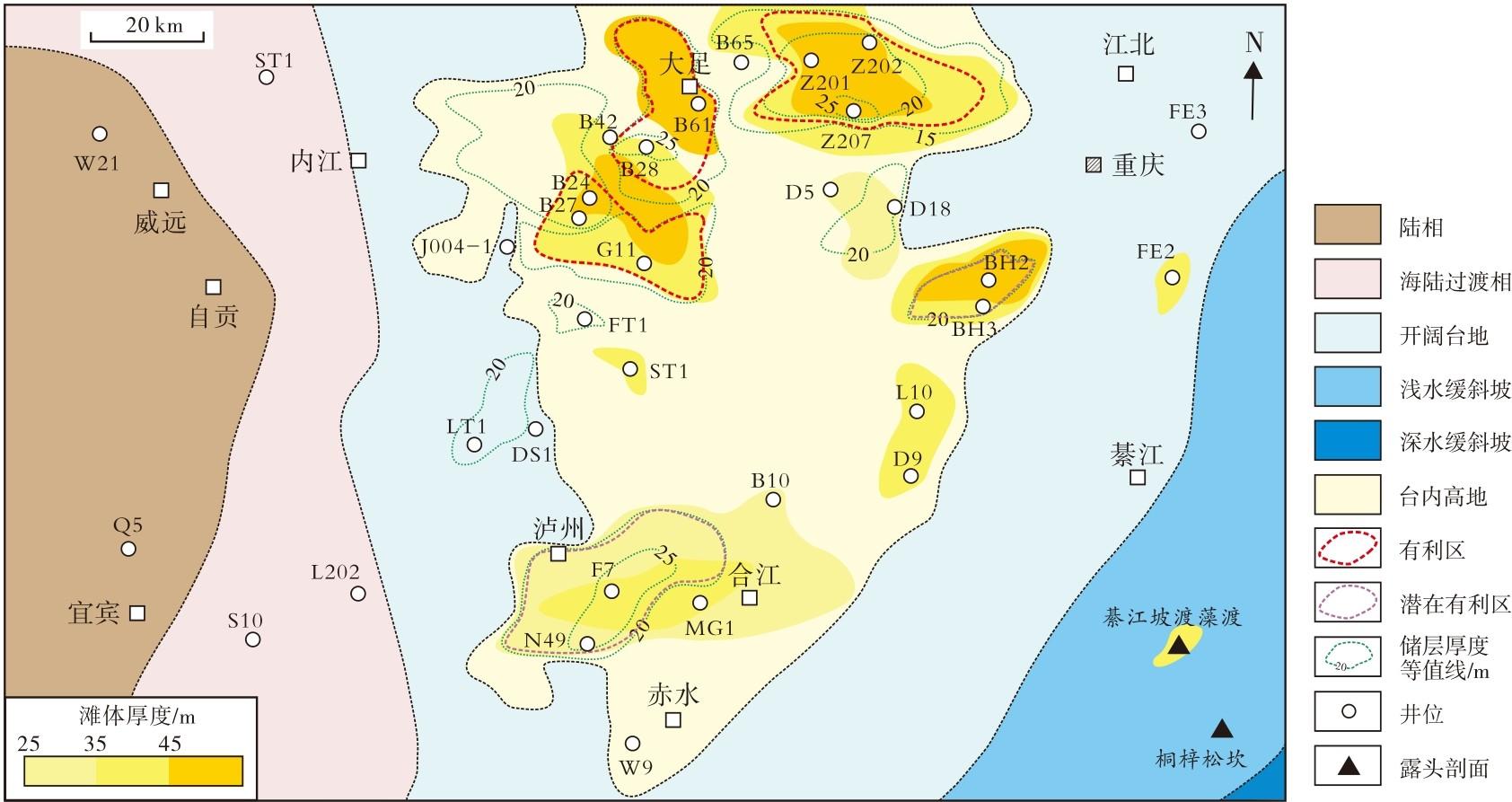
研究区长兴组优质储层主要发育在台内滩体展布与溶蚀、断裂改造叠加的有利区带(图9)。纵向上,优质储层集中发育于Sq2-HST时期。根据研究区产油井情况,储层厚度多分布在20~25 m。该时期水体能量强、滩体规模大,为优质储层的形成奠定了物质基础。东部地震反射强振幅指示高能滩有利发育带,与开阔台地的台内滩亚相相吻合。局部异常高振幅可能为溶蚀及裂缝系统形成的次生孔隙带。根据研究区已探明井,发现长兴组滩体厚度多分布在25~45 m范围内。东北部因蓬溪—武胜台洼及断裂活动影响,滩体发育相对密集。受沉积与成岩双重因素控制,滩体发育区与次生溶蚀带叠合部位储集性能最优。整体上,滩相储层在研究区呈点状或片状展布。综合评价:Z207井—Z201井—Z202井一带、B28井—B61井一带以及B24井—G11井一带为有利储层发育区;BH2井—BH3井一带与F7井—N49井一带为储层发育潜在有利区。
5 结论
(1)蜀南地区东部长兴组沉积早期为碳酸盐深—浅缓坡沉积,中—晚期发育缓坡型碳酸盐台地沉积。开阔台地台内滩亚相是储层发育的最佳相带,在垂向上主要发育于Sq1-HST和Sq2-HST时期,以Sq2-HST最为发育。滩体在平面上呈侧向迁移,垂向上呈局部叠加的特征。
(2)长兴组主要发育石灰岩储层,优质储层包括生屑灰岩和藻屑灰岩,储集空间类型以孔隙、裂缝-孔洞为主,其中以晶间(溶)孔最为发育,储层发育主要受沉积相和溶蚀作用控制。
(3)评价预测长兴组的储层发育区:Z207井—Z201井—Z202井一带、B28井—B61井一带和B24井—G11井一带为有利储层发育区;BH2井—BH3井一带与F7井—N49井一带为潜在有利区。