
ISSN 1672-9854
CN 33-1328/P

Hydrocarbon generation characteristics and modelling of in-situ conversion in high-abundance organic shale of Nenjiang Formation in Songliao Basin

  • GUO Zeyang , 1, 2 ,
  • LIU Yan , 1, 2 ,
  • WANG Xing 1, 2 ,
  • ZHENG Shuangjin 1, 2 ,
  • LI Yang 1, 2 ,
  • WEI Shiyun 1, 2 ,
  • YANG Can 1, 2 ,
  • ZHU Ruiying 1, 2 ,
  • XIAO Zili 1, 2 ,
  • ZHONG Chenpan 1, 2
Expand
  • 1 Yangtze University
  • 2 Hubei Key Laboratory of Petroleum Geochemistry and Environment
LIU Yan, PhD, Professor, mainly engaged in petroleum geology and geochemistry, as well as unconventional petroleum geology. Add: No.111 Daxue Rd., Caidian District, Wuhan, Hubei 430100, China. E-mail:

GUO Zeyang, Master's degree candidate, mainly engaged in research on petroleum geochemistry. Add: No.111 Daxue Rd., Caidian District, Wuhan, Hubei 430100, China. E-mail:

Received date: 2026-01-15

  Revised date: 2026-03-19

  Online published: 2026-05-12

Abstract

The shale of the Nenjiang Formation in the Songliao Basin generally exhibits a high total organic carbon content(TOC), locally exceeding 10%. However, the shale is mainly at low-to-medium maturity stage, making it a potential target stratum for in-situ conversion development. Although it is generally believed that higher TOC indicates greater hydrocarbon generation potential, there is still a lack of sufficient understanding regarding whether the in-situ conversion characteristics of different intervals depend solely on their TOC. Optimizing the most economical development intervals under a high TOC background requires additional selection criteria. In this study, two typical Nenjiang Formation shale samples with different organic abundance (with TOC of 9.63% and 5.08% respectively) are selected. Hydrocarbon generation kinetic parameters are obtained through thermal simulation experiments. By coupling the temperature field, an electric-heating in-situ conversion model is established to evaluate the in-situ development potential of the two typical Nenjiang Formation shales with varying abundances. The results indicate that both shale samples from the Nenjiang Formation predominantly generate oil. The high organic abundance shale yields more oil, whereas the low organic abundance shale has a slightly higher gas-oil ratio (GOR). With increasing heating time, the equivalent vitrinite reflectance (Easy Ro%) gradually increases from the heating well center to the periphery. By the third year, the Easy Ro% in the area within a 13 m radius from the heating well had exceeded 1.2%, indicating that the thermal maturation of organic matter in the main hydrocarbon generation zone is essentially completed. Under in-situ conversion conditions, both shales begin to generate significant amounts of oil after approximately two years of heating, reaching over 80% of their peak oil production rates in the third year. Furthermore, the cumulative oil production of the high organic abundance shale is about twice that of the low organic abundance shale. Given its higher cumulative oil production, the high organic abundance shale demonstrates superior in-situ development potential. These findings provide important theoretical support and exploration directions for the in-situ development of low-to-medium maturity shales of the Nenjiang Formation in the Songliao Basin.

Cite this article

GUO Zeyang , LIU Yan , WANG Xing , ZHENG Shuangjin , LI Yang , WEI Shiyun , YANG Can , ZHU Ruiying , XIAO Zili , ZHONG Chenpan . Hydrocarbon generation characteristics and modelling of in-situ conversion in high-abundance organic shale of Nenjiang Formation in Songliao Basin[J]. Marine Origin Petroleum Geology, 2026 , 31(3) : 251 -263 . DOI: 10.3969/j.issn.1672-9854.2026.03.004

0 前言

目前,中—高成熟度页岩油的水平井体积压裂开发技术已较为成熟[1-2]。然而,低熟页岩油受含油率低、可动油比例低、黏度高等因素影响,难以通过常规压裂改造实现有效开发。近年来,低熟页岩油原位转化技术备受关注,但仍处于试验探索阶段[3]。在此背景下,如何准确评价低熟页岩的原位转化潜力并预测其实际开发效果,已成为制约该类资源有效动用的关键科学问题[4]
松辽盆地古龙凹陷上白垩统嫩江组广泛发育富有机质页岩,有机质类型以Ⅰ型和Ⅱ₁型为主。资源评价结果表明,该层系页岩油地质资源量巨大,且已通过大庆油田NY1H试验井累计产油2 160 t的初步验证,展现出良好的可动用前景[5]。嫩江组页岩Ro值总体分布于0.5%~0.8%之间,其中嫩一段、嫩二段主体为低成熟页岩油(0.5%<Ro≤0.75%),需通过人工热干预实现原位转化与有效开发[6-7]。前人研究表明,泥页岩储层在有机地球化学特征、矿物组成及物性等方面均表现出明显的非均质性,这直接控制着烃类的富集规律与有利区优选[8]。嫩江组页岩同样具有明显的非均质性,总有机碳含量(TOC)主体介于1.0%~4.0%,局部可达15.6%。然而,不同有机质丰度页岩在真实原位加热条件下的生烃行为与转化效率差异尚不明确,制约了有利目标区优选与转化潜力的可靠评价[9]
前人的研究多基于传统热模拟实验(如半封闭/开放体系),分析了页岩的生烃、排烃与滞留烃特征,并建立了相应的生烃动力学模型,以揭示其“生‑排‑滞”演化机制[10-14]。例如,Wang等[11]针对松辽盆地湖相Ⅰ型干酪根样品,采用单频因子(SFF)和多频因子(MFF)离散活化能模型,对其生烃动力学特征进行分析。孙彪等[12]基于半封闭体系地层孔隙热压生‑排烃热模拟实验,系统研究了渤海湾盆地沧东凹陷古近系孔二段页岩的生烃、排烃及烃类滞留过程,揭示了其“生‑排‑滞”差异演化机制。史玉玲等[13]针对惠州26-6构造文昌组半深湖相暗色泥岩样品(有机质类型为Ⅱ₁型)开展了半开放体系热压模拟实验,据此建立了该区半封闭体系下泥岩样品的生烃动力学模型,并系统分析了其生排烃模式与生烃潜力。柳波等[14]针对松辽盆地嫩一段、嫩二段低熟页岩,基于测井资料和岩心实测数据,结合页岩原位电加热模型对研究区资源潜力进行了分析。这些工作为认识页岩生烃过程提供了重要基础,但仍存在明显局限:传统实验虽能反映生烃潜力,但往往脱离实际地层中的非均质热传导条件,无法有效耦合热场时空演化与生烃反应动力学过程,导致从实验室数据向真实原位开发效果的推演存在显著不确定性。此外,现有研究多聚焦于烃源岩评价范畴,缺乏针对低熟页岩原位转化场景、结合生烃动力学与实际热场模拟的开发可行性预测方法。
针对上述问题,本文提出一种热‑化耦合数值模拟方法,以克服传统手段在评价原位转化潜力时的不足。以松辽盆地嫩江组低熟富有机质页岩为对象,在系统表征其地球化学特征的基础上,开展地层孔隙热压生排烃模拟实验,获取不同TOC页岩的油气产率曲线及生烃动力学参数。本次研究的创新之处在于,将实验获得的生烃动力学模型与ANSYS温度场数值模拟相结合,实现真实非均质热场条件下生烃动态过程的反演与预测。该方法相较于传统实验‑统计途径具有以下优势:①能够定量耦合非均匀热传导与化学反应动力学,更真实地反映原位加热过程中热‑化相互作用;②可揭示TOC非均质性对生烃行为与转化效率的空间控制作用;③为原位转化示范区选址、加热方案优化及开发效果预测提供具有时空分辨率的定量化依据。本次研究旨在明确嫩江组不同TOC页岩在原位热干预下的转化效果差异,为低熟页岩油的经济有效开发提供科学依据。

1 地质背景
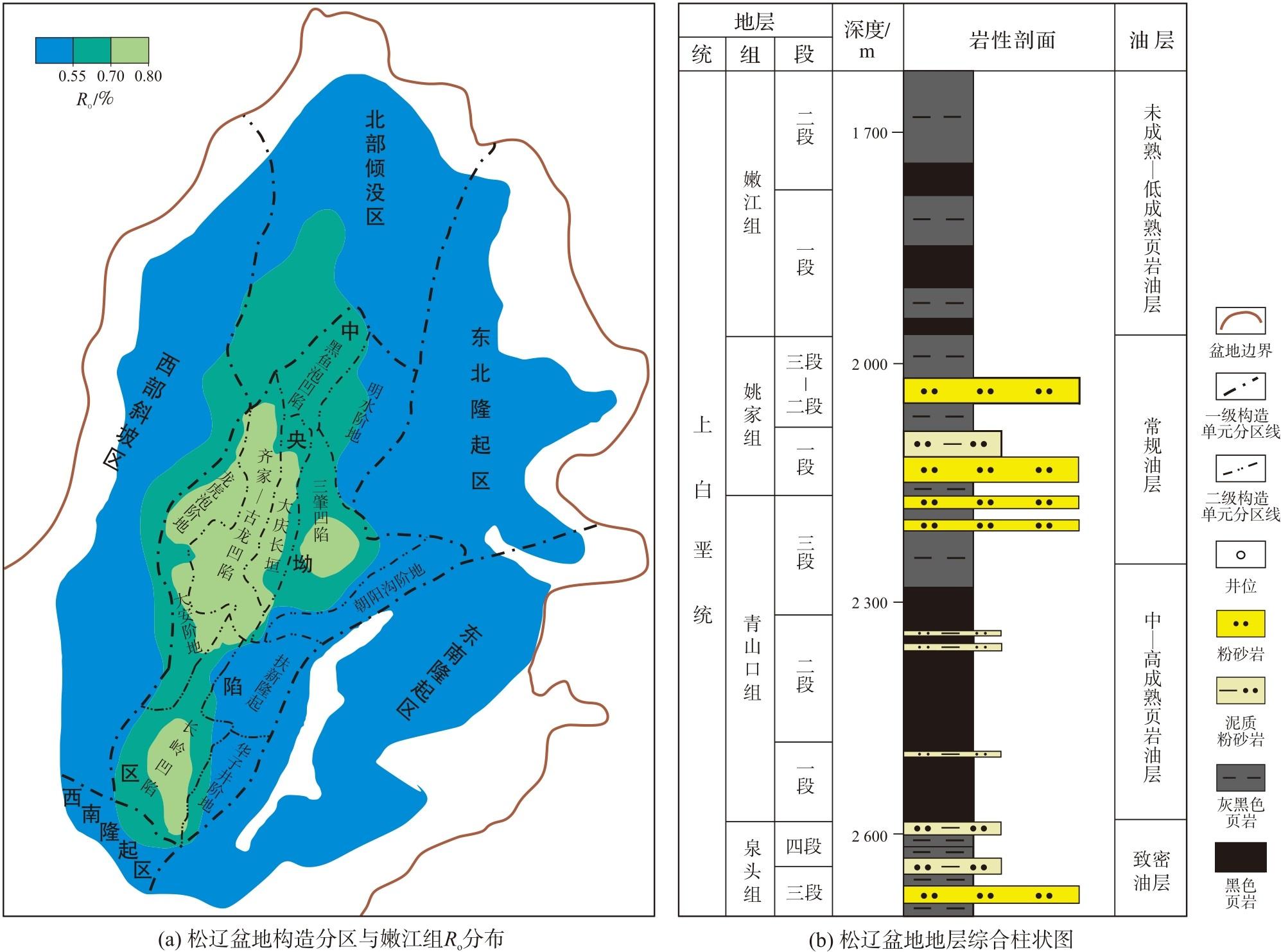
松辽盆地是中国东北部大型陆相含油气盆地,发育于古生代基底之上,总面积约26×104 km2,横跨黑龙江、吉林、辽宁三省[15]。依据基底结构,盆地可划分为六个一级构造单元(图1):北部倾没区、西部斜坡区、中央坳陷区、东北隆起区、东南隆起区及西南隆起区[16]
图1 松辽盆地构造分区与地层综合柱状图(引自文献[9])

Fig. 1 Tectonic divisions and comprehensive stratigraphic column in the Songliao Basin (cited from reference [9])

中央坳陷区作为主要油气富集带,包含古龙凹陷、大庆长垣、三肇凹陷、朝阳沟阶地与长岭凹陷等重要构造,其中古龙凹陷与三肇凹陷为两大主力生烃凹陷[22]图1a)。盆地演化历经3个关键阶段:晚侏罗世—早白垩世为同裂谷断陷期;早白垩世晚期至晚白垩世为热沉降拗陷期;晚白垩世四方台组、明水组沉积期至新生代则为构造反转期,最终形成“下断上坳”双层结构[16]。拗陷阶段在热沉降控制下,依次沉积泉头组、青山口组、姚家组及嫩江组。青山口组与嫩江组沉积期对应古湖盆两次大规模湖泛事件[18-19]。古龙凹陷作为中央坳陷区的沉积—沉降中心,发育完整的上白垩统嫩江组(图1b)。该组自下而上划分为五段,其中嫩一段、嫩二段以半深湖—深湖相暗色富有机质泥页岩为主,为本次研究的目标层。嫩二段底部发育一套黑褐色油页岩,为区域标志层,与下伏地层整合接触(图1b[20-22]。嫩江组页岩整体热演化程度相对较低。嫩一段烃源岩Ro主要分布于0.3%~1.0%,处于未成熟—成熟演化阶段,且Ro值大于0.75%的成熟页岩分布面积不足1 500 km²(图2a)。整体上,嫩二段烃源岩的成熟度低于嫩一段(图2b)。
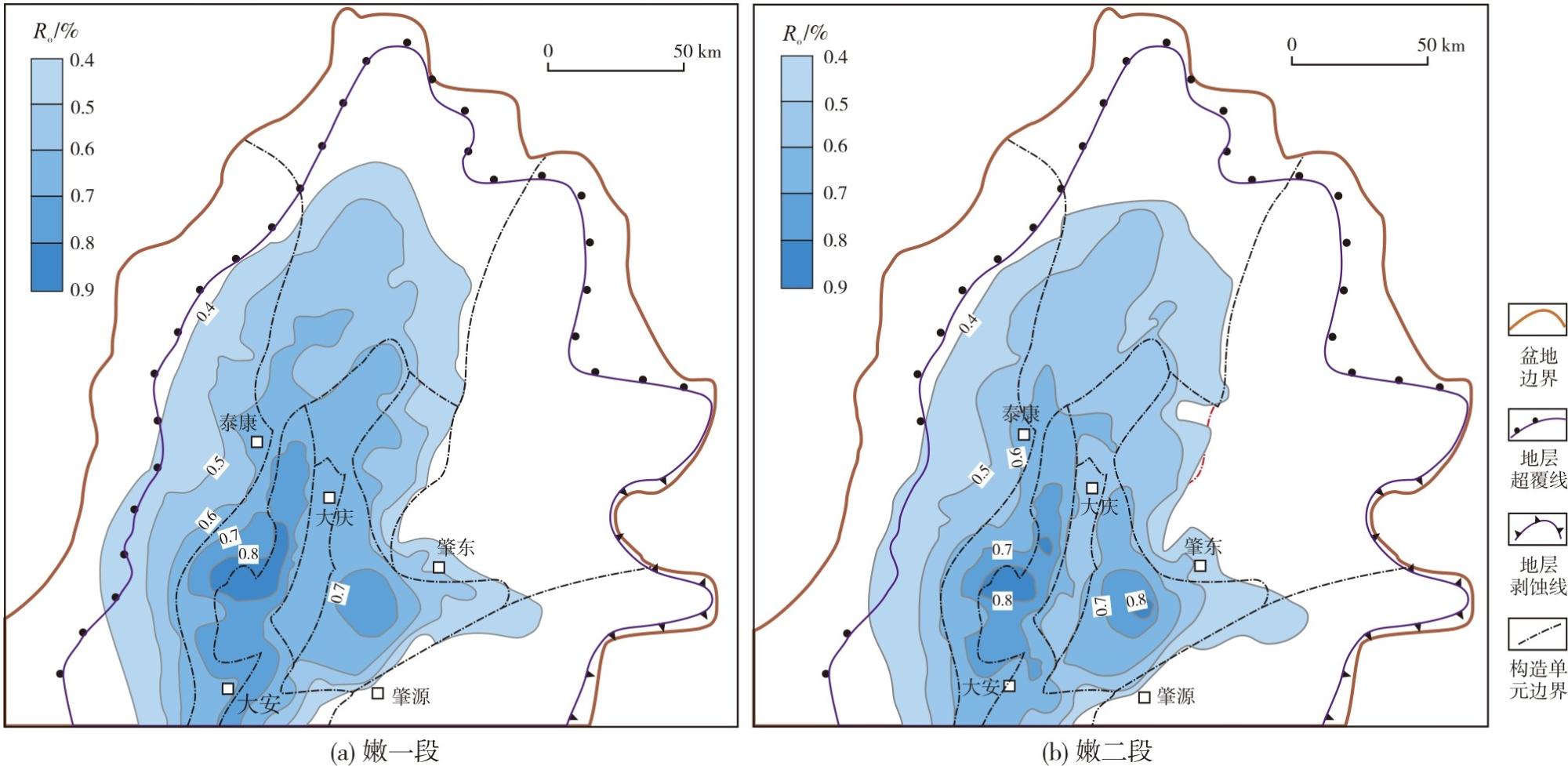
图2 松辽盆地北部嫩江组烃源岩成熟度平面分布(修改自文献[5])

Fig. 2 Planar distribution of source rock maturity of the Nenjiang Formation in the northern Songliao Basin (modified from reference [5])

2 样品、实验与数学模型

2.1 样品

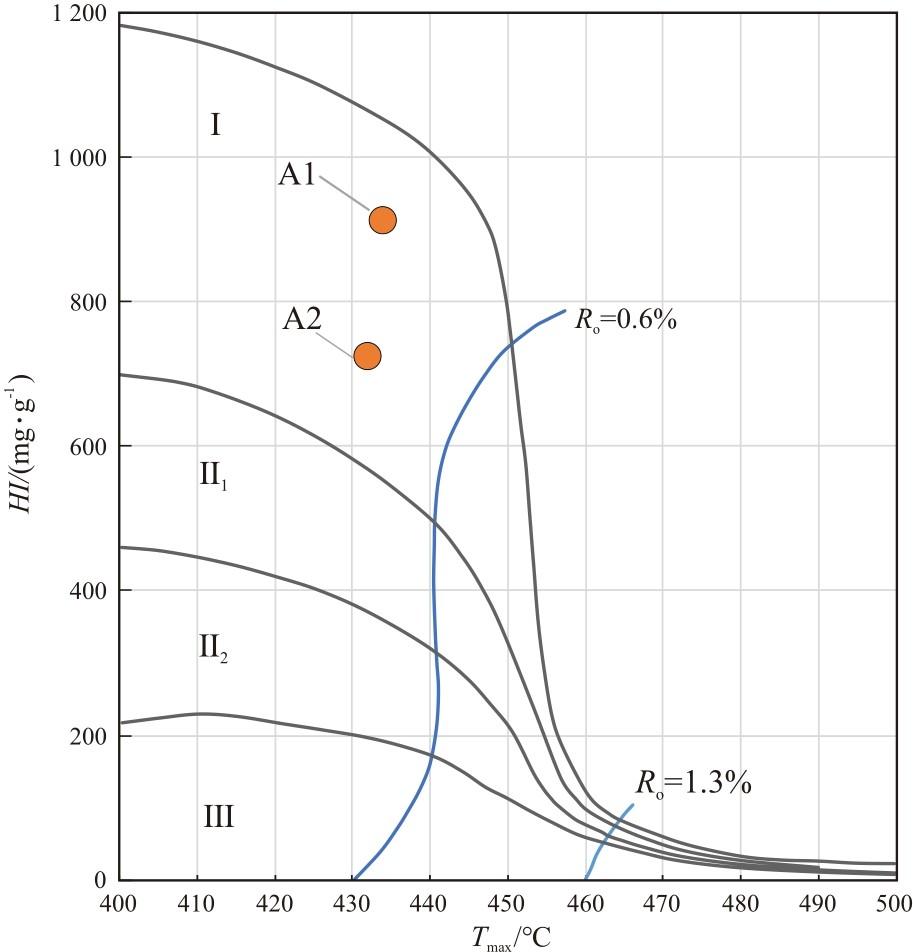
本次研究的样品取自古龙凹陷嫩江组,为浅钻井岩心样品,属于典型的半深湖—深湖相沉积。原始样品的系统地球化学分析结果如表1所示。嫩江组页岩整体表现出较高的有机质丰度。具体来看,样品A1的总有机碳含量(TOC)、游离烃含量(S1)及热解烃含量(S2)均较高,分别为9.63%、3.02 mg/g和65.48 mg/g;而样品A2的有机质丰度相对较低,TOCS1S2分别为5.08%、0.57 mg/g和30.09 mg/g。基于最高热解峰温(Tmax)与氢指数(HI)的关系交会图分析,样品A1、A2的有机质类型均被判定为Ⅰ型干酪根(图3)。此外,样品A1和A2的Ro值分别为0.39%和0.38%,表明其热演化程度处于未熟阶段,该成熟度完全满足本次热模拟实验的要求。
表1 原始样品基础有机地球化学参数

Table 1 Basic organic geochemical parameters of the original sample

样品
TOC/% S1/
(mg·g-1)
S2/
(mg·g-1)
Tmax/ HI/
(mg·g-1)
Ro/%
A1 9.63 3.02 65.48 434 913 0.39
A2 5.08 0.57 30.09 432 724 0.38

注:TOC为总有机碳含量;Tmax为最高热解峰温;S1为游离烃含量;S2为热解烃含量;HI为氢指数;Ro为镜质体反射率 。

图3 松辽盆地古龙凹陷嫩江组页岩样品TmaxHI交会图

Fig. 3 Tmax-HI crossplot of shale samples from the Nenjiang Formation in the Gulong Sag, Songliao Basin

2.2 实验方法

TOC、岩石热解和Ro的测定均为常规分析项目。TOC分析实验过程严格遵循中国国家标准《沉积岩中总有机碳的测定》(GB/T 19145—2022),岩石热解实验严格遵循中国国家标准《岩石热解分析》(GB/T 18602-2012),Ro的测定严格遵循石油行业标准《沉积岩中镜质体反射率测定方法》(SY/T 5124—2012)。上述3类实验的方法参见文献[23]。下文对其他实验方法进行介绍。

2.2.1 热压生排烃模拟实验

利用嫩江组页岩样品A1、A2进行半封闭体系生排烃模拟实验。为使半封闭体系实验条件更贴近实际地质情况,本次热解实验采取了如下设置(设计):①在反应釜中充注蒸馏水,以形成与模拟深度相对应的地层压力;②依据嫩江组的埋藏史、热史及地层流体压力演化史,设定热解实验的温度、静岩压力及流体压力,并规定当压力系数大于1.5时,反应釜自动开启实现排烃。实验共设置八个温度点,分别为301 °C、335 °C、355 °C、360 °C、370 °C、385 °C、392 °C和431 °C,各点均恒温24 h。恒温结束后,收集排出气与排出油,并对块状样品进行有机溶剂抽提以获取滞留油,最终对这三部分产物进行定量,采用气相色谱仪分析油气组分[24-25]

2.2.2 生烃活化能分布

页岩中干酪根生成油气的过程遵循化学动力学的基本原理,通常采用平行一阶反应模型进行描述。本文采用Rock-Eval 6型岩石热解仪,对实验样品进行了不同升温速率的实验,反应温度从300 ℃升温至700 ℃,升温速率分别为5 ℃/min、10 ℃/min和25 ℃/min,获得生烃转化率与温度关系数据,将数据导入Kinetics-2015生烃动力学评价软件,标定动力学参数,获得生烃化学反应活化能分布情况。生烃动力学模型及标定方法见文献[23]。

2.3 温压场与生烃原位转化模拟数学模型

2.3.1 原位电法加热(ICP)

ICP的技术原理是通过加热井对地层输入能量,使地层中的有机质裂解转化为油和气的产物。在页岩中的有机质热裂解的过程中,主要是热效应促使有机物质的转化,其热解动力学可用阿伦尼乌斯(Arrhenius)公式表示为:
dx/dt=A(1-x)me-E/RT
式中:x为页岩有机质的热解转化率,%;t为反应时间,s;A为指前因子,s-1E为活化能,J/mol;R为气体常数,J/(mol·K);T为绝对温度,K。在有机质热裂解过程中,温度热裂解起主导作用,因此,本文主要研究温度分布对页岩热解成熟度和转化率的影响。页岩温度场方程为:
$\frac{\partial }{\partial x}$(λ$\frac{\partial T}{\partial x}$)+$\frac{\partial }{\partial y}$(λ$\frac{\partial T}{\partial y}$)+$\frac{\partial }{\partial z}$(λ$\frac{\partial T}{\partial z}$)=ρc $\frac{\partial T}{\partial t}$+WA(1-x)me-E/RT+Q(x, y, z)
初始条件为:
T(x, y, z, 0)= T0
边界条件为:
$\left\{\begin{array}{l}T(x, y, z, t)={T}_{1}(L\in {\Gamma }_{1})\\ T(x, y, z, t)=q(L\in {\Gamma }_{2})\\ T(x, y, z, t)=h({T}_{1}-T)(L\in {\Gamma }_{3})\end{array}\right.$
式(2)—(4)中:λ为页岩的热传导系数,W/(M·K);c为页岩的比热,J/(kg·K);ρ为页岩的密度,kg/m3W为化学反应热,J/kg;Q为源汇项,W/m3T0为页岩内部初始温度,K;T1为页岩边界上流体的温度,K;q为边界热流密度,W/m2h为边界换热系数,W/(m2·K);L为控制体的全部边界条件;Γ1、Γ2和Γ3分别为第1类、第2类和第3类边界条件。将式(3)和式(4)代入式(2)中,可得到温度场的能量泛函为:
I(T)=$\frac{1}{2}\underset{\nu }{\overset{}{\iiint }}\left[\lambda {\left(\frac{\partial T}{\partial x}\right)}^{2}+\lambda {\left(\frac{\partial T}{\partial y}\right)}^{2}+\lambda {\left(\frac{\partial T}{\partial z}\right)}^{2}\right]$dν+$\frac{1}{2}\underset{\nu }{\overset{}{\iiint }}\left\{2\left[\rho c\frac{\partial T}{\partial t}+WA{(1-x)}^{m}{e}^{-E/RT}+Q\right]T\right\}$dν+$\underset{L}{\overset{}{\iint }}qTdL$
式中:ν为给定的页岩传热区域[27]

2.3.2 几何模型和边界条件

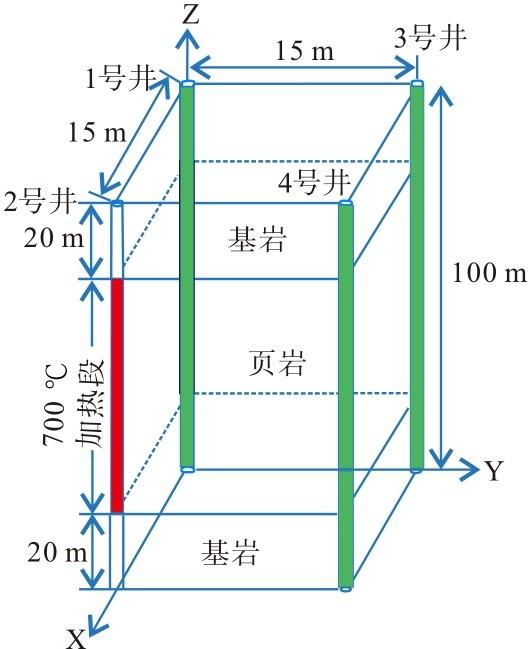
根据嫩江组地层特点,参考前人工作基础[26],建立了ICP开发几何模型。研究区面积为75 m×75 m,页岩高度为60 m,加热井在垂向的温度传递能力有限,故设置上下基岩高度为20 m,并设置井间距为15 m(图4)。模型初始地层温度设为30 ℃,加热井温度设定为700 ℃[27]。页岩与基岩的主要物理性质参数如表2所示。
图4 ICP技术几何模型(修改自文献[26-27])

Fig. 4 Geometric model of the ICP technology (modified from reference [26-27])

表2 油页岩和基岩的物性参数(引自文献[26-27])

Table 2 Physical property parameters of oil shale and base rock (cited from reference [26-27])

样品名称 模拟温度/ 体积百分含量/%
H2 CO2 CH4 C2H6 C3H8 i-C4H10 n-C4H10 i-C5H12 n-C5H12
A1 301 1.80 25.28 4.03 0.50 0.25 0.04 0.09 0.03 0.03
A1 335 12.38 31.14 8.84 2.41 1.26 0.17 0.56 0.18 0.25
A1 355 11.19 25.33 11.81 4.87 2.77 0.36 1.33 0.39 0.63
A1 360 11.14 26.07 10.19 4.75 2.69 0.32 1.26 0.33 0.57
A1 370 9.26 29.07 12.40 5.62 3.25 0.37 1.43 0.32 0.51
A1 385 8.88 22.14 18.75 8.97 5.48 0.61 2.63 0.57 1.03
A1 392 5.70 11.85 16.53 7.86 4.80 0.56 2.35 0.57 0.99
A1 431 6.54 10.18 25.68 12.32 8.39 0.99 3.89 0.66 1.05
A2 301 4.25 9.19 10.83 4.10 2.84 0.39 1.48 0.38 0.62
A2 335 5.10 5.23 4.46 1.03 0.65 0.09 0.32 0.08 0.14
A2 355 14.33 10.15 7.06 2.50 1.44 0.19 0.62 0.17 0.23
A2 360 15.87 17.92 7.50 3.13 1.84 0.25 0.88 0.28 0.44
A2 370 17.55 15.47 8.24 3.69 2.15 0.29 0.97 0.29 0.42
A2 385 5.57 6.61 11.89 5.48 3.29 0.41 1.57 0.43 0.66
A2 392 14.97 8.52 13.43 6.34 3.80 0.53 1.75 0.54 0.66
A2 431 10.99 11.60 22.00 10.27 7.16 1.12 3.45 0.96 1.23

3 结果与讨论

3.1 页岩生烃特征

3.1.1 烃产率特征

总生烃率作为评价烃源岩生烃潜力的关键参数,利用其随热模拟温度的变化可有效刻画有机质的热演化路径[28-29]。样品A1与A2的总生烃率随温度升高表现出相似的演化模式,均经历快速增加而后趋于平稳的过程。然而,两种样品的生烃能力存在明显差异。样品A1在低温热解阶段即表现出较高的初始生烃率,随后迅速增加至峰值,并持续保持较强的生烃状态。样品A2生烃能力相对较弱,且在整个模拟温度范围内,其生烃率始终低于样品A1。A1样品的总生烃潜力高于A2,这是两种样品TOC和有机质组成的差异造成的[5]。此外,两者的生烃作用均主要集中于340~380 °C这一热演化区间,该阶段是烃源岩贡献其主要烃类产物的关键生烃窗口。

页岩的总油产率随温度的变化特征如图5所示,高TOC的样品A1与低TOC的样品A2呈现出高度相似的生油规律。在低温阶段(<300 °C),两种样品的产油率均较低;随着热模拟温度升高,总生油率迅速增长,并于360 °C达到峰值;而后随着温度的不断升高,油发生二次裂解,产油率开始下降。该趋势符合干酪根热降解生烃理论[30]
图5 松辽盆地古龙凹陷嫩江组页岩样品热模拟产烃率柱状图

Fig. 5 Bar charts of hydrocarbon yield under the thermal simulation of shale samples from Nenjiang Formation in the Gulong Sag, Songliao Basin

图5所示,两种不同TOC含量样品总气产率均随热演化程度升高而总体增加,在300~350 °C区间内增长缓慢,之后显著加速。此外,两种样品的总产气率在整个热模拟温度序列中较为接近,但在最高温度下,样品A2的气产率略高于A1。产气特征表明,两者经历了相似的成气动力学过程,但样品A2的生气潜力略优于样品A1(图5)。
样品A1的气体产物随温度升高呈现规律性演化:初期CO₂含量高,随后烃类气体(尤其是CH₄)持续、显著增长,气体逐渐变干,表现出典型的连续热裂解特征。而样品A2的气体组成演化则复杂且波动:CH₄含量始终较高,但重烃生成不连续,特别是在中温段(355~392 ℃)伴随异常高的H₂产出,CO₂含量也起伏较大。这表明A2的有机质类型或矿物基质环境与A1存在显著差异,可能其生烃过程受到多种反应路径或矿物催化作用的显著影响(表3)。
表3 嫩江组页岩样品生烃模拟气体产物组成

Table 3 Composition of gaseous products from hydrocarbon generation simulation of shale samples of the Nenjiang Formation

参数 密度/(kg·m-3 热传导系数/(W·m-1·K-1 比热容/(J·kg-1·K-1 表观活化能/(J·mol-1 指前因子/s-1 反应热/(J·kg-1
油页岩 2.5×10³ 2.5 2.5×10³ 1.5×10³ 6.0×10³ 1.9×10⁵
基岩 2.7×10³ 1.0 1.2×10³

3.1.2 生烃动力学特征

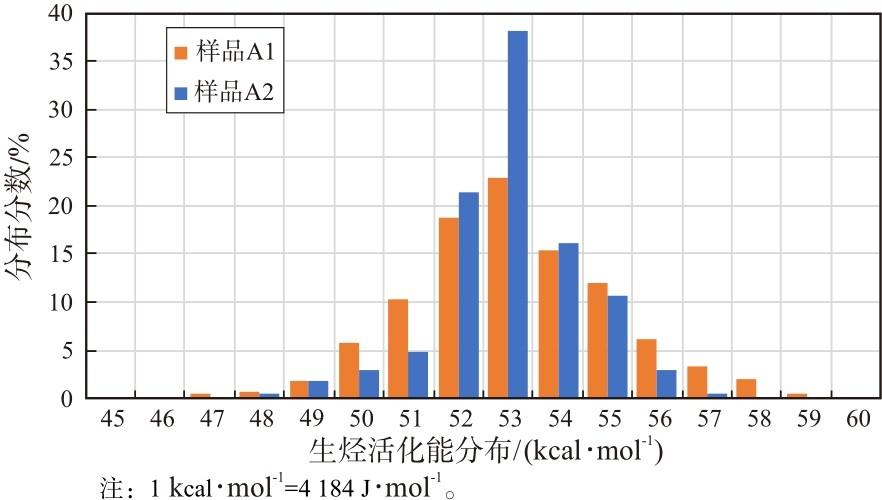
根据阿伦尼乌斯方程,指前因子与活化能分布具有协变性特点,不同指前因子条件下难以直接依靠活化能进行对比。为此,参照前人关于湖相烃源岩生烃动力学参数特点的研究成果,假定指前因子固定为1.0×10¹⁴ s-1,在此情况下,活化能分布宽度控制生烃反应持续时间,其主峰位置决定生烃难度,主峰升高则生烃所需温度门槛相应提高[31-34]。本次研究应用Kinetics-2015软件计算了嫩江组页岩样品的生烃动力学参数(图6)。以反应分数大于5%作为界限,如图6所示,在热演化程度相似的情况下,古龙凹陷嫩江组不同丰度两种典型页岩样品活化能分布位于50~56 kcal/mol之间,指示其主导生油反应的化学键稳定性较低,可在中等温度的热条件下裂解生烃[35-36]
图6 松辽盆地古龙凹陷嫩江组页岩样品生烃活化能分布直方图

Fig. 6 Distribution histogram of hydrocarbon generation activation energy of shale samples from the Nenjiang Formation in the Gulong Sag, Songliao Basin

3.1.3 气油比特征

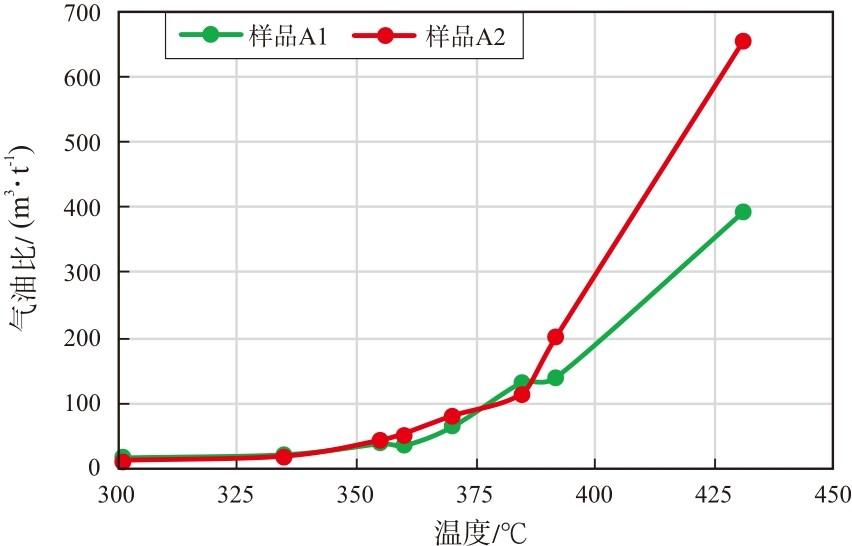
气油比是决定原油开采难度的关键参数,储层原油中溶解气含量越高,其黏度越低,流动性越好[37]。然而,在开采过程中,大部分气态烃会发生逸散损失[38],造成难以获取此实测数据。热模拟实验是估算储层原始气油比和评价原油流动性的有效手段[39]。如图7所示,在整个热演化过程中,随着温度增加,两种样品的气油比均呈上升趋势,且样品A1和A2的气油比峰值分别达到391.5 m3/t和653.4 m3/t。相比于样品A2,样品A1的气油比始终维持在较低水平。这表明样品A2在原位热演化过程中生成的原油可能具有更强的流动性,从而更有利于页岩油的流动[40]
图7 松辽盆地古龙凹陷嫩江组页岩样品热模拟产物气油比曲线

Fig. 7 Gas-oil ratio curve under the thermal simulation of shale samples from the Nenjiang Formation in the Gulong Sag, Songliao Basin

3.2 温度和等效镜质体反射率分布特征

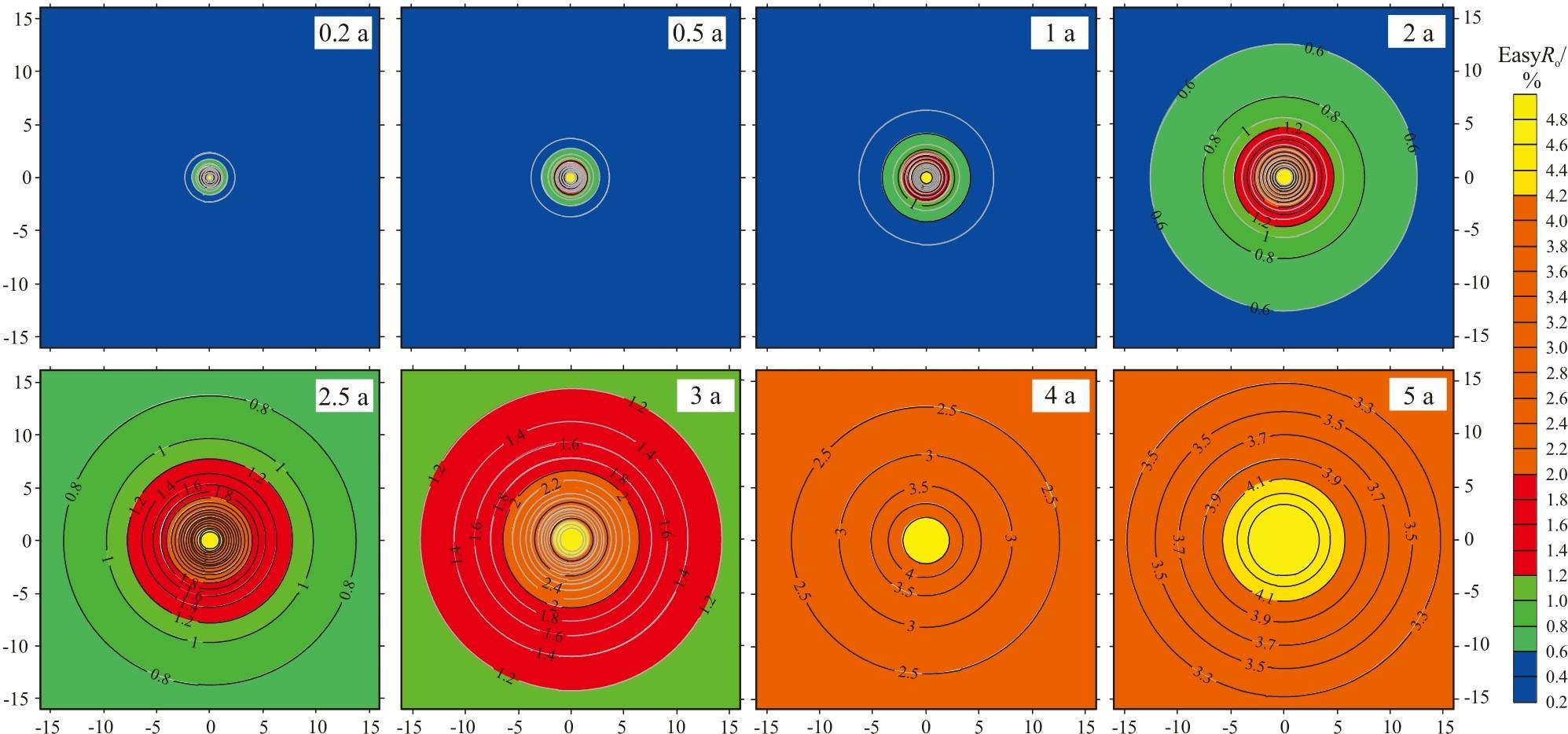
嫩江组页岩生烃原位转化数值模拟不同加热时间下温度与等效镜质体反射率随径向距离的分布分别如图8图9所示。随着加热时间延长,热量从单井加热中心向外传递,导致储层温度自中心向边缘逐渐升高[27]。以升温最缓慢的距加热中心15 m的区域为例,其温度从第1年的150 ℃升至第2年的200 ℃,并最终在第5年达到约420 ℃(图8)。等效镜质体反射率(Easy Ro)随加热时间的变化规律与温度场的分布特征相似。由于所采用算法的限定,基于Easy Ro法计算得到的最大值不超过5.0%;同时,该值超过5.0%后对生烃过程的指示意义不大。Easy Ro高值区由加热井筒向外逐渐扩展。随着加热时间的推移,第0.2~1年有效受热范围极其有限,进入生油门限的范围仅局限在加热井周5 m范围以内,生烃量极为有限;至第2年时进入生油窗范围开始扩大到井周约10 m范围,但整体成熟度较低,大多Easy Ro% 处于0.6%~0.8%的生油早期阶段(图9);第3年时,Easy Ro%>1.2%的范围达到井周13 m左右。此后至第4~5年,受热传导效率限制及目标层热物性影响,井周主要生烃区内有机质的成熟演化已基本完成,后续加热对总生烃量的贡献不显著。
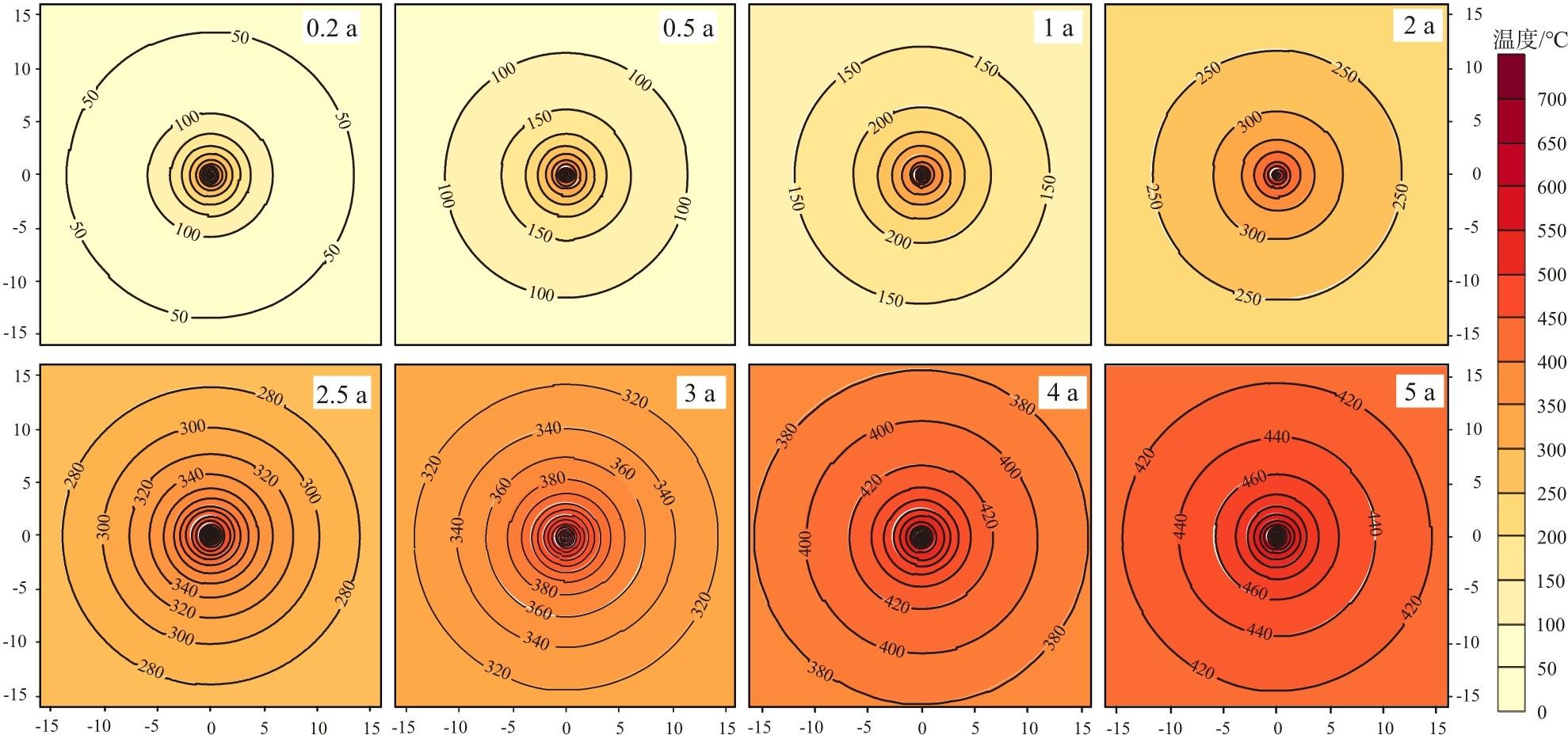
图8 不同加热年限加热单元的温度场分布

注:横坐标和纵坐标为距离加热井的距离,单位m。

Fig. 8 Temperature field distribution of heating units with different heating years

图9 不同加热年限加热单元的Easy Ro%分布

注:横坐标和纵坐标为距离加热井的距离,单位m。

Fig. 9 Distribution of Easy Ro% for heating units with different heating years

3.3 页岩原位转化生烃潜力评价

3.3.1 有机质成烃转化率

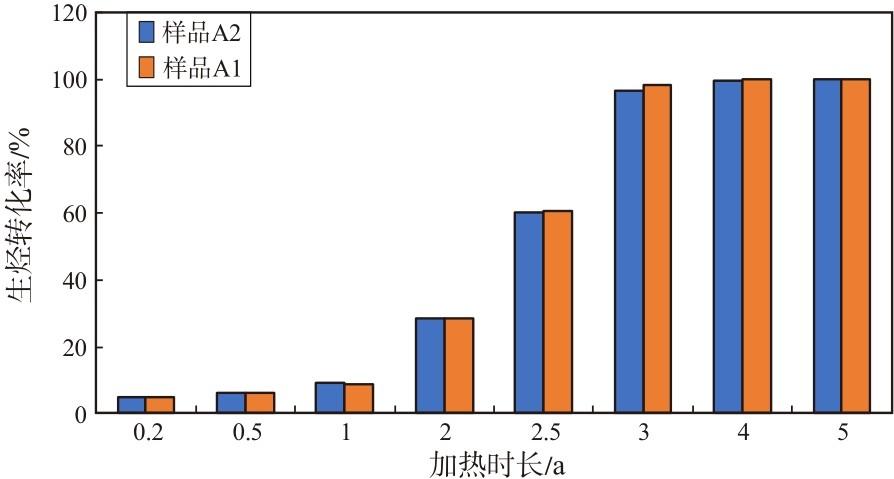
当研究区域的实际温度达到生烃门限后,低熟页岩中的干酪根便开始裂解转化为油气[41-42]。基于前述原位电加热温度场模拟结果,结合嫩江组页岩样品的生烃动力学参数,定量计算了两类不同有机质丰度页岩的生烃转化率随加热时间的变化关系(如图10)。随着加热年限增加,两者成烃转化率均呈逐渐上升趋势,且在不同加热年限后的数值相差不大。加热至2年时,两者的转化率均超过20%,并自此随加热年限增加迅速上升;至加热第3年,模拟转化率已接近100%(图10)。因此,页岩生烃过程主要集中在加热第2年至第3年,此后继续加热虽略有生烃,但增量明显放慢。
图10 不同加热年限页岩的生烃转化率

Fig. 10 Conversion rates of hydrocarbon generation of shales with different heating years

3.3.2 生油气量模拟结果

根据油气生成理论,单位体积页岩的油气生成量主要受有机质丰度、类型及成熟度等关键参数控制,这些参数可分别用总有机碳含量、氢指数和有机质成烃转化率定量表征[43]。基于区域地质特征[17]分析评价,嫩江组的实际TOC>2%的有效页岩厚度在80~180 m之间,其中TOC>5%厚度约在100~130 m之间,TOC>10%的厚度约为50 m[44]。前述结果表明,不同丰度页岩生烃特性存在一定的差异,为了便于系统对比有利原位加热层段不同有机质丰度页岩的原位开发效益差异,取相同厚度(嫩江组地层厚度中值100 m)的TOC为5%的页岩层和TOC为10%的页岩层作为限定条件进行有限元模拟,模拟了不同加热时间条件下的温度场分布与生烃强度变化。结果表明,在页岩转化充分的情况下,两种丰度层段的累积生烃强度均可达到8 t/m2以上(图11),均具有较好的开发前景。与此同时,在同等加热能耗条件下,高丰度有机质层段的总生油强度更高,可以达到中等丰度(TOC为5%)的2.3倍(图11),表明高丰度层段具有更高的生烃潜力。
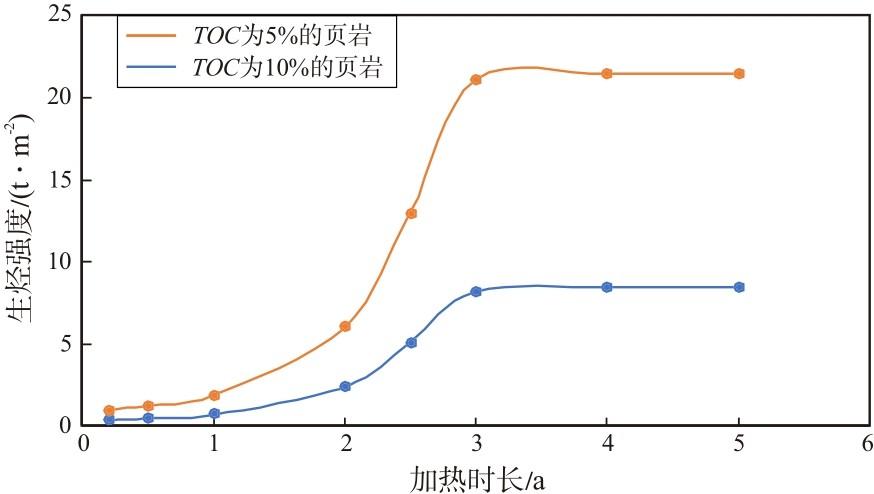
图11 不同加热年限页岩生烃强度特征

Fig. 11 Characteristics of hydrocarbon generation intensity of shales at different heating years

3.3.3 嫩江组页岩油原位转化可行性对比

渤海湾盆地沧东凹陷孔二段、鄂尔多斯盆地长7段,是典型的低熟富有机质页岩层系,均具备实施原位转化的地质潜力[45]。本次研究以松辽盆地嫩江组低熟页岩为研究对象,将其与地质条件相似的典型层系进行系统对比,通过模拟其原位转化过程,揭示该层系页岩油原位转化的地质可行性与潜在开发优势。其中,孔二段与长7段页岩的转化率数据来源于作者团队前期未公开的实验成果整理与对比分析,非引自外部公开文献。
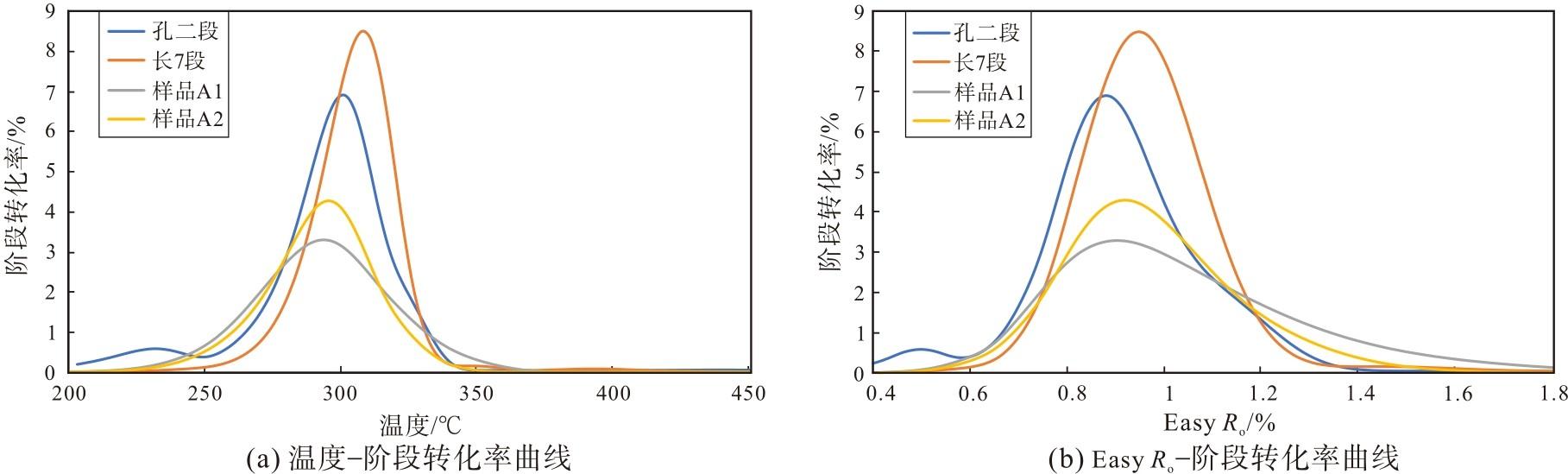
图12展示了松辽盆地嫩江组、沧东凹陷孔二段及鄂尔多斯盆地长7段页岩的温度-阶段转化率与Easy Ro%-阶段转化率曲线。嫩江组低成熟度页岩样品A1的生烃高峰温度约为296 °C(图12a),对应的等效镜质体反射率Easy Ro%为0.92%(图12b);而样品A2的生烃高峰温度为294 °C(图12a),对应的Easy Ro%为0.91%(图12b)。相比之下,孔二段及长7段页岩的阶段生烃高峰温度均高于嫩江组页岩,长7段页岩对应的Easy Ro%也高于嫩江组页岩。
图12 原位条件下不同地区页岩生烃阶段转化率曲线对比

Fig. 12 Comparison of stage conversion rate curves of hydrocarbon generation for shales from different regions under in-situ conditions

嫩江组低成熟度页岩的主要生烃阶段(转化率20%~80%)所对应的温度范围因有机质丰度不同而存在差异:A1的主要生烃区间为275~308 ℃(图13a),对应的Easy Ro%范围为0.77%~1.04%(图13b);A2的主要生烃区间则为272~313 ℃(图13a),对应的Easy Ro%范围为0.75%~1.10%(图13b)。值得注意的是,A1与A2样品的生烃窗口集中于272~313 ℃,对应的表观活化能主要分布在50~56 kcal/mol范围内。这一低活化能特征与相对较低的生烃起始温度相吻合,表明其有机质富含热稳定性较弱的化学键(如长链烷烃的C-C键及部分含氧官能团)。这些组分在中等温度下即可发生有效裂解,因而样品表现出生烃启动早、主生油阶段温度适中的特点。
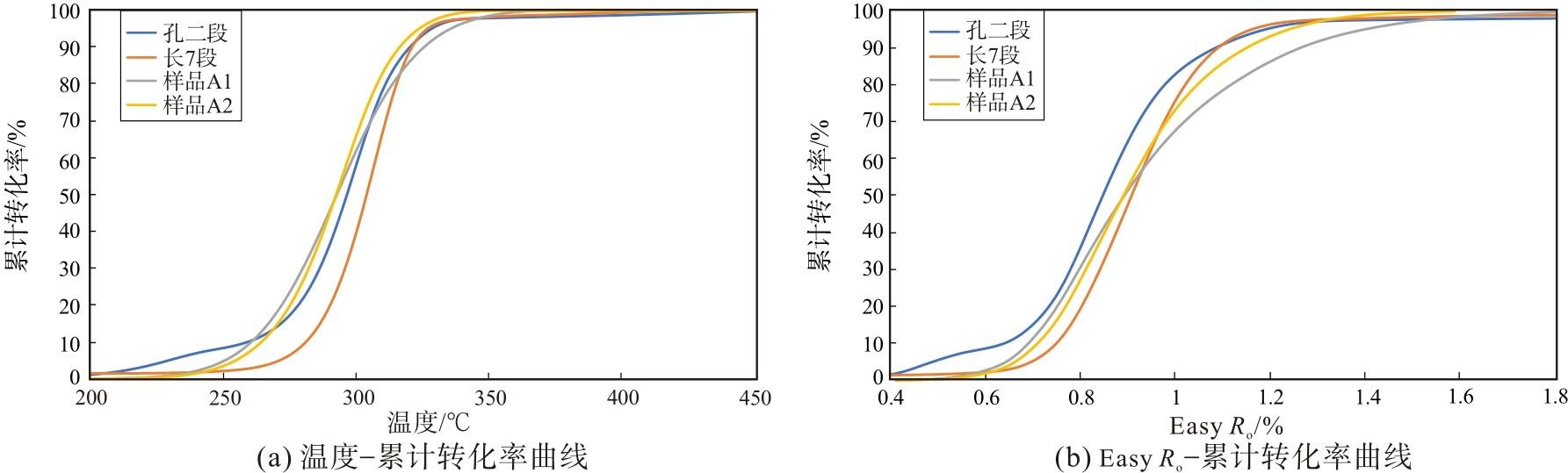
图13 原位条件下不同地区页岩生烃累计转化率曲线对比

Fig. 13 Comparison of cumulative conversion rate curves of hydrocarbon generation for shales from different regions under in-situ conditions

相较于孔二段及长7段,嫩江组A1和A2样品所代表的层段展现出显著的生烃优势,具体表现为生烃门限更低、生烃效率更高。从图13中清晰可见,在更低的热演化程度(Easy Ro%约0.6%~0.8%)和更低的温度条件下,A1和A2层段就已快速达到累计转化率的高峰(超过80%),而其他层段在此成熟度下的转化率仍显著偏低。这意味着A1和A2层段能够在埋藏更浅、地温更低的条件下,更早、更高效地生成油气,从而在热演化条件相对有限的盆地或层段中具有更大的资源潜力和勘探价值。

4 结论

(1)生烃模拟实验表明,松辽盆地嫩江组两种典型不同TOC页岩具备良好的生烃潜力,且高TOC页岩总生烃率在生烃全阶段高于低TOC含量页岩,表现出更好的生烃潜力。然而,高TOC含量页岩生烃的气油比低于低TOC页岩,原油的流动性可能较差。
(2)原位转化条件下,随着加热时间增加,嫩江组两种典型不同TOC页岩温度逐渐增大,在第3年时,等效镜质体反射率主要区域高于1.2%,页岩生烃转化率已接近100%,此后至第4年和第5年持续加热时总生烃量的增加已不显著。
(3)在页岩充分转化情况下,嫩江组两种丰度页岩层段的累计生烃强度可达到8 t/m2以上,相对于渤海湾盆地沧东凹陷孔二段、鄂尔多斯盆地长7段页岩,嫩江组页岩展现出良好的开发前景。建议在实际开发中,依据页岩热响应特征优化加热周期与能量配置,通过调整加热策略提升整体能源利用效率,从而实现低熟页岩油资源的高效开发。

[1]
雷群, 胥云, 才博, 等. 页岩油气水平井压裂技术进展与展望[J]. 石油勘探与开发, 2022, 49(1): 166-172, 182.

LEI Qun, XU Yun, CAI Bo, et al. Progress and prospects of horizontal well fracturing technology for shale oil and gas reservoirs[J]. Petroleum exploration and development, 2022, 49(1): 166-172, 182.

[2]
袁士义, 雷征东, 李军诗, 等. 古龙页岩油有效开发关键理论技术问题与对策[J]. 石油勘探与开发, 2023, 50(3): 562-572.

YUAN Shiyi, LEI Zhengdong, LI Junshi, et al. Key theoretical and technical issues and countermeasures for effective development of Gulong shale oil, Daqing Oilfield, NE China[J]. Petroleum exploration and development, 2023, 50(3): 562-572.

[3]
孙金声, 刘克松, 金家锋, 等. 中低熟页岩油原位转化技术研究现状及发展趋势[J]. 钻采工艺, 2023, 46(6): 1-7.

SUN Jinsheng, LIU Kesong, JIN Jiafeng, et al. Research status and development trend of in-situ catalytic conversion technology for medium-low maturity shale oil[J]. Drilling & production technology, 2023, 46(6): 1-7.

[4]
孙友宏, 郭威, 邓孙华. 油页岩地下原位转化与钻采技术现状及发展趋势[J]. 钻探工程, 2021, 48(1): 57-67.

SUN Youhong, GUO Wei, DENG Sunhua. The status and development trend of in-situ conversion and drilling exploitation technology for oil shale[J]. Drilling engineering, 2021, 48(1): 57-67.

[5]
何文渊, 崔宝文, 张金友, 等. 松辽盆地北部嫩江组中—低成熟页岩油地质特征及勘探突破[J]. 石油学报, 2024, 45(6): 900-913.

HE Wenyuan, CUI Baowen, ZHANG Jinyou, et al. Geological characteristics and exploration breakthroughs of the middle to low mature shale oil of Nenjiang Formation in northern Songliao Basin[J]. Acta petrolei sinica, 2024, 45(6): 900-913.

[6]
何文渊, 蒙启安, 林铁锋, 等. 松辽盆地北部白垩系嫩江组低熟页岩原位渗透率随温度变化演化特征[J]. 石油勘探与开发, 2022, 49(3): 453-464.

HE Wenyuan, MENG Qi'an, LIN Tiefeng, et al. Evolution of in-situ permeability of low-maturity shale with the increasing temperature, Cretaceous Nenjiang Formation, northern Songliao Basin, NE China[J]. Petroleum exploration and development, 2022, 49(3): 453-464.

[7]
刘合, 黄有泉, 蔡萌, 等. 松辽盆地古龙页岩油储集层压裂改造工艺实践与发展建议[J]. 石油勘探与开发, 2023, 50(3): 603-612.

LIU He, HUANG Youquan, CAI Meng, et al. Practice and development suggestions of hydraulic fracturing technology in the Gulong shale oil reservoirs of Songliao Basin, NE China[J]. Petroleum exploration and development, 2023, 50(3): 603-612.

[8]
姜生玲, 彭传圣, 周庆华, 等. 鹤峰地区中上二叠统海相页岩储层非均质性特征: 以HD1井为例[J]. 海相油气地质, 2024, 29(1): 71-80.

JIANG Shengling, PENG Chuansheng, ZHOU Qinghua, et al. The heterogeneity characteristics of marine shale reservoirs of Middle-Upper Permian in Hefeng area: a case study of the Well HD1[J]. Marine origin petroleum geology, 2024, 29(1): 71-80.

[9]
孙龙德, 贾承造, 张君峰, 等. 松辽盆地古龙页岩油重点地区资源潜力[J]. 石油学报, 2024, 45(12): 1699-1714.

SUN Longde, JIA Chengzao, ZHANG Junfeng, et al. Resource potential of Gulong shale oil in the key areas of Songliao Basin[J]. Acta petrolei sinica, 2024, 45(12): 1699-1714.

[10]
王自翔, 贾楠, 韩琪琪, 等. 油页岩原位加热开采中的生烃反应动力学模型[J]. 实验技术与管理, 2023, 40(7): 33-40.

WANG Zixiang, JIA Nan, HAN Qiqi, et al. Kinetic model of hydrocarbon generation reaction in in-situ heating of oil shale[J]. Experimental technology and management, 2023, 40(7): 33-40.

[11]
WANG Min, LU Shuangfang, XUE Haitao. Kinetic simulation of hydrocarbon generation from lacustrine type I kerogen from the Songliao Basin: model comparison and geological application[J]. Marine and petroleum geology, 2011, 28(9): 1714-1726.

[12]
孙彪, 刘小平, 赵贤正, 等. 渤海湾盆地沧东凹陷孔店组二段纹层状页岩地层孔隙热压生-排烃模拟及其页岩油地质意义[J]. 石油与天然气地质, 2026, 47(1): 180-197.

SUN Biao, LIU Xiaoping, ZHAO Xianzheng, et al. Formation porosity thermocompression simulations of hydrocarbon generation and expulsion of lamellar shales and their geological implications for shale oil exploration in the 2nd member of Kongdian Formation, Cangdong Sag,Bohai Bay Basin[J]. Oil & gas geology, 2026, 47(1): 180-197.

[13]
史玉玲, 刘杰, 温华华, 等. 珠江口盆地惠州26-6烃源岩热压模拟实验及生气潜力[J]. 海洋地质前沿, 2021, 37(11): 53-59.

SHI Yuling, LIU Jie, WEN Huahua, et al. Thermo-compression simulation experiment and gas generation potential analysis of Huizhou 26-6 source rocks in the Pearl River Mouth Basin[J]. Marine geology frontiers, 2021, 37(11): 53-59.

[14]
柳波, 刘阳, 刘岩, 等. 低熟页岩电加热原位改质油气资源潜力数值模拟: 以松辽盆地南部中央坳陷区嫩江组一、二段为例[J]. 石油实验地质, 2020, 42(4): 533-544.

LIU Bo, LIU Yang, LIU Yan, et al. Prediction of low-maturity shale oil produced by in situ conversion: a case study of the first and second members of Nenjiang Formation in the Central Depression, southern Songliao Basin, Northeast China[J]. Petroleum geology and experiment, 2020, 42(4): 533-544.

[15]
付秀丽, 常健, 唐博宁, 等. 热盆环境对页岩油快速成熟演化的影响: 以松辽盆地齐家古龙凹陷为例[J]. 地球物理学报, 2025, 68(1): 182-198.

FU Xiuli, CHANG Jian, TANG Boning, et al. Rapid maturation evolution of the shale oil in the heat sedimentary basins: a case study of the Qijiagulong Sag in Songliao Basin, Northeastern China[J]. Chinese journal of geophysics, 2025, 68(1): 182-198.

[16]
宋立斌, 丛杉, 张艳, 等. 松辽盆地南部伏双大地区登娄库组孢粉组合特征研究及地质意义[J]. 非常规油气, 2025, 12(2): 11-24.

SONG Libin, CONG Shan, ZHANG Yan, et al. A study on characteristics of sporopollen assemblage of the Denglouku Formation in the Fushuangda area, southern Songliao Basin and its geological significance[J]. Unconventional oil & gas, 2025, 12(2): 11-24.

[17]
冯子辉, 霍秋立, 曾花森, 等. 松辽盆地古龙页岩地球化学特征与油气资源评价方法[J]. 大庆石油地质与开发, 2025, 44(3): 1-10.

FENG Zihui, HUO Qiuli, ZENG Huasen, et al. Geochemical characteristics of Gulong shale in Songliao Basin and evaluation methods for oil and gas resources[J]. Petroleum geology & oilfield development in Daqing, 2025, 44(3): 1-10.

[18]
LIU Bo, WANG Haoli, FU Xiaofei, et al. Lithofacies and depositional setting of a highly prospective lacustrine shale oil succession from the Upper Cretaceous Qingshankou Formation in the Gulong Sag, northern Songliao Basin, Northeast China[J]. AAPG bulletin, 2019, 103(2): 405-432.

[19]
代宇, 谭静强, 谢文泉. 松辽盆地中央凹陷青山口组一段页岩生烃潜力及沉积环境研究[J]. 非常规油气, 2022, 9(5): 9-24.

DAI Yu, TAN Jingqiang, XIE Wenquan. Study on hydrocarbon generation potential and sedimentary environment of shale in the first member of Qingshankou Formation in Central Depression of Songliao Basin[J]. Unconventional oil & gas, 2022, 9(5): 9-24.

[20]
贾建亮, 刘招君, BECHTEL A, 等. 松辽盆地嫩江组油页岩发育控制因素[J]. 地球科学(中国地质大学学报), 2014, 39(2): 174-186.

JIA Jianliang, LIU Zhaojun, BECHTEL A, et al. Controlling factors of oil shale development in the Nenjiang Formation of Songliao Basin[J]. Earth science (Journal of China University of Geosciences), 2014, 39(2): 174-186.

[21]
王岚, 周海燕, 商斐, 等. 松辽盆地北部白垩纪青山口组黑色页岩元素地球化学特征及沉积古环境恢复[J]. 地质科学, 2022, 57(1): 156-171.

WANG Lan, ZHOU Haiyan, SHANG Fei, et al. Element geochemical characteristics of black shale and paleo-sedimentary environmental restoration of Qingshankou Formation of the Cretaceous in the northern Songliao Basin[J]. Chinese journal of geology, 2022, 57(1): 156-171.

[22]
吴怀春, 李山, 王成善, 等. 松辽盆地白垩纪综合年代地层格架[J]. 地学前缘, 2024, 31(1): 431-445.

WU Huaichun, LI Shan, WANG Chengshan, et al. Integrated chronostratigraphic framework for Cretaceous Strata in the Songliao Basin[J]. Earth science frontiers, 2024, 31(1): 431-445.

[23]
王民, 张宇辰, 邓仔晓, 等. 微波辐射加热对页岩有机质生烃和化学结构的影响机制: 与常规加热的对比[J]. 石油学报, 2024, 45(10): 1492-1506.

WANG Min, ZHANG Yuchen, DENG Zaixiao, et al. Influence mechanism of microwave irradiation heating on hydrocarbon generation and chemical structure of shale organic matter: a comparison with conventional heating[J]. Acta petrolei sinica, 2024, 45(10): 1492-1506.

[24]
柳波, 蒙启安, 付晓飞, 等. 松辽盆地白垩系青山口组一段页岩生、排烃组分特征及页岩油相态演化[J]. 石油与天然气地质, 2024, 45(2): 406-419.

LIU Bo, MENG Qi'an, FU Xiaofei, et al. Composition of generated and expelled hydrocarbons and phase evolution of shale oil in the 1st member of Qingshankou Formation, Songliao Basin[J]. Oil & gas geology, 2024, 45(2): 406-419.

[25]
高攀明. 鄂尔多斯盆地吴起地区长7页岩油烃源岩特征及生排烃潜力[J]. 非常规油气, 2024, 11(3): 10-18.

GAO Panming. Characteristics and hydrocarbon generation and expulsion potential of Chang7 shale oil source rocks in Wuqi area, Ordos Basin[J]. Unconventional oil & gas, 2024, 11(3): 10-18.

[26]
马建雄, 薛林福, 赵金岷, 等. 油页岩原位裂解开采温度场数值模拟与设计方案优化[J]. 科学技术与工程, 2019, 19(5): 94-103.

MA Jianxiong, XUE Linfu, ZHAO Jinmin, et al. Numerical simulation and design optimization of temperature field of oil shale in-situ pyrolysis and exploitation[J]. Science technology and engineering, 2019, 19(5): 94-103.

[27]
康志勤, 赵阳升, 杨栋. 利用原位电法加热技术开发油页岩的物理原理及数值分析[J]. 石油学报, 2008, 29(4): 592-595, 600.

KANG Zhiqin, ZHAO Yangsheng, YANG Dong. Physical principle and numerical analysis of oil shale development using in-situ conversion process technology[J]. Acta petrolei sinica, 2008, 29(4): 592-595, 600.

[28]
朱连丰. 银根—额济纳旗盆地主力烃源岩生烃热模拟实验研究[J]. 石油实验地质, 2019, 41(5): 731-738, 745.

ZHU Lianfeng. Pyrolysis hydrocarbon generation of the main source rock in Yin'gen-E'ji'naqi Basin[J]. Petroleum geology & experiment, 2019, 41(5): 731-738, 745.

[29]
孙宇, 王云鹏, 刘金钟, 等. 基于全岩半封闭热模拟实验的页岩排烃效率与孔隙及裂隙演化特征[J]. 地球化学, 2024, 53(6): 815-826.

SUN Yu, WANG Yunpeng, LIU Jinzhong, et al. Hydrocarbon expulsion efficiency and pore and fracture evolution characteristics of shale based on whole rock semi-closed thermal simulation experiments[J]. Geochimica, 2024, 53(6): 815-826.

[30]
李贤庆, 仰云峰, 王萌, 等. 塔里木盆地原油裂解成气动力学实验[J]. 新疆石油地质, 2013, 34(4): 432-435.

LI Xianqing, YANG Yunfeng, WANG Meng, et al. The kinetic experiment of crude oil cracked gas in Tarim Basin[J]. Xinjiang petroleum geology, 2013, 34(4): 432-435.

[31]
李政, 包友书, 朱日房, 等. 页岩油赋存特征、可动性实验技术及研究方法进展[J]. 油气地质与采收率, 2024, 31(4): 84-95.

LI Zheng, BAO Youshu, ZHU Rifang, et al. Progress in experimental techniques and research methods for shale oil occurrence characteristics and mobility[J]. Petroleum geology and recovery efficiency, 2024, 31(4): 84-95.

[32]
李志强, 李慧勇, 张中巧, 等. 常规-非常规含油气系统模拟中的湖相烃源岩金管生烃动力学: 应用、问题与展望[J/OL]. 地球科学, 2025: 1-59 (2025-09-15) [2025-11-11]. https://link.cnki.net/urlid/42.1874.P.20250915.1454.002.

LI Zhiqiang, LI Huiyong, ZHANG Zhongqiao, et al. Hydrocarbon generation kinetics of lacustrine source rocks in gold tube systems for modeling of conventional and unconventional petroleum systems: advances, challenges, and perspectives[J/OL]. Earth science, 2025: 1-59 (2025-09-15) [2025-11-11]. https://link.cnki.net/urlid/42.1874.P.20250915.1454.002.

[33]
祝彦贺, 朱学申, 王存武, 等. 鄂尔多斯盆地东缘北段深层煤层气源储特征及资源潜力: 以神府区块为例[J]. 非常规油气, 2025, 12(1): 30-39.

ZHU Yanhe, ZHU Xueshen, WANG Cunwu, et al. Source-reservoir characteristics of deep coal seams and its resources potential in eastern margin of Ordos Basin: a case study of Shenfu block[J]. Unconventional oil & gas, 2025, 12(1): 30-39.

[34]
王晓东, 王波, 杨纪磊, 等. 不同类型有机质生烃动力学特征: 以渤海湾盆地KL-A构造为例[J]. 天然气地球科学, 2025, 36(2): 354-366.

WANG Xiaodong, WANG Bo, YANG Jilei, et al. Kinetics of hydrocarbon generation of different types of organic matter in the KL-A structure of the Bohai Bay Basin[J]. Natural gas geoscience, 2025, 36(2): 354-366.

[35]
张喜龙, 杨兴, 周飞, 等. 温压共控生烃模拟实验烃类产率演化特征及地质意义[J]. 天然气地球科学, 2022, 33(9): 1460-1475.

ZHANG Xilong, YANG Xing, ZHOU Fei, et al. Hydrocarbon yield evolution characteristics and geological significance in temperature-pressure controlled simulation experiment[J]. Natural gas geoscience, 2022, 33(9): 1460-1475.

[36]
曾立飞, 靳军, 马万云, 等. 准噶尔盆地南缘侏罗系煤岩生烃动力学研究[J]. 地球化学, 2021, 50(3): 282-293.

ZENG Lifei, JIN Jun, MA Wanyun, et al. Petroleum generation kinetics of Jurassic coals in the southern margin of the Junggar Basin[J]. Geochimica, 2021, 50(3): 282-293.

[37]
王强, 彭平安, 张文正, 等. 鄂尔多斯盆地延长组7段页岩全组分定量生烃模拟及原油可动性评价[J]. 石油学报, 2018, 39(5): 541-553.

WANG Qiang, PENG Ping'an, ZHANG Wenzheng, et al. Quantitative full-component hydrocarbon-generating simulation and crude oil mobility evaluation of shale in 7th member of Yanchang Formation, Ordos Basin[J]. Acta petrolei sinica, 2018, 39(5): 541-553.

[38]
CHENG Bin, LI Shida, XU Jianbing, et al. Gaseous hydrocarbons cracking in shale: mechanism, impact and resource significance[J]. Earth-science reviews, 2025, 270: 105211.

[39]
赵晗, 马中良, 郑伦举, 等. 有限空间温压共控热模拟油气产物地球化学特征[J]. 天然气地球科学, 2020, 31(1): 73-83.

ZHAO Han, MA Zhongliang, ZHENG Lunju, et al. Geochemical characteristics of hydrocarbon products under thermal simulation of temperature and pressure co-control in finite space[J]. Natural gas geoscience, 2020, 31(1): 73-83.

[40]
高岗, 刘诗局, 靳军, 等. 原油物性演化规律新发现及其对页岩油勘探的启示[J]. 地质学报, 2023, 97(5): 1561-1575.

GAO Gang, LIU Shiju, JIN Jun, et al. A new discovery of physical property evolution of crude oil and insights into shale oil exploration[J]. Acta geologica sinica, 2023, 97(5): 1561-1575.

[41]
蒋海岩, 胡清萍, 王姣, 等. 鄂尔多斯长7段油页岩不同阶段热解反应特征[J]. 油田化学, 2024, 41(3): 444-450.

JIANG Haiyan, HU Qingping, WANG Jiao, et al. Pyrolysis reaction characterization at different stages in oil shale from the Ordos Chang 7 section[J]. Oilfield chemistry, 2024, 41(3): 444-450.

[42]
崔景伟, 朱如凯, 侯连华, 等. 页岩原位改质技术现状、挑战和机遇[J]. 非常规油气, 2018, 5(6): 103-114.

CUI Jingwei, ZHU Rukai, HOU Lianhua, et al. Shale in-situ mining technology status quo of challenges and opportunities[J]. Unconventional oil & gas, 2018, 5(6): 103-114.

[43]
邹才能, 马锋, 潘松圻, 等. 全球页岩油形成分布潜力及中国陆相页岩油理论技术进展[J]. 地学前缘, 2023, 30(1): 128-142.

ZOU Caineng, MA Feng, PAN Songqi, et al. Formation and distribution potential of global shale oil and the developments of continental shale oil theory and technology in China[J]. Earth science frontiers, 2023, 30(1): 128-142.

[44]
LIU B, LIU L, FU J, et al. The Songliao Super Basin in northeastern China[J]. AAPG bulletin, 2023, 107(8): 1257-1297.

[45]
赵文智, 赵阳升, 李根生, 等. 陆相中低熟页岩油富集与原位转化科学问题及关键技术[J]. 中国科学基金, 2023, 37(2): 276-284.

ZHAO Wenzhi, ZHAO Yangsheng, LI Gensheng, et al. Scientific problems and key technologies of enrichment and in-situ transformation of mid-low mature shale oil in continental facies[J]. Bulletin of National Natural Science Foundation of China, 2023, 37(2): 276-284.

Outlines

/