ISSN 1672-9854
CN 33-1328/P

Reservoir characteristics and physical property control factors in deep water and low-permeability oil and gas reservoirs: a case study of the 3rd member of Lingshui Formation on the southern slope of Baodao Sag in Qiongdongnan Basin

  • XU Xiaoting ,
  • ZHOU Wei ,
  • ZHANG Chong ,
  • QIN Lijuan ,
  • MENG Di
Expand
  • Hainan Branch of CNOOC(China) Co., Ltd
ZHANG Chong, PhD, Senior Engineer, mainly engaged in research on oil and gas field development geology. Add: Yufu International Building, Changbin 3rd Rd., Xiuying District, Haikou, Hainan 570312, China. E-mail:

XU Xiaoting, Master Candidate, Engineer, mainly engaged in research on oil and gas field development geology. Add: Yufu International Building, Changbin 3rd Rd., Xiuying District, Haikou, Hainan 570312, China. E-mail:

Received date: 2025-08-08

  Revised date: 2025-11-12

  Online published: 2026-02-04

Abstract

The controlling mechanisms of physical properties and distribution laws of deep water and low-permeability reservoirs have become key scientific issues urgently to be solved in China offshore oil and gas exploration and development. Taking the 3rd member of Lingshui Formation reservoir in YL10 structure on the southern slope of Baodao Sag, Qiongdongnan Basin as the research object, this paper systematically studies the petrological characteristics, pore-throat structure and physical property distribution laws of the reservoir by comprehensively using experiments such as cast thin sections, scanning electron microscopy (SEM), high-pressure mercury intrusion and fluid inclusions. The results show that: (1) The 3rd member of Lingshui Formation in the study area has strong heterogeneity and complex pore-throat structure, generally developing medium-porosity, low to ultra-low permeability reservoirs, with "sweet spot" reservoirs of high porosity and high permeability existing in some areas. (2) The difference in reservoir physical properties is controlled by the sedimentary-diagenetic coupling effect. Sedimentation lays the material foundation for the Lingshui Member 3 reservoir, and diagenesis is the main controlling factor affecting the reservoir type. Compaction, affected by burial depth, is the main cause of reservoir differentiation. Cementation intensifies the differentiation of reservoir physical properties, and the differences in the type, content and occurrence of cements lead to the differentiation between low-permeability and ultra-low-permeability reservoirs. Dissolution controlled by oil and gas charging plays a constructive role in reservoir porosity, and the formation of a large number of mold pores results in maintaining medium porosity while low permeability in the deeply buried reservoir. (3) The shallow, weak-diagenetic zone in the south is a favorable reservoir distribution area, where thick underwater distributary channel sand bodies exhibit high porosity and permeability characteristics; the deep reservoirs in the north require special attention to zones with developed dissolution pores and weak cementation.

Cite this article

XU Xiaoting , ZHOU Wei , ZHANG Chong , QIN Lijuan , MENG Di . Reservoir characteristics and physical property control factors in deep water and low-permeability oil and gas reservoirs: a case study of the 3rd member of Lingshui Formation on the southern slope of Baodao Sag in Qiongdongnan Basin[J]. Marine Origin Petroleum Geology, 2026 , 31(1) : 48 -60 . DOI: 10.3969/j.issn.1672-9854.2026.01.004

0 前言

我国海上低渗油气勘探始于20世纪90年代。相较于陆上,海上低渗油气田具有埋藏深、分布散、沉积类型多样的特点[1]。近几年随着技术革新、理论突破以及装备的进步,深水深层低渗(水深达1 500 m,埋深大于3 500 m,渗透率为(1~10)×10-3 μm2)油气勘探取得重大突破,已成为增储上产的重要领域[2-4]。海上低渗储层物性演化受构造、沉积及成岩作用共同控制:构造作用控制埋藏史及热史,影响储层的压实、溶蚀等过程;沉积作用决定沉积相带类型,控制沉积物粒度及分选性,影响储层空间展布规律;成岩作用通过差异压实、胶结、溶蚀等方式,对储层进行二次改造,最终影响储层品质。储层物性的主控因素具有区域差异性,需结合具体区域地质条件开展针对性分析。
琼东南盆地宝岛凹陷位于超深水区(水深1 900~2 100 m),构造-沉积演化过程复杂,多期断裂发育,且局部区域发育高压(压力系数为1.44~1.50)。前期研究主要集中在宝岛凹陷烃源、构造和沉积方面[5-6],取得以下认识:宝岛凹陷具备较大的天然气资源潜力,发育始新统湖相、渐新统崖城组陆源海相优质烃源岩[7-10];受盆地多期构造活动影响,发育一系列断阶带,主要由3组深大断裂构成,直接沟通烃源岩,为油气重要输导通道[11];广泛分布大型辫状河三角洲、扇三角洲,渐新统陵水组以滨—浅海相沉积为主,其中陵水组三段(简称陵三段)下部以浅海及前三角洲沉积为主,上部以三角洲前缘沉积为主[12-14]。目前在宝岛凹陷北坡已发现BD21大气田,但南坡储层非均质性强、低渗成因不明及储层分布规律认识不清,制约了凹陷周缘油气藏的后续评价。
本文以宝岛凹陷南坡YL10构造为研究区,综合应用铸体薄片、扫描电镜、高压压汞和流体包裹体分析等实验手段,系统开展储层岩石学、物性及孔喉结构特征研究,重点探讨影响储层物性及孔隙结构的地质因素,厘清储层物性差异的主控因素,建立中孔低渗储层成因模式,为低渗油气藏评价提供理论支撑。

1 地质概况

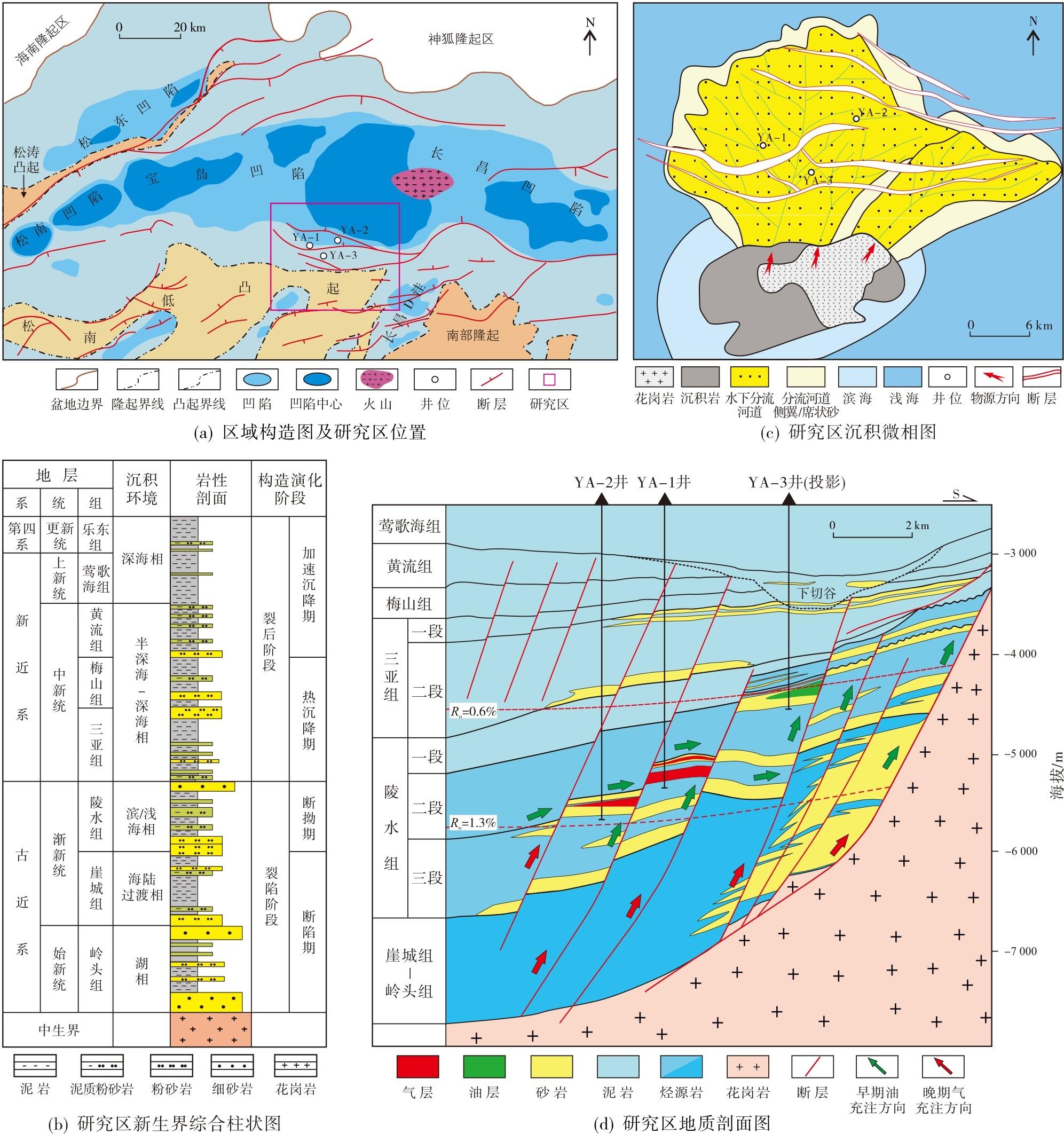
琼东南盆地位于中国南海西北部,为北东向展布的新生代被动大陆边缘盆地,中央坳陷包括乐东凹陷、陵水凹陷、宝岛凹陷、长昌凹陷等二级构造单元[15-19]。宝岛凹陷北邻神狐隆起区,南接松南低凸起,西靠松南凹陷,东至长昌凹陷(图1a)。盆地经历了裂陷、裂后构造演化阶段(图1b):裂陷阶段分为断陷期和断拗期,发育始新统岭头组湖相地层、渐新统崖城组海陆过渡相地层和陵水组海相地层;裂后阶段分为热沉降期和加速沉降期,发育中新统三亚组、梅山组、黄流组半深海—深海相地层和上新统莺歌海组、第四系乐东组深海相地层[20-22]。宝岛凹陷主体受裂陷阶段断层控制[23]。生储盖组合主要由始新统湖相—渐新统崖城组陆源海相烃源岩、渐新统陵水组与中新统三亚组三角洲—深水沉积体系的碎屑岩储层以及中新统厚层半深海—深海相泥岩盖层组成(图1b),具有烃源充足、储层物性较好、盖层封闭性强等特征[24]。研究区位于宝岛凹陷南坡(图1a),受陵水组同沉积断层控制,发育若干个小断块,形成一系列近东西向展布的多级断阶(图1c,1d)。陵水组沉积期研究区南部YL10剥蚀区提供物源,在区内发育三角洲浅灰色细砂岩储集体(图1c)。研究区主要含油气层位为陵三段(图1d)。
图1 研究区地质概况

Fig. 1 Geological overview of the study area

2 储层特征

2.1 岩石学特征

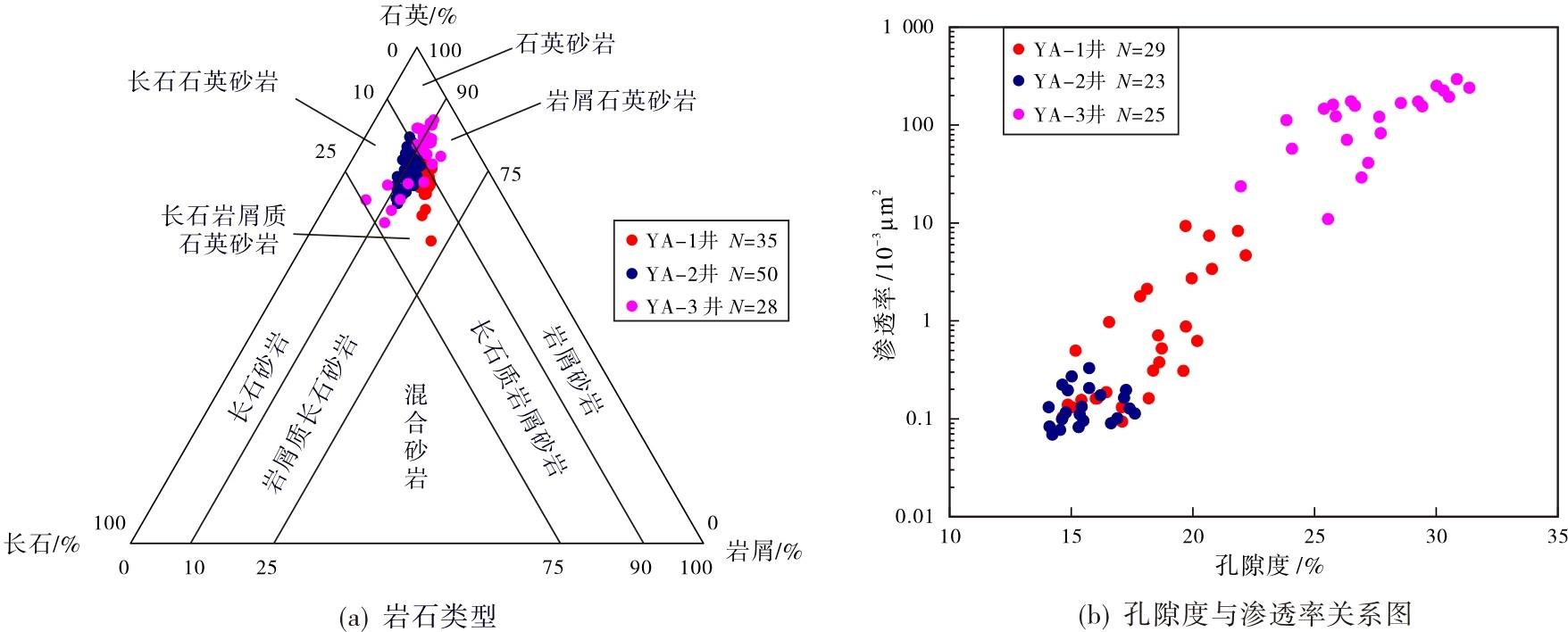
对研究区3口井共121块薄片样品进行镜下鉴定,陵三段储层岩性主要为长石岩屑质石英砂岩和岩屑石英砂岩(图2a)。其石英含量为61%~85%,平均为75.6%;长石以斜长石和钾长石为主,含量在4%~24%之间,平均为12.3%;岩屑以变质岩岩屑和岩浆岩岩屑为主,含量在6%~22%之间,平均为12.1%。砂岩粒度较细,以极细砂岩为主,占比77%,局部含粉砂级细颗粒,含量在23%左右;分选中等—好,磨圆多为次棱角状—次圆状,接触关系以点-线式为主。颗粒间填隙物主要为胶结物和泥质杂基,其中胶结物以碳酸盐胶结物和黏土矿物为主,含少量硅质胶结物,胶结类型以孔隙式为主,接触式次之。储层总体具成分成熟度高和结构成熟度中等偏高的特点。
图2 琼东南宝岛凹陷南坡陵水组三段砂岩类型及物性特征

Fig. 2 Sandstone types and physical properties of the 3rd member of Lingshui Formation on the southern slope of Baodao Sag in Qiongdongnan Basin

2.2 物性特征

储层壁心物性分析表明(图2b):研究区陵三段主要发育中孔低渗储层,物性差,在整体低渗的背景下,局部发育甜点储层。南部YA-3井陵三段埋深为3 770~4 150 m(平均4 070 m),属于深层中的相对浅埋藏储层,孔隙度分布范围为22.0%~31.4%、平均值为27.4%,渗透率分布在(10.95~293.21)×10-3 μm2之间、平均值为136.79×10⁻³ μm2,为高孔高渗储层,属于甜点储层;北部YA-1井埋深为4 890~5 290 m(平均5 050 m),属于中等埋藏储层,孔隙度分布范围为14.7%~22.2%、平均值为18.8%,渗透率分布在(0.09~9.30)×10-3 μm2之间、平均值为1.60×10⁻³ μm2,为中孔低渗储层;北部YA-2井埋深为5 130~5 290 m(平均5 180 m),属于深埋藏储层,孔隙度分布范围为14.1%~17.6%、平均值为15.6%,渗透率分布在(0.07~0.33)×10-3 μm2之间、平均值为0.14×10⁻³ μm2,为中孔特低渗储层。研究区储层物性南北分异明显:从南至北储层孔隙度逐渐变小,由高孔转变为中孔;渗透率大幅降低,由高渗转变为低渗、特低渗。

2.3 孔隙结构特征

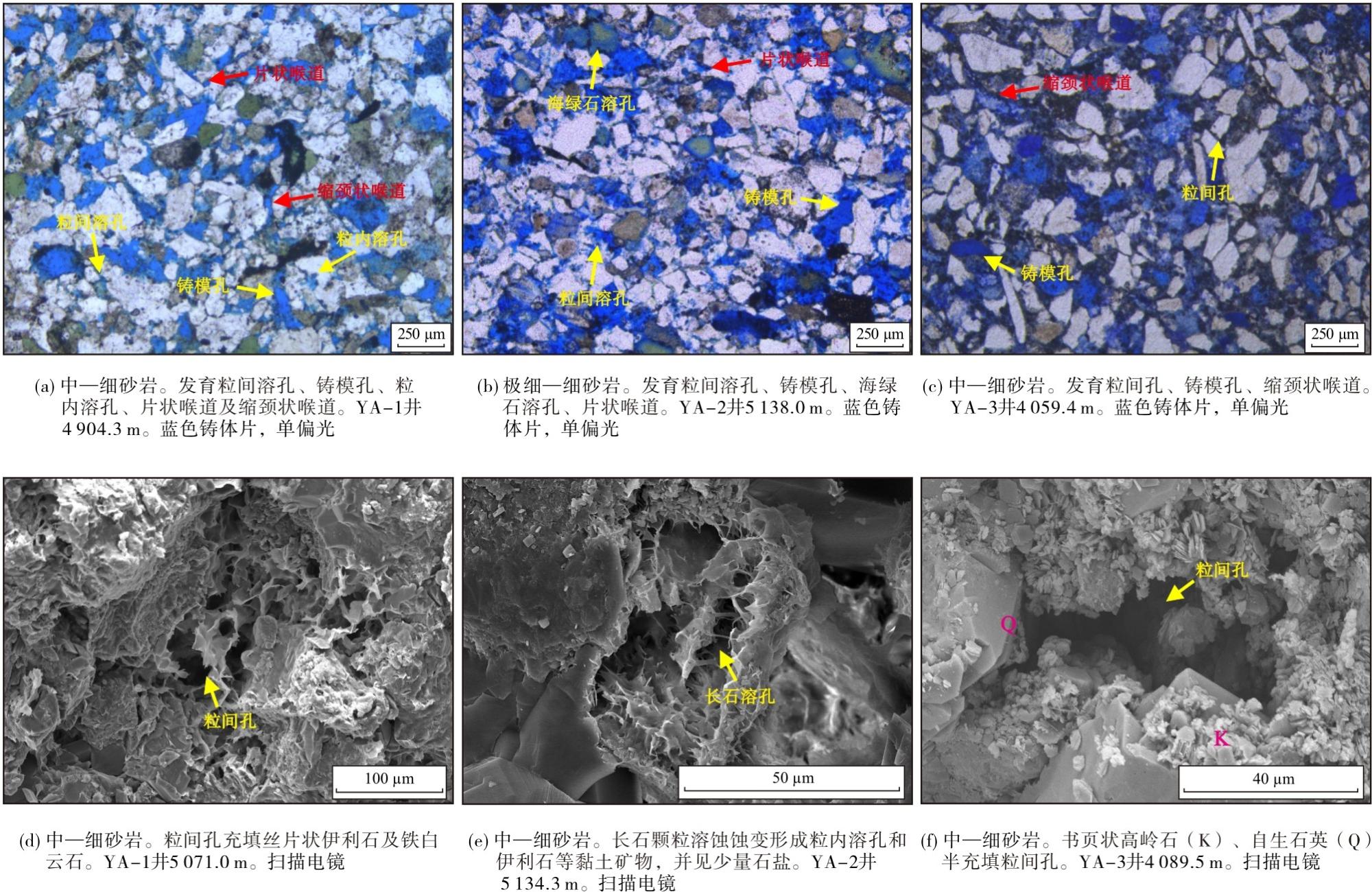
铸体薄片结合扫描电镜鉴定表明:研究区陵三段储层孔隙类型以粒内溶孔、铸模孔、粒间溶孔和残余粒间孔为主,主要的喉道类型为片状、缩颈状(图3)。在相对浅埋藏区,南部YA-3井孔隙类型以残余粒间孔、粒间溶孔为主,发育部分铸模孔,喉道类型主要为缩颈状;在中等埋藏区,北部YA-1井孔隙类型以铸模孔、残余粒间孔为主,喉道类型主要为片状,部分为缩颈状;在深埋藏区,北部YA-2井孔隙类型以铸模孔、粒内溶孔为主,喉道类型主要为片状。
图3 琼东南宝岛凹陷南坡陵水组三段储层孔隙类型

Fig. 3 Pore types of the 3rd member of Lingshui Formation on the southern slope of Baodao Sag in Qiongdongnan Basin

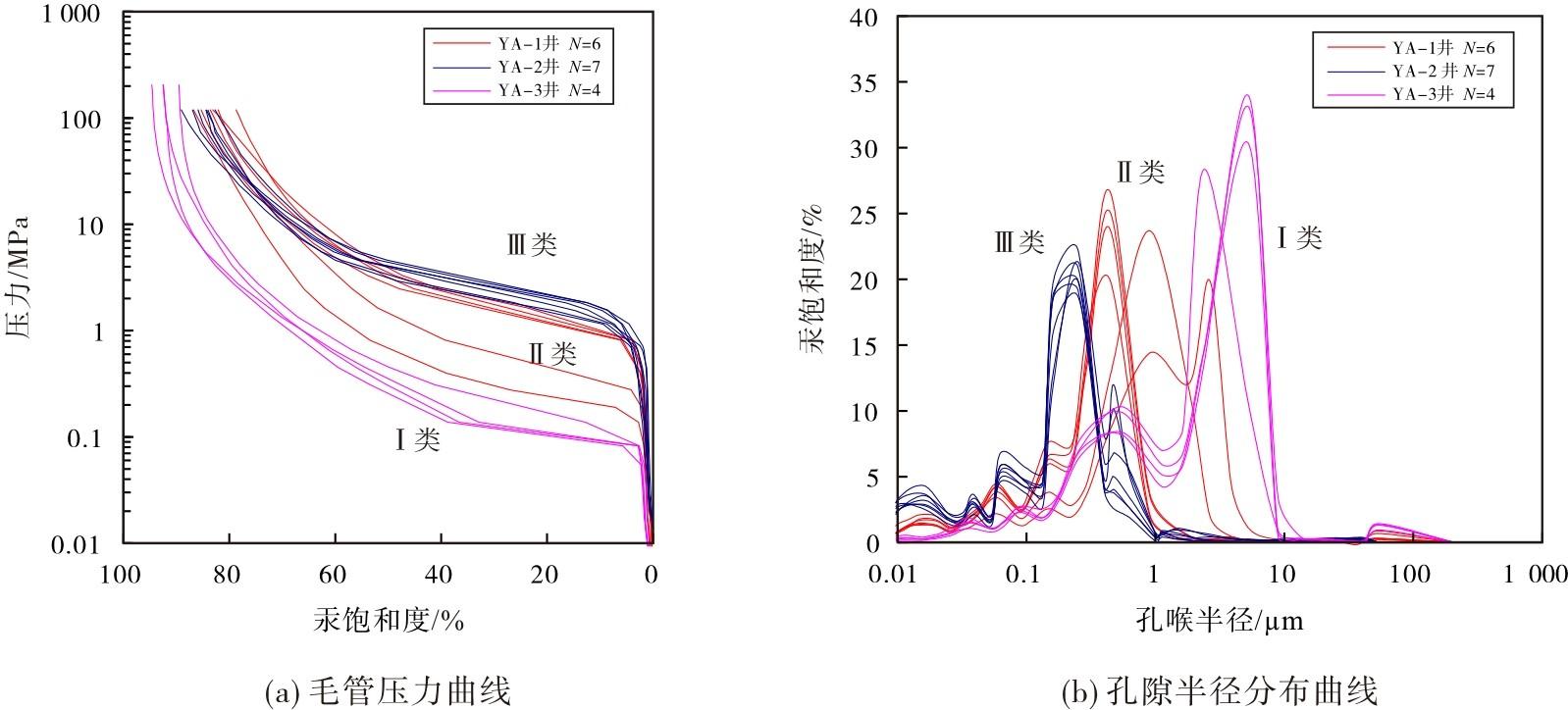
对3口井的储层样品进行高压压汞分析,结果表明:储层排驱压力较高,孔喉半径小、分选差,总体属中细孔-微细喉的孔隙结构特征(图4)。YA-3井样品的排驱压力为0.059~0.076 MPa,平均孔喉半径为2.614~3.965 μm;YA-1井样品的排驱压力为0.138~0.401 MPa,平均孔喉半径为0.866~1.566 μm;YA-2井样品的排驱压力为0.402~0.736 MPa,平均孔喉半径为0.203~0.266 μm。基于高压压汞曲线形态及参数,结合孔隙度、渗透率分析,可将陵三段储层划分为3类:Ⅰ类(缩颈状喉道,孔喉半径>2 μm)、Ⅱ类(片状喉道,孔喉半径为0.5~2 μm)和Ⅲ类(片状喉道,孔喉半径<0.5 μm),分别对应YA-3、YA-1、YA-2等井区(表1)。
图4 琼东南宝岛凹陷南坡陵水组三段储层孔隙结构特征

Fig. 4 Reservoir pore structure characteristics of the 3rd member of Lingshui Formation on the southern slope of Baodao Sag in Qiongdongnan Basin

表1 琼东南宝岛凹陷南坡陵水组三段储层不同类型高压压汞曲线参数统计表

Table 1 Statistics of high pressure mercury injection curve parameters for different types of reservoirs of the 3rd member of Lingshui Formation on the southern slope of Baodao Sag in Qiongdongnan Basin

曲线形态 埋深/m 孔隙度/% 渗透率/10-3μm 最大孔喉半径/μm 平均孔喉半径/μm 退汞效率/% 最大汞饱和度/% 排驱压力/MPa 代表井区
Ⅰ类 3 770~4 150
/4 070
23.9~30.5
/27.0
82.70~197.00
/137.33
9.72~12.57
/10.43
2.61~3.96
/3.34
34.21~38.85
/35.77
87.24~91.43
/89.65
0.06~0.08
/0.07
YA-3
Ⅱ类 4 890~5 290
/5 050
17.8~19.7
/18.8
1.77~9.30
/5.54
3.84~5.34
/4.59
0.87~1.57
/1.22
22.33~33.13
/27.73
85.34~86.80
/86.07
0.14~0.40
/0.16
YA-1
Ⅲ类 5 130~5 290
/5 180
14.9~20.2
/16.9
0.10~0.71
/0.32
1.00~1.84
/1.32
0.20~0.30
/0.25
24.29~32.25
/26.85
78.78~89.11
/84.13
0.40~0.74
/0.61
YA-2

注:数据为范围值/平均值。

3 储层类型主控因素

3.1 沉积作用

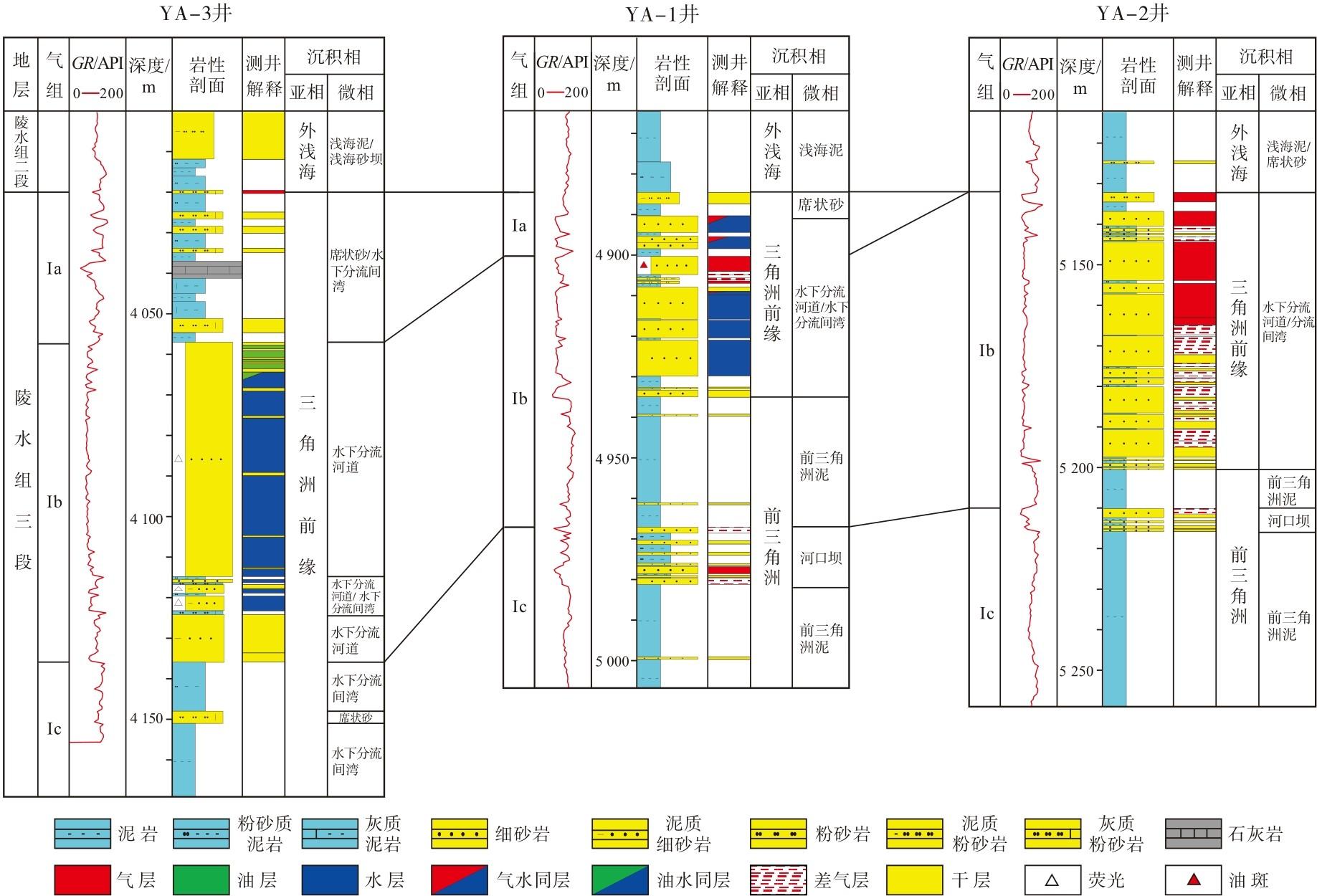
研究区早渐新世经历了构造抬升,导致南部YL10物源区崖城组发生区域性剥蚀作用,这为陵三段三角洲体系的发育提供了充足的陆源碎屑物质。受基底断裂差异活动控制,剥蚀强度表现出东弱西强的构造分带性,在研究区“两脊一洼”古地貌背景下,最终形成西大东小2个朵叶体状的规模三角洲(图1c)。沉积微相类型包括水下分流河道、水下分流间湾、席状砂,其中主力气组Ib砂体展布范围广(图5)。
图5 琼东南宝岛凹陷南坡陵水组三段顺物源方向连井剖面图

Fig. 5 Inter-well correlation section along the paleo-source direction of 3rd member of Lingshui Formation on the southern slope of Baodao Sag in Qiongdongnan Basin

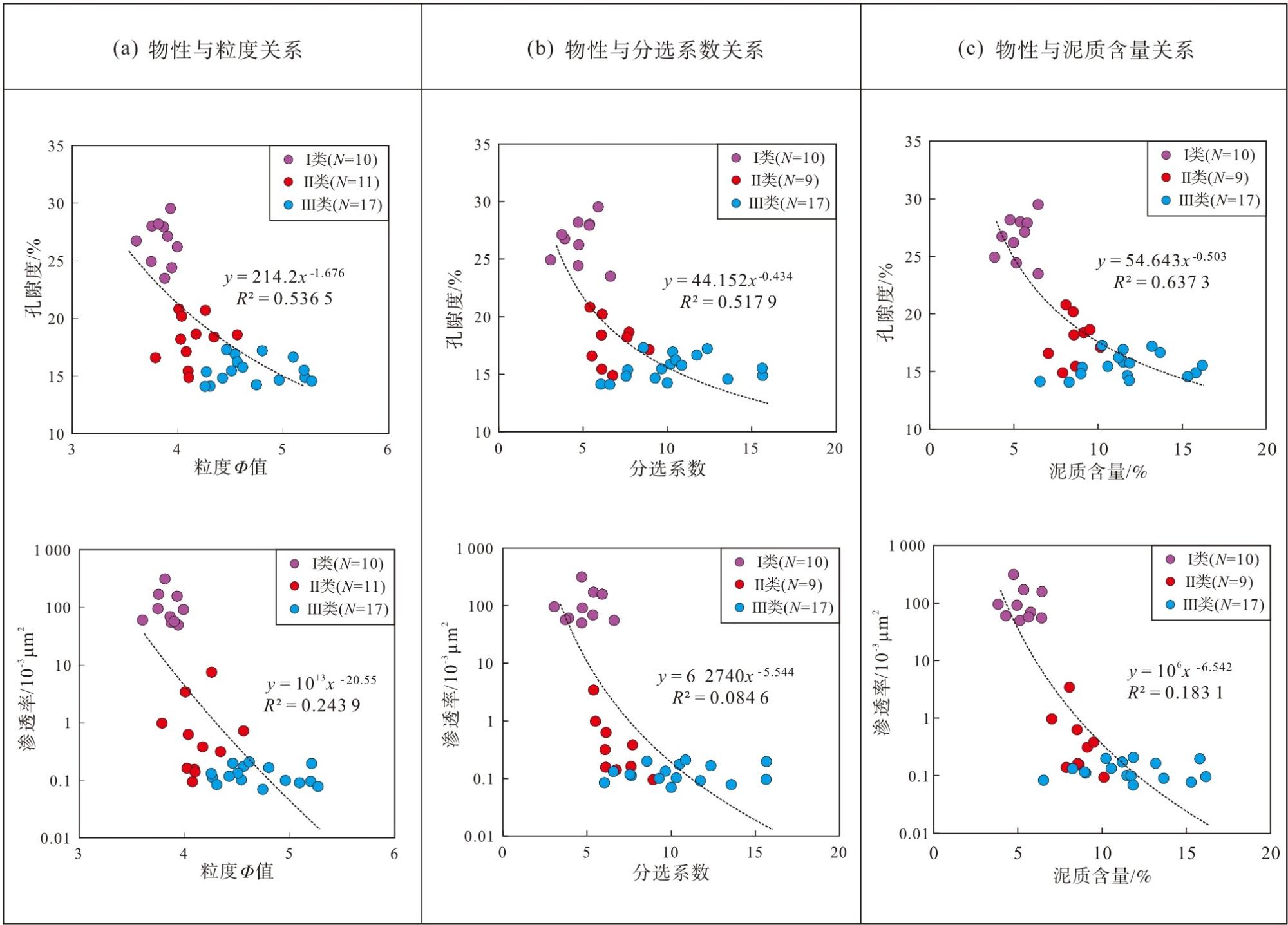
碎屑搬运距离对沉积体的发育特征具有显著控制作用,主要表现在粒度、泥质含量及分选等方面。储层物性与此三者相关性好(图6):Ⅰ类储层位于近源区,为水下分流河道沉积,砂岩粒度粗、泥质含量低、分选性好且呈厚层;Ⅱ、Ⅲ类储层位于远源区,为水下分流河道沉积,砂岩粒度相对细、泥质含量高、分选差且厚度减薄。总体上,古地貌与搬运距离控制了研究区砂体的分布和规模,沉积作用奠定了陵三段储层的物质基础。
图6 琼东南宝岛凹陷南坡陵水组三段储层物性与粒度、泥质含量、分选系数的相关关系

Fig. 6 Correlations between reservoir properties and particle size, mud content, and sorting coefficient of the 3rd member of Lingshui Formation on the southern slope of Baodao Sag in Qiongdongnan Basin

3.2 成岩作用

3.2.1 压实作用

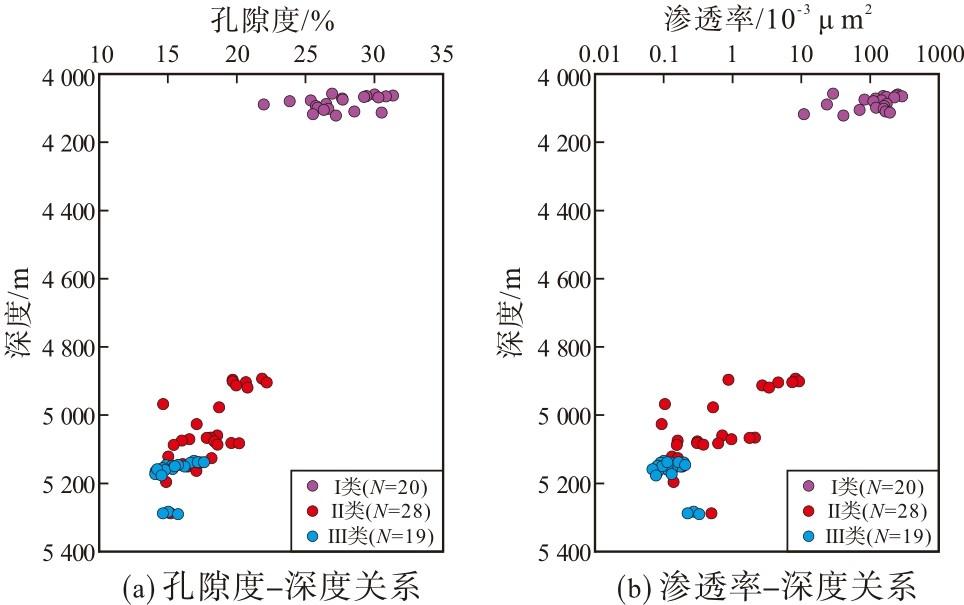
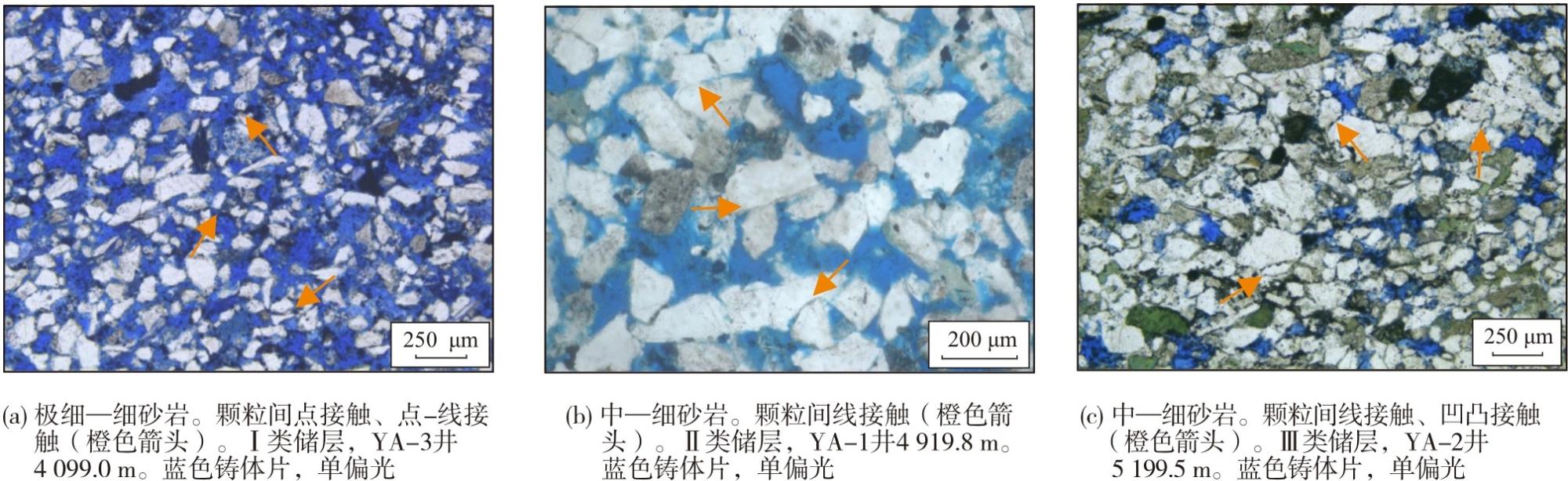
压实作用是研究区储层物性变差的主要原因,表现为储层孔隙度、渗透率与深度基本呈负相关(图7)。根据镜质组反射率、最大热解峰温以及伊蒙混层中伊利石层含量等参数进行成岩阶段划分,研究区陵三段储层处于中成岩阶段(表2)。Ⅰ类储层处于中成岩A1亚期,平均埋深在4 000 m左右,颗粒间主要为线-点接触,压实程度中等(图8a);Ⅱ类储层处于中成岩A2亚期,平均埋深在5 000 m左右,颗粒间以线接触为主(图8b),压实作用较强;Ⅲ类储层处于中成岩A2亚期,平均埋深在5 200 m左右,颗粒间为线接触(图8c),压实作用强。埋深的差异导致储层物性分布不均:Ⅰ类储层埋深相对较浅,压实作用较弱,原生孔隙得以较好保存,储层物性好;Ⅱ、Ⅲ类储层埋藏深度大,压实作用强,颗粒间孔隙被大量压缩,导致储层物性显著变差。
图7 宝岛凹陷南坡陵水组三段储层物性随深度变化关系

Fig. 7 Variations of reservoir properties with depth of the 3rd member of Lingshui Formation on the southern slope of Baodao Sag

表2 宝岛凹陷南坡陵水组三段3类储层成岩阶段划分

Table 2 Classification of diagenetic stages for three types of reservoirs of the 3rd member of Lingshui Formation on the southern slope of Baodao Sag

分类 镜质组反射率/% 最大热解峰温/℃ I/S中S层含量/% 颗粒接触类型 孔隙类型 成岩阶段
Ⅰ类 0.5~0.7 435~440 50~35 线-点 原生孔为主 中成岩A1
Ⅱ类 0.7~1.3 440~445 20~15 线 次生溶孔发育 中成岩A2
Ⅲ类 0.7~1.3 450~455 25~15 线 次生溶孔发育 中成岩A2
图8 宝岛凹陷南坡陵水组三段储层压实作用显微特征

Fig. 8 Microscopic characteristics of reservoir compaction of the 3rd member of Lingshui Formation on the southern slope of Baodao Sag

3.2.2 胶结作用

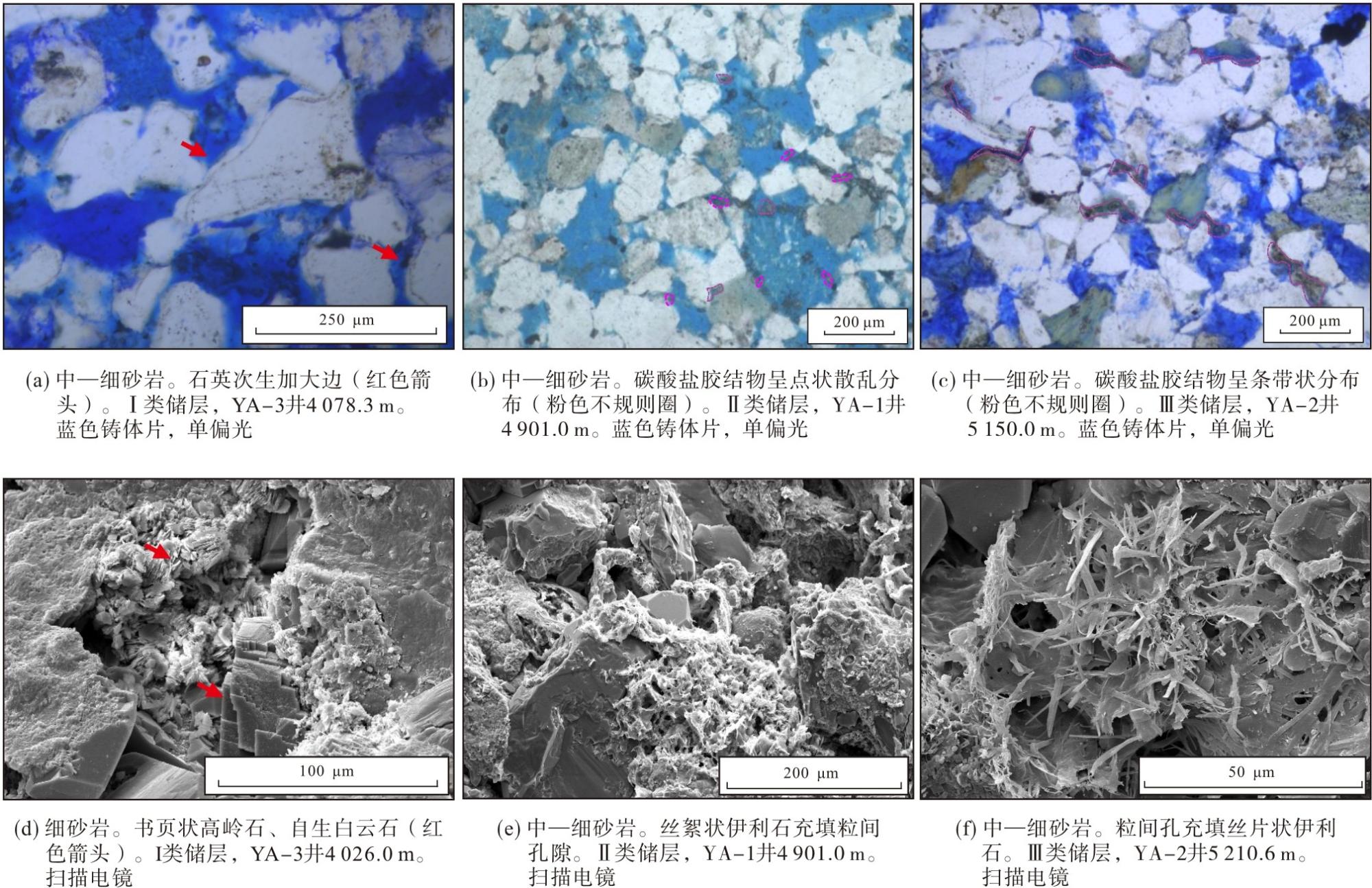
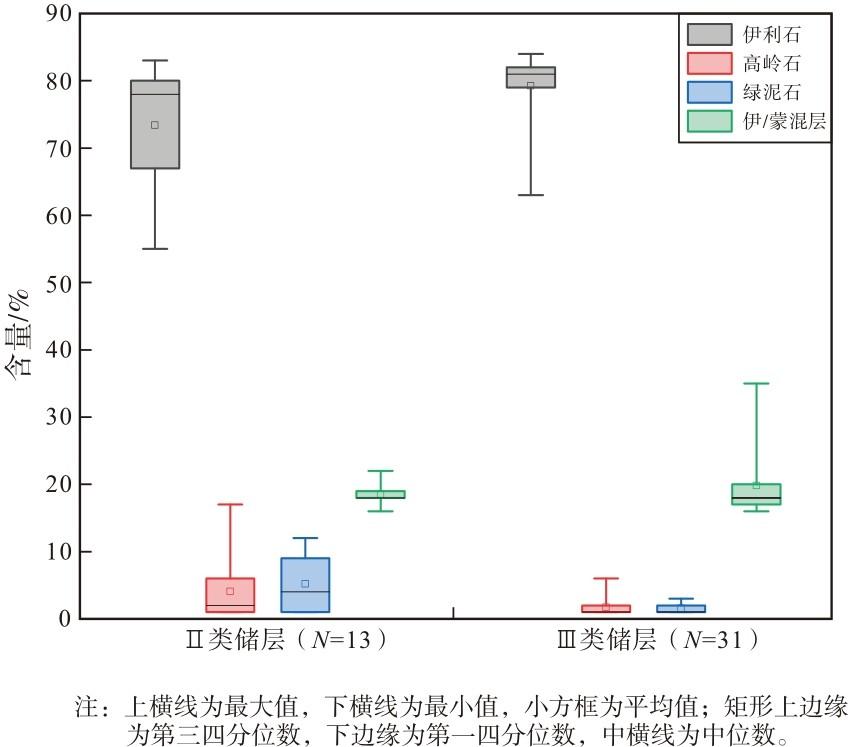
胶结作用是造成储层物性差异的关键因素,主要体现在胶结物的类型、含量及产状等3个方面。研究区陵三段储层经历了硅质胶结、碳酸盐胶结、黏土矿物胶结等多种胶结作用(图9),以黏土矿物胶结、碳酸盐胶结为主。基于3口井样品分析结果,在不同类型储层中黏土矿物、碳酸盐胶结物的含量如下:Ⅰ类储层分别为14%~26%、6%~13%;Ⅱ类储层分别为18%~24%、5%~8%;Ⅲ类储层分别为15%~29%、4%~11%。铸体薄片观察结合扫描电镜图像分析发现,碳酸盐胶结物在Ⅱ类储层中呈点状分布(图9b),在Ⅲ类储层中呈条带状分布(图9c)。条带状碳酸盐胶结物相较于点状的,对储层孔隙的连通性危害更大。黏土矿物具有吸水膨胀性,在一定程度上会影响储层的渗流能力[25]。通过对Ⅱ、Ⅲ类储层黏土矿物X衍射定量分析可知,黏土矿物以伊利石、伊/蒙混层发育为主。在不同类型储层中伊利石、伊/蒙混层的含量如下:Ⅱ类储层分别为55%~83%、16%~22%;Ⅲ类储层分别为63%~84%、16%~35%(图10)。扫描电镜观察到Ⅲ类储层中伊利石、伊/蒙混层呈片状、丝缕状充填粒间孔(图9f)。高的伊利石含量与片状、丝缕状赋存方式导致储层原生粒间孔喉道变窄、弯曲度加大[26],储层物性变差。
图9 琼东南宝岛凹陷南坡陵水组三段储层胶结作用显微特征

Fig. 9 Microscopic characteristics of reservoir cementation of the 3rd member of Lingshui Formation on the southern slope of Baodao Sag in Qiongdongnan Basin

图10 宝岛凹陷南坡陵水组三段Ⅱ类、Ⅲ类储层黏土矿物类型及含量统计

Fig. 10 Types and contents of clay minerals for type Ⅱ and Ⅲ reservoirs of the 3rd member of Lingshui Formation on the southern slope of Baodao Sag

3.2.3 溶蚀作用

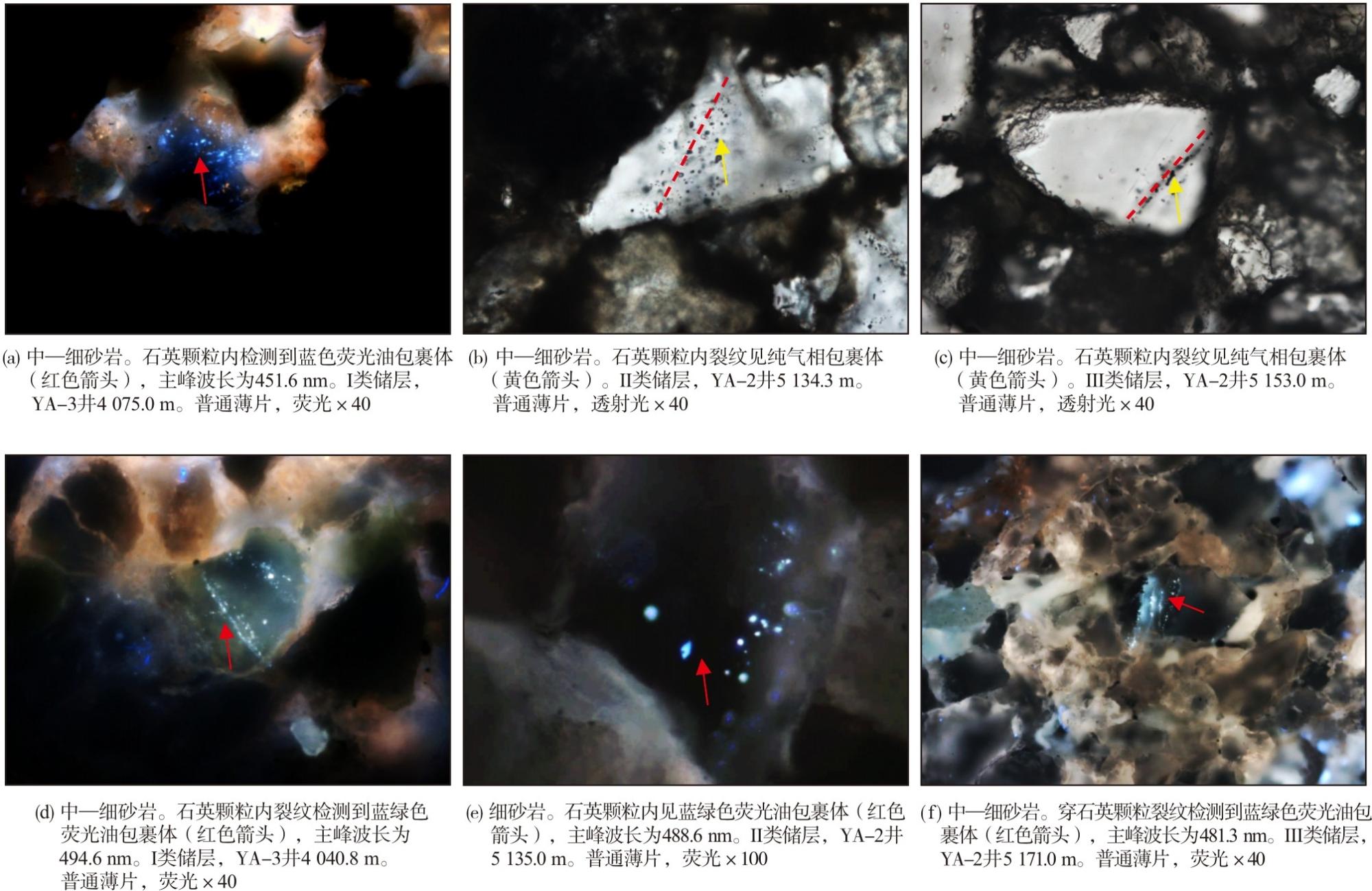
陵水组沉积时期宝岛凹陷中心区的烃源岩处于生烃高峰,持续产生大量酸性流体[27]。酸性流体沿着凹陷南坡的断裂系统大规模向低势区运移聚集,为后续溶蚀作用的发生和储层物性改造奠定了物质基础。通过流体包裹体分析手段证实了研究区陵三段储层经历了多期烃类流体充注。研究区南部Ⅰ类储层距生烃中心远,检测到了蓝色(λmax=450 nm)、蓝绿色(λmax=500 nm)荧光油包裹体;北部Ⅱ、Ⅲ类储层距生烃中心近,检测到了大量气包裹体,部分蓝绿色(λmax=500 nm)荧光油包裹体(图11)。受距生烃中心远近的影响,研究区南部Ⅰ类储层溶蚀相对较弱,北部Ⅱ、Ⅲ类储层溶蚀作用强——次生溶蚀孔大量发育,这是Ⅱ、Ⅲ类深埋藏储层渗透率低但仍保持中等孔隙度的主要原因。
图11 琼东南宝岛凹陷南坡陵水组三段储层流体包裹体特征

Fig. 11 Reservoir fluid inclusion characteristics of the 3rd member of Lingshui Formation on the southern slope of Baodao Sag in Qiongdongnan Basin

3.3 地层压力

研究区陵三段存在压力分布不均的现象:南部压力系数在1.117~1.172之间,为正常压力体系;北部压力系数在1.442~1.503之间,为异常高压体系。研究区南部陵三段同沉积断层下降盘接受正常沉积,地层压力正常。对于地层超压,其形成机制因地质条件差异而呈现出复杂性[28-33]。研究区北部陵三段异常高压形成的主要原因是欠压实作用——新构造期以来(5.3Ma至今)快速沉降,巨厚的泥岩层使储层中孔隙水来不及排出,导致地层处于欠压实状态;其次为烃源岩成熟生烃——崖城组进入过成熟阶段,干酪根降解生油或裂解生气,生烃作用使地层内流体体积增加,但在欠压实阶段烃类排出较为困难,进而加剧了超压的形成[28-30]
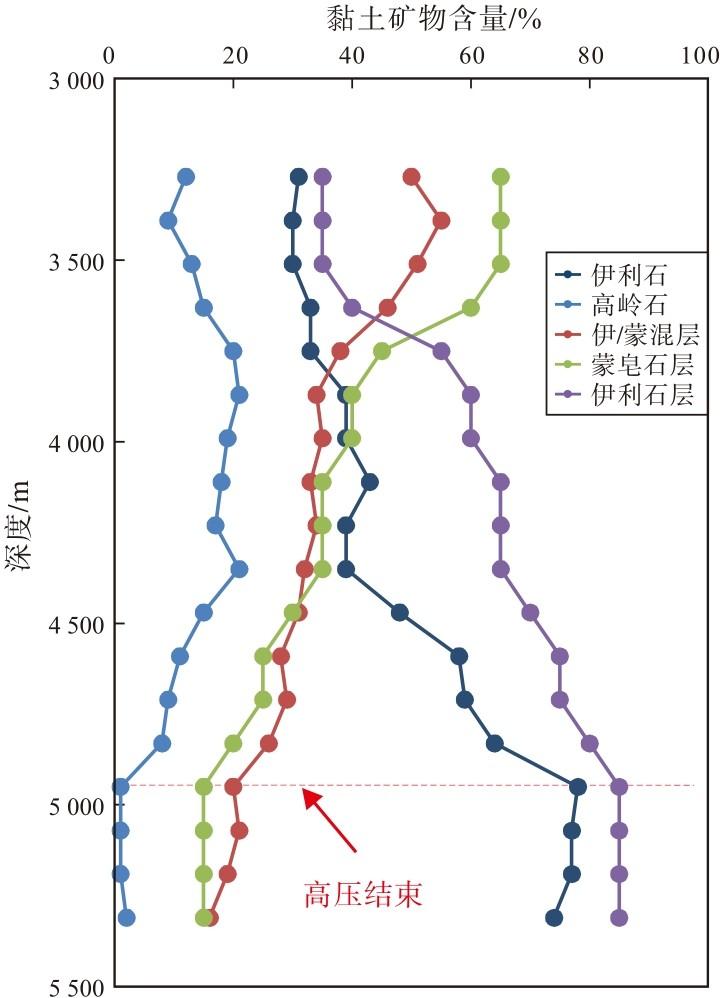
研究区内Ⅱ、Ⅲ类储层在埋深5 000 m处发生黏土矿物转化形成大量伊利石(图12),而伊利石在持续深埋的情况下更容易堵塞孔隙和喉道,虽然异常高压对深埋藏下的储层孔隙有一定的保护[34],但由于喉道受到伊利石的堵塞而连通性受损,因此储层渗透率降低,物性变差。
图12 宝岛凹陷南坡陵水组三段Ⅱ、Ⅲ类储层黏土矿物含量随深度变化关系

Fig. 12 Variations of clay mineral contents with depth for type Ⅱ and Ⅲ reservoirs of the 3rd member of Lingshui Formation on the southern slope of Baodao Sag

4 储层类型模式

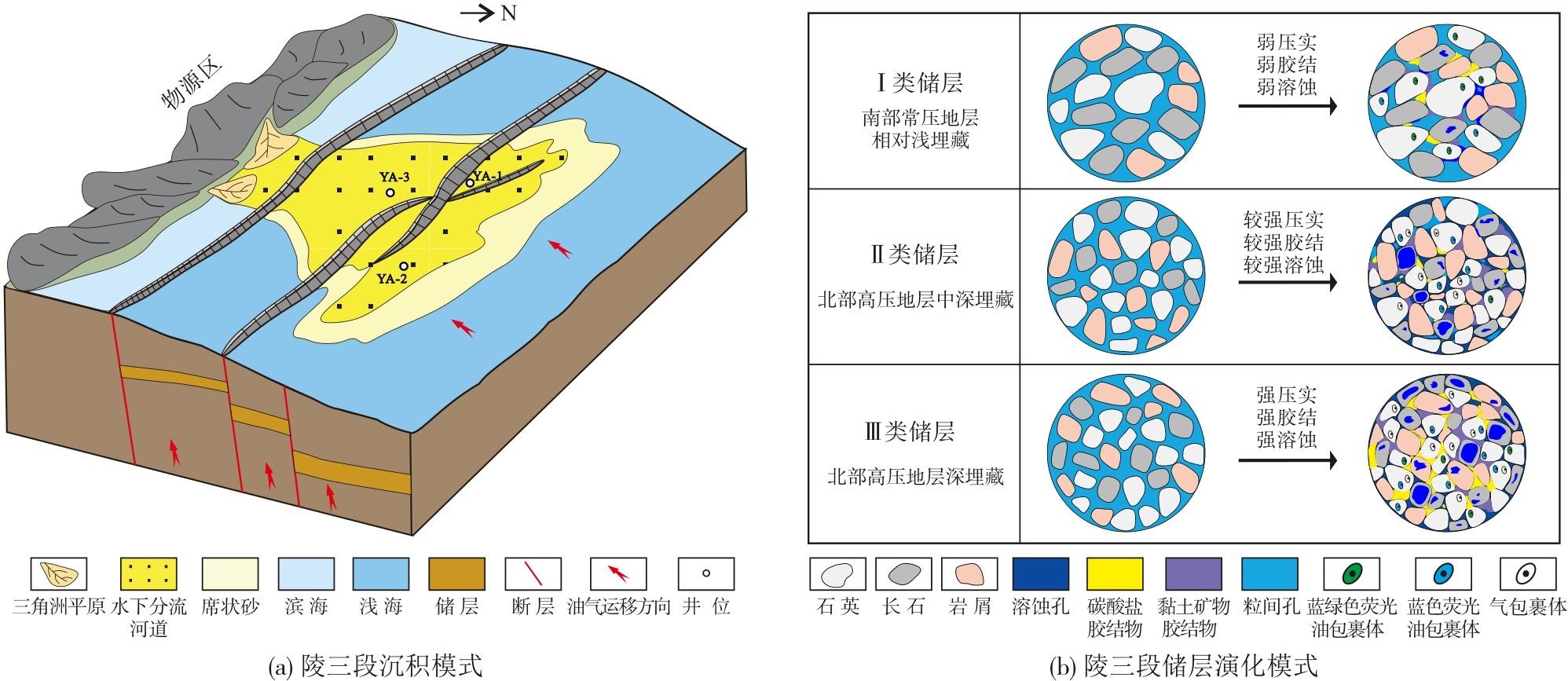
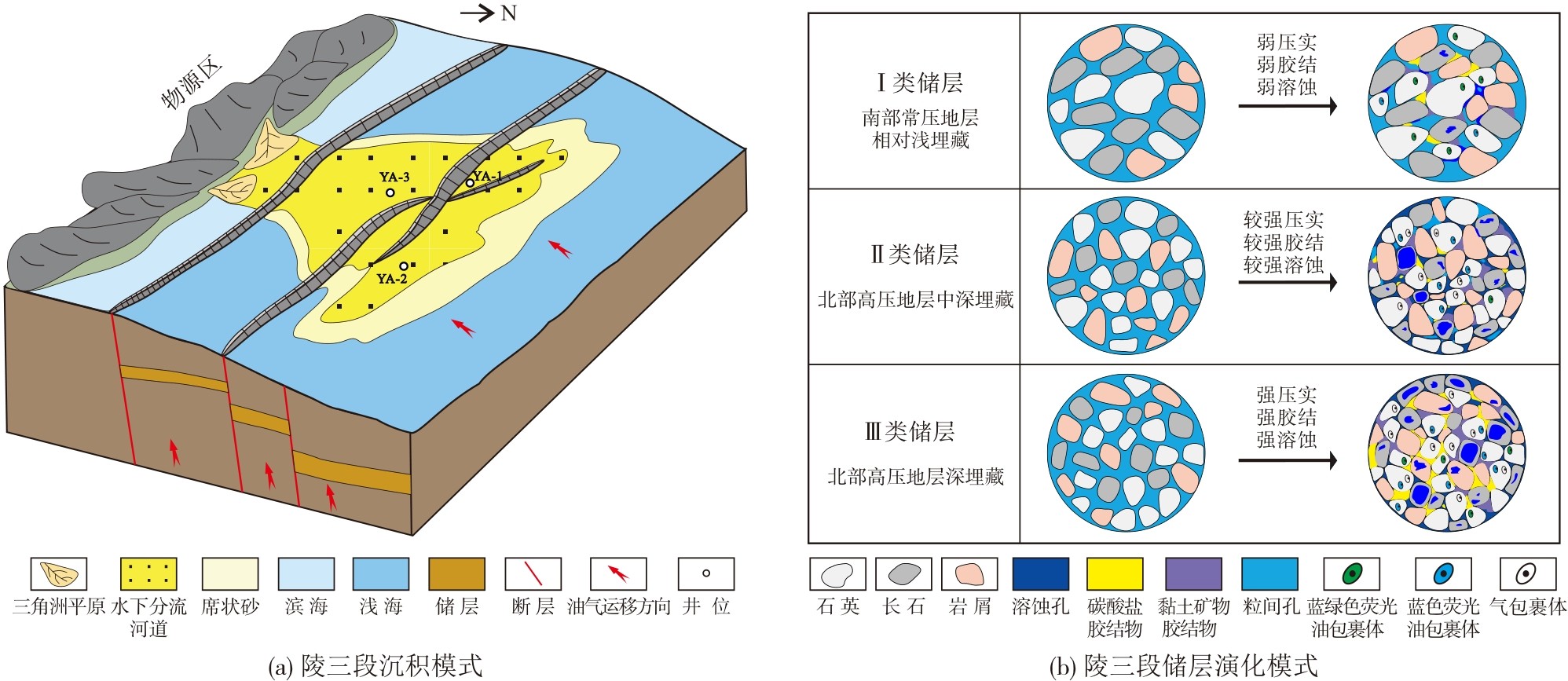
受沉积-成岩耦合作用控制,研究区陵三段储层演化具有“沉积相带控基、成岩演化定型”的双重机制,最终形成Ⅰ、Ⅱ、Ⅲ有序分异的3类储集体。不同类型储层的岩石学特征、孔喉结构及物性分布特点不同,其形成的控制因素如下:
Ⅰ类储层 位于研究区南部常压地层相对浅埋藏区(埋深4 000~4 200 m),以水下分流河道厚层细砂岩为主,砂岩粒度粗、泥质含量低、分选性好,岩屑含量高,岩石类型主要为岩屑石英砂岩和长石岩屑质石英砂岩。该区距生烃中心远,以早期油充注为主形成现今油藏。受弱压实、弱胶结及弱溶蚀的影响,储层孔隙类型主要为残余粒间孔和粒间溶孔,喉道类型主要为缩颈状喉道,孔喉半径>2 μm,储层物性好,高孔高渗(孔隙度>25%,渗透率>100×10-3 μm2),为优势储集体。
Ⅱ类储层 位于研究区北部高压地层的中深埋藏区(埋深4 800~5 000 m),为水下分流河道薄层细砂岩,粒度相对细、泥质含量较高、分选较差,石英含量低,主要岩石类型为长石岩屑质石英砂岩,胶结物分布散乱,碳酸盐胶结物呈点状分布,伊利石、伊/蒙混层含量较低。该区距生烃中心较近,充注晚期天然气形成气藏。储层经历了较强的压实、胶结及溶蚀作用,孔隙类型以铸模孔和残余粒间孔为主,主要为片状喉道类型,孔喉半径为0.5~2 μm,储层物性较差,中孔低渗(孔隙度为15%~22%,渗透率为(1~10)×10-3 μm2),为低渗储集体。
Ⅲ类储层 位于研究区北部高压地层深埋藏区(埋深5 200~5 400 m),发育水下分流河道薄层细砂岩,粒度细、泥质含量高、分选差,石英含量高,岩石类型主要为长石石英砂岩与长石岩屑质石英砂岩,胶结物分布集中,碳酸盐胶结物呈条带状分布,黏土矿物胶结物含量高,呈片状、丝缕状。该区距生烃中心近,充注晚期天然气形成气藏。储层经历了强压实、胶结及溶蚀作用,孔隙类型主要为铸模孔、粒内溶孔,喉道类型主要为片状喉道,孔喉半径<0.5 μm,储层物性差,中孔特低渗(孔隙度为14%~18%,渗透率<1×10⁻³ μm2),为特低渗储集体。
综上所述,沉积作用控制砂体展布,奠定了储层物质基础,而储层分异主要受成岩作用(浅部弱压实弱胶结→深部强压实强胶结)以及溶蚀作用与地层压力系统的空间分异控制。研究区自南向北随埋深增大,储层类型呈有序递变(Ⅰ→Ⅱ→Ⅲ类),相应建立了陵三段储层分类演化模式(图13)。压实作用、胶结作用导致研究区储层原生孔被破坏,胶结物大量发育,胶结物的类型、含量及产状的差异导致Ⅱ类低渗储层与Ⅲ类特低渗储层的物性差异,溶蚀作用对储层孔隙度起建设性作用,形成大量铸模孔,为研究区Ⅱ、Ⅲ类储层低渗-中孔的成因。
图13 琼东南宝岛凹陷南坡陵水组三段储层演化模式图

Fig. 13 Reservoir evolution pattern of the 3rd member of Lingshui Formation on the southern slope of Baodao Sag in Qiongdongnan Basin

5 结论

(1)琼东南盆地宝岛凹陷南坡YL10构造陵水组三段储层可划分为3类:南部相对浅埋区(Ⅰ类)为高孔高渗甜点储层,以残余粒间孔和缩颈状喉道为主;北部中深埋区(Ⅱ类)为中孔低渗储层,发育铸模孔和片状喉道;北部深埋高压区(Ⅲ类)为中孔特低渗储层,以粒内溶孔和片状微细喉道为特征。这3类储层孔隙度依次递减(>25%→15%~22%→14%~18%),渗透率显著降低(>100×10-3 μm2→(1~10)×10-3 μm2→<1×10⁻³ μm2)。
(2)储层分异受“沉积相带控基、成岩演化定型”双重机制控制。沉积相带(水下分流河道)奠定砂体物质基础,而成岩作用强度随埋深分异:浅部(<4 200 m)弱压实弱胶结保存原生孔隙,深部(>4 800 m)强压实和差异胶结(伊利石含量为55%~84%、碳酸盐条带状胶结)导致物性劣质化。溶蚀作用受烃源距离控制,北部近烃源区发育铸模孔,形成低渗中孔特殊结构。
(3)南部地层相对浅埋的弱成岩区(埋深4 000~4 200 m)为有利储层分布区,发育厚层水下分流河道砂体,具高孔高渗特征;北部深部储层需重点关注溶蚀孔隙发育带与胶结弱化区。异常高压(压力系数为1.44~1.50)对深部储层起保护作用,但伊利石大量生成(含量达63%~84%)导致喉道弯曲度增加,建议在开发中采取储层改造措施改善渗流能力。
[1]
范廷恩. 中国海上低渗油气田开发历程、关键技术及攻关方向[J]. 中国海上油气, 2024, 36(3): 95-109.

FAN Tingen. Development process, key technologies and research directions of China's offshore low-permeability oil and gas fields[J]. China offshore oil and gas, 2024, 36(3): 95-109.

[2]
张迎朝, 蒋一鸣, 刁慧, 等. 东海盆地西湖凹陷低渗—特低渗天然气勘探开发实践、地质新认识及资源潜力[J]. 石油学报, 2025, 46(6): 1074-1088.

DOI

ZHANG Yingzhao, JIANG Yiming, DIAO Hui, et al. Exploration and development practice, new geological understanding and resource potential of low to ultra-low permeability gas reservoirs in Xihu Sag of East China Sea Basin[J]. Acta petrolei sinica, 2025, 46(6): 1074-1088.

DOI

[3]
谢玉洪, 袁全社. 中国近海深水深层油气地球物理勘探实践与展望[J]. 石油物探, 2023, 62(2): 183-193.

DOI

XIE Yuhong, YUAN Quanshe. Practice and prospects of deep-water and deep-formation geophysical exploration[J]. Geophysical prospecting for petroleum, 2023, 62(2): 183-193.

DOI

[4]
徐长贵. 中国近海油气勘探新进展与勘探突破方向[J]. 中国海上油气, 2022, 34(1): 9-16.

XU Changgui. New progress and breakthrough directions of oil and gas exploration in China offshore area[J]. China offshore oil and gas, 2022, 34(1): 9-16.

[5]
甘军, 张亚震, 林璐, 等. 琼东南盆地宝岛凹陷天然气差异聚集主控因素与成藏模式[J]. 地球科学, 2023, 48(2): 439-450.

GAN Jun, ZHANG Yazhen, LIN Lu, et al. Main controlling factors of natural gas differential accumulation model, in Baodao Sag, Qiongdongnan Basin[J]. Earth science, 2023, 48(2): 439-450.

[6]
汪锴, 王根厚, 贾庆军, 等. 琼东南盆地深水区松南—宝岛凹陷的构造演化及其与油气成藏关系[J]. 现代地质, 2023, 37(2): 245-258.

WANG Kai, WANG Genhou, JIA Qingjun, et al. Tectonic evolution of Songnan-Baodao Sag in Qiongdongnan Basin and its relationship with oil-gas reservoir[J]. Geoscience, 2023, 37(2): 245-258.

[7]
雷超, 任建业, 李绪深, 等. 琼东南盆地深水区结构构造特征与油气勘探潜力[J]. 石油勘探与开发, 2011, 38(5): 560-569.

LEI Chao, REN Jianye, LI Xushen, et al. Structural characteristics and petroleum exploration potential in the deep-water area of the Qiongdongnan Basin, South China Sea[J]. Petroleum exploration and development, 2011, 38(5): 560-569.

[8]
戴娜, 钟宁宁, 邓运华, 等. 中生代—新生代大陆边缘盆地海相烃源岩成因类型[J]. 石油学报, 2015, 36(8): 940-953.

DOI

DAI Na, ZHONG Ningning, DENG Yunhua, et al. Genetic types of marine source rock in Meso-Cenozoic continental margin basins[J]. Acta petrolei sinica, 2015, 36(8): 940-953.

DOI

[9]
黄保家, 李绪深, 王振峰, 等. 琼东南盆地深水区烃源岩地球化学特征与天然气潜力[J]. 中国海上油气, 2012, 24(4): 1-7.

HUANG Baojia, LI Xushen, WANG Zhenfeng, et al. Source rock geochemistry and gas potential in the deep water area, Qiongdongnan Basin[J]. China offshore oil and gas, 2012, 24(4): 1-7.

[10]
张功成, 屈红军, 刘世翔, 等. 边缘海构造旋回控制南海深水区油气成藏[J]. 石油学报, 2015, 36(5): 533-545.

DOI

ZHANG Gongcheng, QU Hongjun, LIU Shixiang, et al. Tectonic cycle of marginal sea controlled the hydrocarbon accumulation in deep-water areas of South China Sea[J]. Acta petrolei sinica, 2015, 36(5): 533-545.

DOI

[11]
袁朱晔斐, 田杨, 熊小峰, 等. 琼东南盆地宝岛凹陷南北断阶带古近系陵水组三段天然气差异富集机理[J]. 吉林大学学报(地球科学版), 2024, 54(6): 1998-2013.

YUAN-ZHU Yefei, TIAN Yang, XIONG Xiaofeng, et al. Comparative analysis of gas enrichment differences in the third member of the Paleogene Lingshui Formation in the south-north step-fault zone of Baodao Sag, Qiongdongnan Basin[J]. Journal of Jilin University (earth science edition), 2024, 54(6): 1998-2013.

[12]
张迎朝, 甘军, 徐新德, 等. 琼东南盆地深水东区Y8-1含气构造天然气来源及侧向运聚模式[J]. 地球科学, 2019, 44(8): 2609-2618.

ZHANG Yingzhao, GAN Jun, XU Xinde, et al. The source and natural gas lateral migration accumulation model of Y8-1 gas bearing structure, east deep water in the Qiongdongnan Basin[J]. Earth science, 2019, 44(8): 2609-2618.

[13]
裴健翔, 罗威, 呙诗阳, 等. 琼东南盆地宝岛凹陷南部渐新统陵水组三段三角洲的发现及石油地质意义[J]. 石油勘探与开发, 2024, 51(2): 299-310.

DOI

PEI Jianxiang, LUO Wei, GUO Shiyang, et al. Discovery and petroleum geological significance of delta in the third member of Oligocene Lingshui Formation in southern Baodao Sag, Qiongdongnan Basin, South China Sea[J]. Petroleum exploration and development, 2024, 51(2): 299-310.

[14]
张尚锋, 童茜倩, 唐武, 等. 源汇格局差异性及其对储层的控制作用: 以琼东南盆地宝岛—长昌凹陷陵水组为例[J/OL]. 长江大学学报(自然科学版), 2025: 1-15 (2025-03-21). https://doi.org/10.16772/j.cnki.1673-1409.20250321.001.

ZHANG Shangfeng, TONG Qianqian, TANG Wu, et al. Differential source-to-sink configurations and their controls on reservoir development: a case study of the Lingshui Formation in Baodao-Changchang Sag, Qiongdongnan Basin[J/OL]. Journal of Yangtze University (natural science edition), 2025: 1-15 (2025-03-21). https://doi.org/10.16772/j.cnki.1673-1409.20250321.001.

[15]
王旖旎, 张百涛, 王允洪, 等. 琼东南陵水凹陷北坡构造特征及构造演化分析[J]. 海洋石油, 2024, 44(3): 31-38.

WANG Yini, ZHANG Baitao, WANG Yunhong, et al. Structural characteristics and evolution analysis of the north slope of Lingshui Depression in Qiongdongnan[J]. Offshore oil, 2024, 44(3): 31-38.

[16]
龚宇, 佟殿君, 焦垚祺, 等. 琼东南盆地松南—宝岛凹陷北部断阶带演化过程及对成藏的控制作用[J]. 天然气地球科学, 2024, 35(2): 300-312.

DOI

GONG Yu, TONG Dianjun, JIAO Yaoqi, et al. Evolution of the northern step-fault zone in the Songnan-Baodao Sag of the Qiongdongnan Basin and its control on reservoir formation[J]. Natural gas geoscience, 2024, 35(2): 300-312.

DOI

[17]
吴克强, 解习农, 裴健翔, 等. 超伸展陆缘盆地深部结构及油气勘探意义: 以琼东南盆地为例[J]. 石油与天然气地质, 2023, 44(3): 651-661.

WU Keqiang, XIE Xinong, PEI Jianxiang, et al. Deep architecture of hyperextended marginal basin and implications for hydrocarbon exploration: a case study of Qiongdongnan Basin[J]. Oil & gas geology, 2023, 44(3): 651-661.

[18]
施和生, 杨计海, 张迎朝, 等. 琼东南盆地地质认识创新与深水领域天然气勘探重大突破[J]. 中国石油勘探, 2019, 24(6): 691-698.

DOI

SHI Hesheng, YANG Jihai, ZHANG Yingzhao, et al. Geological understanding innovation and major breakthrough to natural gas exploration in deep water in Qiongdongnan Basin[J]. China petroleum exploration, 2019, 24(6): 691-698.

DOI

[19]
张迎朝, 徐新德, 甘军, 等. 琼东南盆地深水大气田地质特征、成藏模式及勘探方向研究[J]. 地质学报, 2017, 91(7): 1620-1633.

ZHANG Yingzhao, XU Xinde, GAN Jun, et al. Study on the geological characteristics, accumulation model and exploration direction of the giant deepwater gas field in the Qiongdongnan Basin[J]. Acta geologica sinica, 2017, 91(7): 1620-1633.

[20]
江汝锋, 曹立成, 邓孝亮, 等. 琼东南盆地宝岛21-1区陵水组沉积特征及其油气地质意义[J]. 地质科技通报, 2024, 43(5): 31-44.

JIANG Rufeng, CAO Licheng, DENG Xiaoliang, et al. Sedimentary characteristics of the Lingshui Formation in the Baodao 21-1 area of the Qiongdongnan Basin and their significance in hydrocarbon exploration[J]. Bulletin of geological science and technology, 2024, 43(5): 31-44.

[21]
LIU Kun, PENG Cheng, FAN Caiwei, et al. Evolutions of sedimentary facies and palaeoenvironment and their controls on the development of source rocks in continental margin basins: a case study from the Qiongdongnan Basin, South China Sea[J]. Petroleum science, 2023, 20(5): 2648-2663.

DOI

[22]
徐长贵, 侯明才, 吴克强, 等. 琼东南盆地二叠纪—三叠纪长英质岩浆作用: 对南海北部陆缘构造属性与演化过程的启示[J]. 岩石学报, 2024, 40(8): 2450-2468.

XU Changgui, HOU Mingcai, WU Keqiang, et al. Permian-Triassic felsic magmatism in the Qiongdongnan Basin: implications for the tectonic properties and evolution of the northern continental margin of the South China Sea[J]. Acta petrologica sinica, 2024, 40(8): 2450-2468.

DOI

[23]
杨金海, 杨希冰, 周杰, 等. 琼东南盆地深水区松南—宝岛凹陷反转构造带发育特征及油气地质意义[J]. 海洋学报, 2019, 41(5): 97-106.

YANG Jinhai, YANG Xibing, ZHOU Jie, et al. Characteristics of inversion structure belts and their hydrocarbon geological significance in the Songnan-Baodao Sag in deep water area of the Qiongdongnan Basin[J]. Acta oceanologica sinica, 2019, 41(5): 97-106.

DOI

[24]
郭帅, 曾清波, 杨海长, 等. 琼东南盆地松南—宝岛凹陷三亚组“源—汇”体系与主控因素分析[J]. 天然气地球科学, 2023, 34(12): 2062-2074.

DOI

GUO Shuai, ZENG Qingbo, YANG Haichang, et al. Analysis of "source-sink" systems and major controlling factors of Sanya Formation in the Songnan-Baodao Sag of Qiongdongnan Basin[J]. Natural gas geoscience, 2023, 34(12): 2062-2074.

DOI

[25]
潘辉, 蒋裕强, 朱讯, 等. 河流相致密砂岩气地质甜点评价: 以四川盆地川中地区侏罗系沙溪庙组二段1亚段为例[J]. 石油与天然气地质, 2024, 45(2): 471-485.

PAN Hui, JIANG Yuqiang, ZHU Xun, et al. Evaluation of geological sweet spots in fluvial tight sandstone gas: a case study of the first submember of the second member of the Jurassic Shaximiao Formation, central Sichuan Basin[J]. Oil & gas geology, 2024, 45(2): 471-485.

[26]
赵伟全, 杨磊磊, 何文军, 等. 准噶尔盆地玛湖凹陷风城组云质泥页岩储层成岩作用及其对储层发育的指示意义[J]. 地质学报, 2024, 98(7): 2233-2244.

ZHAO Weiquan, YANG Leilei, HE Wenjun, et al. Diagenesis of dolomitic shale reservoir and its indicative significance for reservoir development in the Fengcheng Formation, Mahu Sag of Junggar Basin[J]. Acta geologica sinica, 2024, 98(7): 2233-2244.

[27]
姜平, 张冲, 叶青, 等. 琼东南盆地宝岛凹陷深水深层“富孔隙型”低渗透砂岩储层成因与“甜点”预测[J]. 天然气工业, 2025, 45(6): 121-135.

JIANG Ping, ZHANG Chong, YE Qing, et al. Genesis of deepwater deep "pore-rich" low-permeability sandstone reservoirs in the Baodao Sag of the Qiongdongnan Basin and "sweet spot" prediction[J]. Natural gas industry, 2025, 45(6): 121-135.

[28]
刘爱群, 范彩伟, 邓勇, 等. 南海琼东南高压盆地压力结构与油气成藏关系[J]. 地球物理学进展, 2017, 32(4): 1817-1822.

LIU Aiqun, FAN Caiwei, DENG Yong, et al. Pressure structure and relationship with hydrocarbon accumulation in Nanhai Qiongdongnan high-pressure basin[J]. Progress in geophysics, 2017, 32(4): 1817-1822.

[29]
王子嵩, 刘震, 王振峰, 等. 琼东南盆地深水区中央坳陷带异常压力分布特征[J]. 地球学报, 2014, 35(3): 355-364.

WANG Zisong, LIU Zhen, WANG Zhenfeng, et al. Distribution characteristics of abnormal pressure in central Depression Belt, deepwater area, Qiongdongnan (southeast Hainan) Basin[J]. Acta geoscientica sinica, 2014, 35(3): 355-364.

[30]
苏龙, 郑建京, 王琪, 等. 琼东南盆地超压研究进展及形成机制[J]. 天然气地球科学, 2012, 23(4): 662-672.

DOI

SU Long, ZHENG Jianjing, WANG Qi, et al. Formation mechanism and research progress on overpressure in the Qiongdongnan Basin[J]. Natural gas geoscience, 2012, 23(4): 662-672.

DOI

[31]
尤丽, 吴仕玖, 代龙, 等. 琼东南盆地乐东—陵水凹陷梅山组海底扇高温超压储层成岩-孔隙演化[J]. 海相油气地质, 2024, 29(3): 280-290.

YOU Li, WU Shijiu, DAI Long, et al. Diagenesis and porosity evolution of high temperature and overpressure submarine fan reservoir of Meishan Formation in Ledong-Lingshui sags,Qiongdongnan Basin[J]. Marine origin petroleum geology, 2024, 29(3): 280-290.

[32]
陈红果, 张凤奇, 江青春, 等. 松辽盆地徐家围子断陷白垩系沙河子组超压形成机制及其演化特征[J]. 岩性油气藏, 2025, 37(1):102-114.

DOI

CHEN Hongguo, ZHANG Fengqi, JIANG Qingchun, et al. Overpressure-generating mechanism and its evolution characteristics of Cretaceous Shahezi Formation in Xujiaweizi Fault Depression,Songliao Basin[J]. Lithologic reservoirs, 2025, 37(1):102-114.

DOI

[33]
刘华, 王伸, 蒋子月, 等. 塔里木盆地阿满过渡带奥陶系油气成藏期压力特征[J]. 中国石油大学学报(自然科学版), 2025, 49(2):82-92.

LIU Hua, WANG Shen, JIANG Ziyue, et al. Pressure characteristics during hydrocarbon charging of Ordovician reservoirs in transitional zone between Awati and Manjar depressions in Tarim Basin[J]. Journal of China University of Petroleum (edition of natural science), 2025, 49(2): 82-92.

[34]
SATHAR S, JONES S. Fluid overpressure as a control on sandstone reservoir quality in a mechanical compaction dominated setting: Magnolia Field, Gulf of Mexico[J]. Terra nova, 2016, 28(3): 155-162.

DOI

Outlines

/